Films are important cultural artifacts. They are key to cultural memory, celebration, and preservation of visual cultures. And no cinema anywhere in the world has reckoned with this truth more than Palestinian cinema. Palestinian film is thus an integral part of Palestinian history and the story of modern Palestine and its people, both at home and in diaspora.
It’s the only cinema industry in the world with a consistent output that has been as fully and utterly enmeshed in political reality. There is but one subject in Palestinian cinema, even if it is told in many beautiful and diverse ways (and with different gradients of hopefulness): the occupation and ethnic cleansing of the land of Palestine.
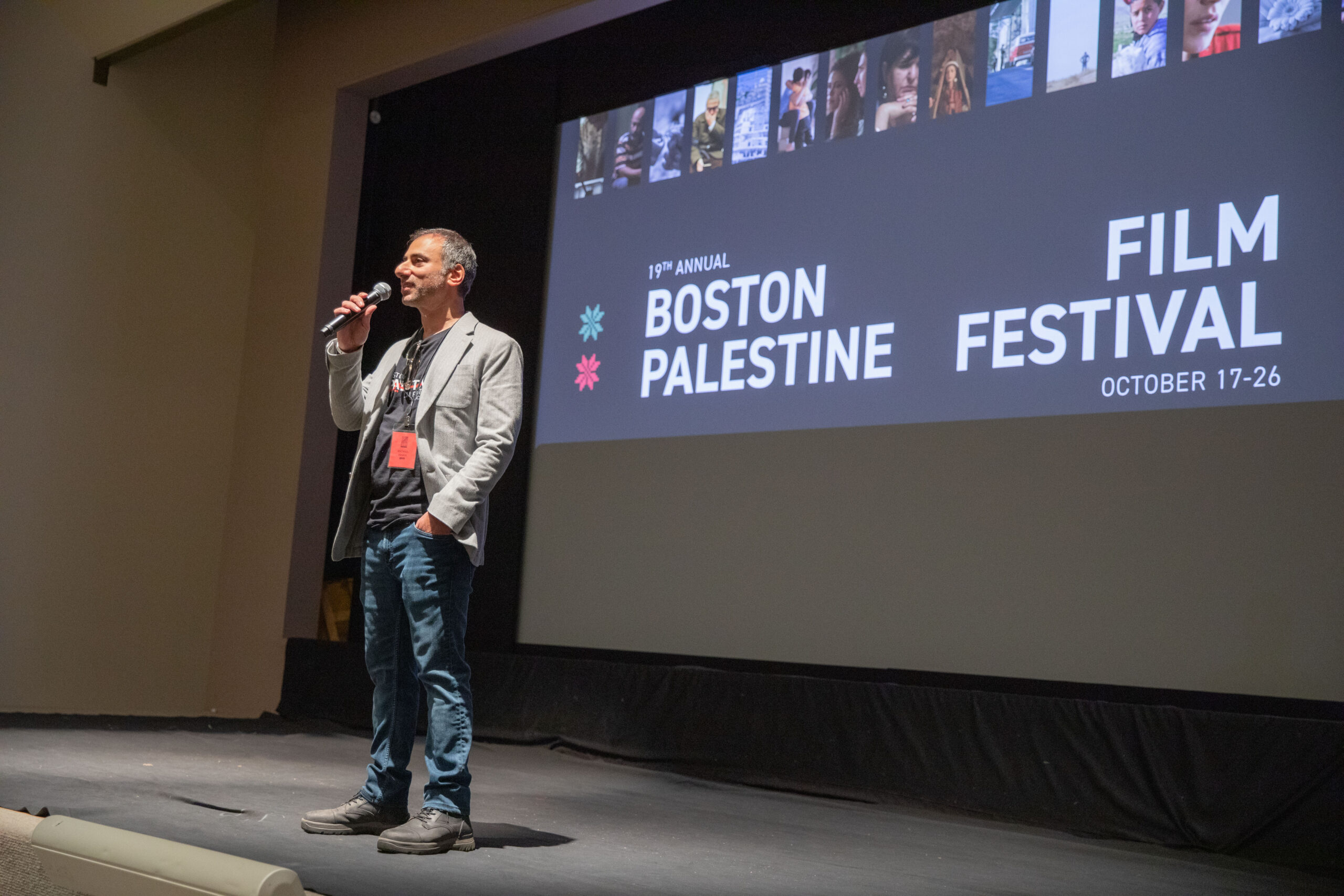
It is in this context that I had an insightful conversation with Michael Maria, the Director of Programming at Boston Palestine Film Festival since 2016 and previously the festival’s Director of Operations. As the festival’s longest-standing face, Michael, a Palestinian American with familial roots from Bethlehem, Palestine, has likely done more for Palestinian film than any other Bostonian.
We chatted over Zoom about this year’s Boston Palestine Film Festival, Palestinian film more broadly, and future festival plans. (This interview has been lightly edited for clarity and flow.)
BOSTON HASSLE: Tell me a little bit about the films at this year’s festival.
MICHAEL MARIA: It was a really strong program this year. Even beyond just the films, we had an art exhibit and a cooking class to make it a more well-rounded festival.
With the films, we have a number of homages to Gaza because it’s really still in the forefront of everybody’s minds having lived through the past two years of livestream genocide. Even though there’s a “ceasefire” now, it doesn’t change much in people’s hearts and minds right now. Gaza is still heavy on our hearts. I’ve got a powerful experimental, documentary, and narrative shorts program that’s the BPFF homage to Gaza.
And then we have Put Your Soul on Your Hand and Walk. It is just tremendously powerful getting to know Fatma [Hassona] on a personal level and seeing her firsthand account and knowing that she was killed after the film was selected for Cannes.
A State of Passion follows the Palestinian medic Dr. Ghassan Abu Sittah and his time serving in Gaza hospitals and the absolutely horrific experience of trying to operate in facilities being destroyed and bombed, and with no resources and electricity. They are all really powerful. Our opening and closing films are great narratives.
Thank You for Banking with Us by Leila Abbas is really a comedy beyond anything else and isn’t specific to Gaza. It was created and conceived before October 2023. It is still so notable because it centers Palestinian society and Palestinian challenges in terms of patriarchy and Islamic law, and the things that really impact Palestinian society. We get a good glimpse of the occupation and how that impacts people’s lives, but it’s just a well-done story at the end of the day. The same is true with Happy Holidays, which centers on a Palestinian family with Israeli citizenship in the ‘48 territories. It’s just a smart, well-done film that has interweaving storylines and timelines that center on this family.
We’ve also been doing a collaboration with 7ajar حجر School of Creative Research/Resistance (Co-Presented by Art Education and Ciné Culture Screening Series at MassArt). We’re bringing in budding Palestinian and non-Palestinian filmmakers to come and work together and collaborate and create short films. It’s really good to be able to give back too and encourage budding filmmakers.
BH: What themes do you see across the films this year?
MM: I would go back to Gaza, because it’s huge and on everybody’s mind, which is why we have three programs dedicated to it.
I should point out that our shorts program is the Prisms of Palestinian Identity Shorts program. There’s a lot of variety there and [many] center childhood and coming of age stories. We see that with 10 minutes Younger, Khaled & Nema, and Born a Celebrity. They’re really stories of childhood coming of age and self-discovery and wanting to expand horizons beyond the limitations that life in Palestine and under occupation brings. Childhood also ties in with Put Your Soul on Your Hand and Walk. A lot of these films really get at that over and over again.
BH: That was a theme I was going to prod if you didn’t. I was thinking especially of Severed and Passing Dreams.
MM: Thank you for mentioning Passing Dreams! I [forgot to mention] it. It’s totally a coming-of-age film with the youth and chasing the carrier pigeon.
Severed is the Jen Marlowe film that’s part of the Gaza homage. The footage begins before October of 2023 and really goes into the history and the background of Gaza as a concentration camp over the last two years, and the periodic bombing campaigns they’ve suffered where thousands of Palestinians have been killed. It’s really well done.
Vibrations from Gaza also ties into the youth theme because it focuses on Palestinian children in Gaza who are deaf [and is] about how they experience the bombing campaigns and living under occupation through sound and vibration, and it’s really deep. I encourage you to watch that if you have some time.
BH: As a programmer of Palestinian films, what kinds of stories do you seek to celebrate at this year’s festival?
MM: First and foremost, I’m just always trying to program the best, highest quality, most well-made, most powerful, impactful films. That’s my criteria first.
Once I get that collection of films, it’s like a jigsaw puzzle and I’m trying to piece what makes sense together, especially if I’m pairing a short with a feature film, which I wasn’t really able to do this year. I’m always thinking about how do these films go together?
I like to have a Palestine short series that usually doesn’t have a theme that weaves them all together… other than having a direct connection to Palestine in some way, shape, or form. Even in Mashed Potatoes, which is a throwback to 9/11 and takes place in New York City, we see Palestinian themes throughout, a Free Palestine poster, and the director is Palestinian.
BH: Do you remember the first Palestinian film you saw? Or, if you don’t, what’s the one that you’ve seen the most over the years?
MM: One of the most impactful early ones was Promises, a documentary that features both Palestinian and Israeli children coming together. I saw it a number of times when I was first discovering Palestinian film and the impact it could have. I remember it having a huge impact on me back in the day. Promises really pulled me into the power of Palestinian filmmaking to be able to move people quickly and emotionally with these really personal stories that were focused on Palestinians and Israelis coming together in this sense [that if they] humanize one another, then there would be a chance for a longer-term peace.
And then Paradise Now or Divine Interventions shortly after that. Those three films had huge influences on me early on for me to recognize the power of Palestinian filmmaking and for it to get us audience visibility.
BH: You have family roots in Bethlehem. Is that right?
MM: Yeah, that’s right. Both of my parents were born and raised there. My dad came to the States for his education. The intent was that he would go back, but he never did. Years later, he married my mom, brought her back to the States, and they’ve been here ever since.
BH: I know at least Passing Dreams shows Bethlehem this year. Are there any other films that show Bethlehem beyond that?
MM: Not in the program. There was a film that I was so close to programming—I really wanted to—that was about the cinema culture in Palestine. It’s a documentary about how the cinemas that used to be prominent in Palestinian society. And actually, my grandfather on my mother’s side used to work in the Bethlehem Cinema doing concessions and vending. I remember going to that cinema as a kid during one of my early trips to Palestine. There’s a personal connection for me as well. I loved watching that short documentary. Of course, [most of them] are deserted and really not maintained anymore, which is sad. It kind of points to a possibility in the future for these aspects of Palestinian society to come back when normalcy returns.
BH: At least from my observation, especially covering your festival these several years, I don’t think I’ve ever seen a Palestinian film that isn’t in some way where the occupation and colonization of the land of Palestine isn’t relevant to the film in some way. As somebody who’s been observing and participating in Palestinian film for much longer and thoroughly than me, I’m curious if you have seen a Palestinian film where the Israeli-shaped elephant in the room is completely absent?
MM: I 100% agree with you. You can’t tease apart the state of the occupation and its influence on Palestinian life because it impacts every single Palestinian on a day-to-day basis, if not on either a micro or a macro scale. Off the top of my head, I can’t really think of [a film] that doesn’t represent and portray the occupation. And truthfully, I feel like if there were a film like that, it would not be authentic or genuine because every Palestinian deals with this. Even my own family deals with this on a day-to-day basis. If a film didn’t incorporate this into its storytelling, it’s not being authentic to Palestinian reality and then I probably lose interest. I don’t recall anything that falls into that category, though.
BH: That’s what I felt like too. And also just because, unfortunately, how long it’s been happening, there’s not even really a pre-Nakba Palestinian cinema to talk of. Not on any significant scale. This makes it one of the world’s most unique cinema industries: there’s just one subject in a way.
MM: I do see the theme [of hope] come through time and time again with Palestinian filmmaking. Even though this is a horrific condition that they’ve been subjected to for decades, there is still this hope for moving beyond and for Palestinian liberation. To me, that is hopeful. A House in Jerusalem, which you reviewed a few years ago, [is like this.]
BH: One of the things I’ve always been impressed by about the Boston Palestine Film Festival is that there’s always some sort of space dedicated to experimental film. Does that come from a personal inclination of yours? Is that something that is so profoundly important in Palestinian cinema that you feel an urge to include it? And what experimental titles made this year’s festival?
MM: I can tell you that we do our audience award balloting each year, and the experimentals, they never do as well as the features and the documentaries. People don’t tend to like them as much.
I like the experimentals to bring a well-rounded and diverse program. And honestly, a well-done experimental film can really move people and drive home a message in ways that a traditional narrative or documentary doesn’t or can’t because of how they’re structured. I just personally love it, and I look for that each year.
This year, the experimental titles are limited. The Lost Paintings art exhibit has video components and those video components are all experimental from my perspective.
One of the films within the Gaza program, the Miracle of Life, borders on experimental as well. It’s not a traditional narrative or documentary, but it’s really looking at the filmmaker’s experience through pregnancy and balancing her conflicting feelings and emotions of bringing forth new life. She’s a Palestinian in the diaspora [bringing forth new life] while also experiencing the genocide in Gaza from a distance. How can we celebrate these joyous occasions in our life? Are we allowed to while also knowing that there’s such trauma being inflicted on the world? The experimentals can get to themes like that in ways that narrative and documentary [struggle.]
BH: My favorite film that you’ve shown was Reel No. 21 A.K.A. Restoring Solidarity (The Tokyo Reel). I watched the screener twice. It was one of my favorite films I saw that year.
MM: Wow. Josh, thank you. You might be the only person who watched that one. I don’t know. That’s fantastic to hear. What an obscure film about Japanese solidarity with the Palestinian Liberation Movement and all of these really precious old films that were discovered. It just makes me wonder about what else is out there? What more could we find?
BH: I was actually thinking a lot about memory in Palestinian film as I was preparing for this interview. I was reading up about the history of Palestinian film, and that film was in the back of my mind as I was reading about the archives being disappeared by Israel decades ago—the PLO archive of Palestinian film that just disappeared randomly and then showed up later in an IDF building.
MM: There’s a film called The Great Book Robbery on the same theme of confiscating all these Palestinian books just to erase this history in a way. They see the same with film. You see that even today where Palestinian journalists killed have their social media accounts taken down within minutes of their murders. All of a sudden [that documentation of genocide] is erased? This is a concerted, calculated effort to try to erase history.
BH: Maybe that’s a good place to transition to the Lost Paintings. What are the lost paintings? Can you tell me more about them?
MM: There was an art exhibit from Maroun Tomb, a Palestinian-Lebanese man, scheduled to open in Haifa on November 29th, 1947. This is the same day that the UN announced its partition plan for Palestine, which led to the Nakba, the mass displacement of hundreds of thousands of Palestinians, and the creation of Israel. Maroun Tomb was exiled from Palestine and those 53 oil paintings were lost. So was the story until his granddaughter rediscovered it.
She [found an old letter] and was motivated to create a new exhibit that re-imagined that original art exhibit as the basis for this new exhibit. She and two other curators came together and recruited 53 Palestinian artists to basically use the original artwork and the titles for the original artwork as inspiration for new works. And that’s what they did. It’s a new collection of pieces in various formats: videos, oil paintings, and all sorts of different types of artistic output and formats.
Now it is in Boston. There are two galleries because no single one was big enough to house the whole thing. One of them is Unbound Visual Arts in Brighton, and the other one is the Brookline Arts Center in Brookline. I really just want to encourage as many people to come and visit both sites. It’s free and open to the public, and the story is so interesting. I love the idea of bringing together modern-day Palestinians to create this art.
BH: What are the festival’s long-term plans? With the cooking class and the Lost Paintings, it seems like some change is happening.
MM: I’m always looking for ancillary programming that takes us beyond just film to make it a deeper, more well-rounded festival. I just put in the extra effort to make the connections with the Lost Paintings and with Sitti’s House, which is really facilitating the knafeh class. In the past, we’ve hosted concerts before and standup comedy, and storytelling. There have been other types of ancillary programming that we’ve done. I want to keep that going. My main goal with the festival is just to make sure it happens. Truthfully, that’s been my goal over the past 10 years.