The Boston Palestine Film Festival runs with a mix of in-person and online availability from October 17 through October 26. Click here for the schedule and ticket info, and watch the site for Joshua Polanski’s continuing coverage.
Put Your Soul on Your Hand and Walk is one of the most important films of 2025. Sepideh Farsi’s latest documentary is a very personal document of life under Israeli siege and bombardment in Gaza, peering into what life in Gaza is like in 2025 through the eyes of a single Palestinian woman: the 24-year-old Fatma Hassona, a photographer and citizen journalist. Farsi, the Iranian director now based in France, may not be Palestinian but, having lived through the 1979 revolution and the 1981–1982 Iran Massacres, she is no stranger to life under oppressive governments. Her films are also banned in her home country.
Hassona was killed by an Israeli missile strike that specifically and precisely targeted her family’s residential apartment on April 16, 2025. Six other members of her family, including her pregnant sister and her 10-year-old brother, were also killed in the strike. The Hassona family massacre occurred just one day after the Cannes Film Festival selected the film for programming. The festival released a statement a week after her killing that very generally condemned violence while also removing the Israeli perpetrators of violence from their murderous culpability.
I was grateful to discuss Put Your Soul on Your Hand and Walk with Farsi over Zoom earlier this week. We talked about her bold stylistic choices, how her experiences in Iran shaped her impulse to tell this story, the genocide, and how Fatma Hassona’s memory will live on with the people of Gaza. She also informed me about a new targeted bombing of the apartment building where Hassona lived and was killed, to destroy the rest of the building just before the “ceasefire” deal.
The following interview has been condensed and edited for clarity. Some of the above text is an adapted selection from Joshua’s full review at In Review Online.
BOSTON HASSLE: The film ends after the death of Hassona’s friend. Death now feels personal and part of her story. It’s sad to say, but it ends with a sense that Fatma could also die, which makes her death even more tragic. Did you have any more calls? Why did that feel like the right place to stop the story?
SEPIDEH FARSI: Actually there is quite a bit more in the film, after the death of her friend.
BH: Yes, it’s not immediate.
SF: There is a very significant call after that, when we talk about depression. There’s that one and there is the video that is the long traveling sequence. But it is true that that moment was a turning point.
I think it was a moment when I realized that she felt death was close to her. But this was not the reason. We did keep calling each other till the last day, until the day before her targeting. Those were recorded as well. The reason I decided at some point to stop integrating the new material in the film was that I couldn’t shoot and edit at the same time. It is a very hard way of functioning. I was the editor, and physically it was impossible to keep shooting and editing the film. At that point, I realized that I had a structure [that] was functioning, so I kept shooting but without adding it to the existing structure after that point in time. I also wanted to be in touch with her [and] talk to her. It was a routine kind of lifeline that we had.
At that point, late November or December last year, I felt that I had reached a stable version. The film had a structure which was emotionally viable. There was a narrative arc.
And then when she was killed, I actually decided not to change the film at all. It was still the same film that I kept for a few weeks. And I just finished working on the post-production and only a few days before the Cannes premiere, I decided to include that little part at the end because I thought that it was important for the viewers to see. Basically, the film is what it was when Fatma was still alive.
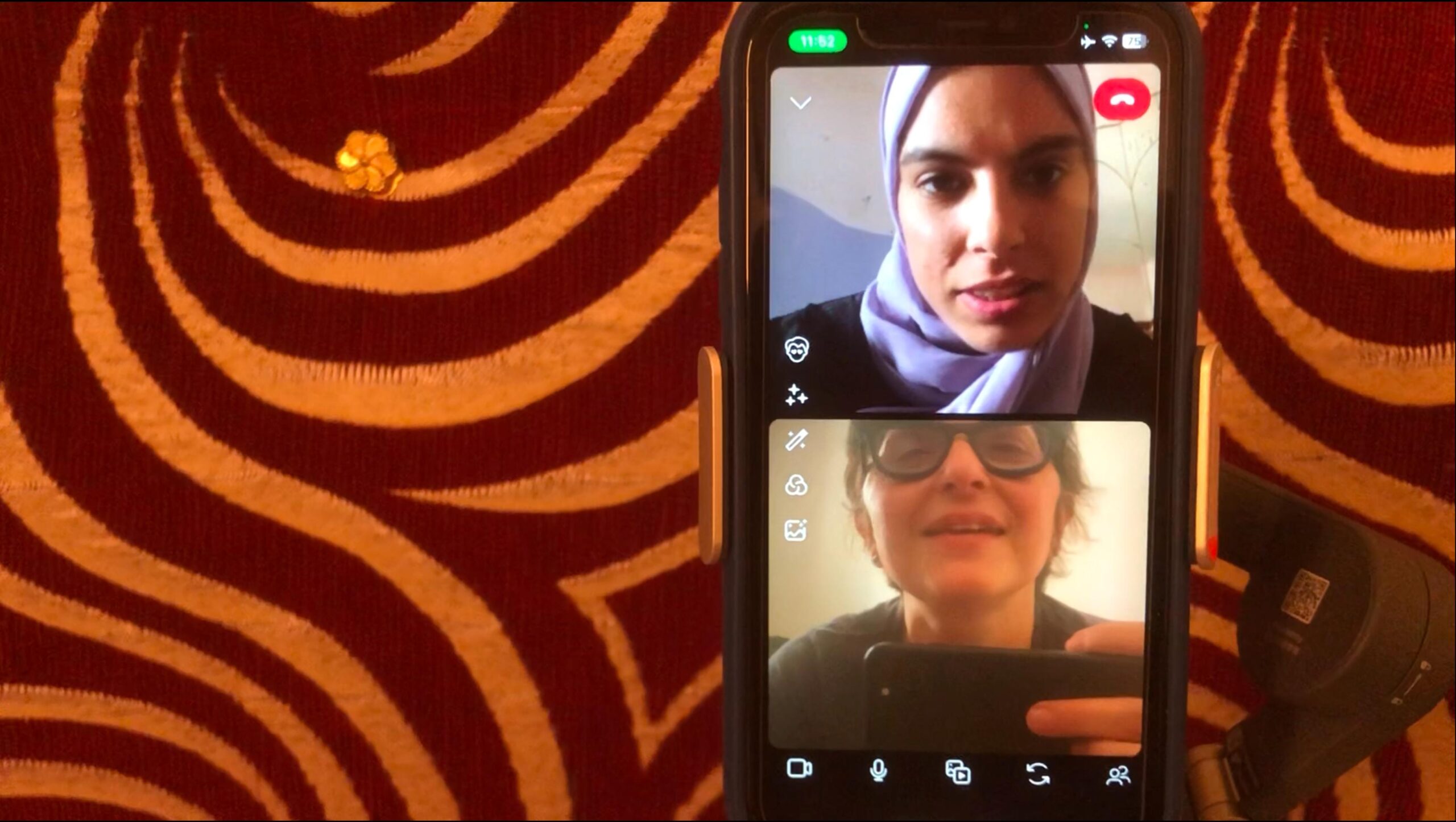
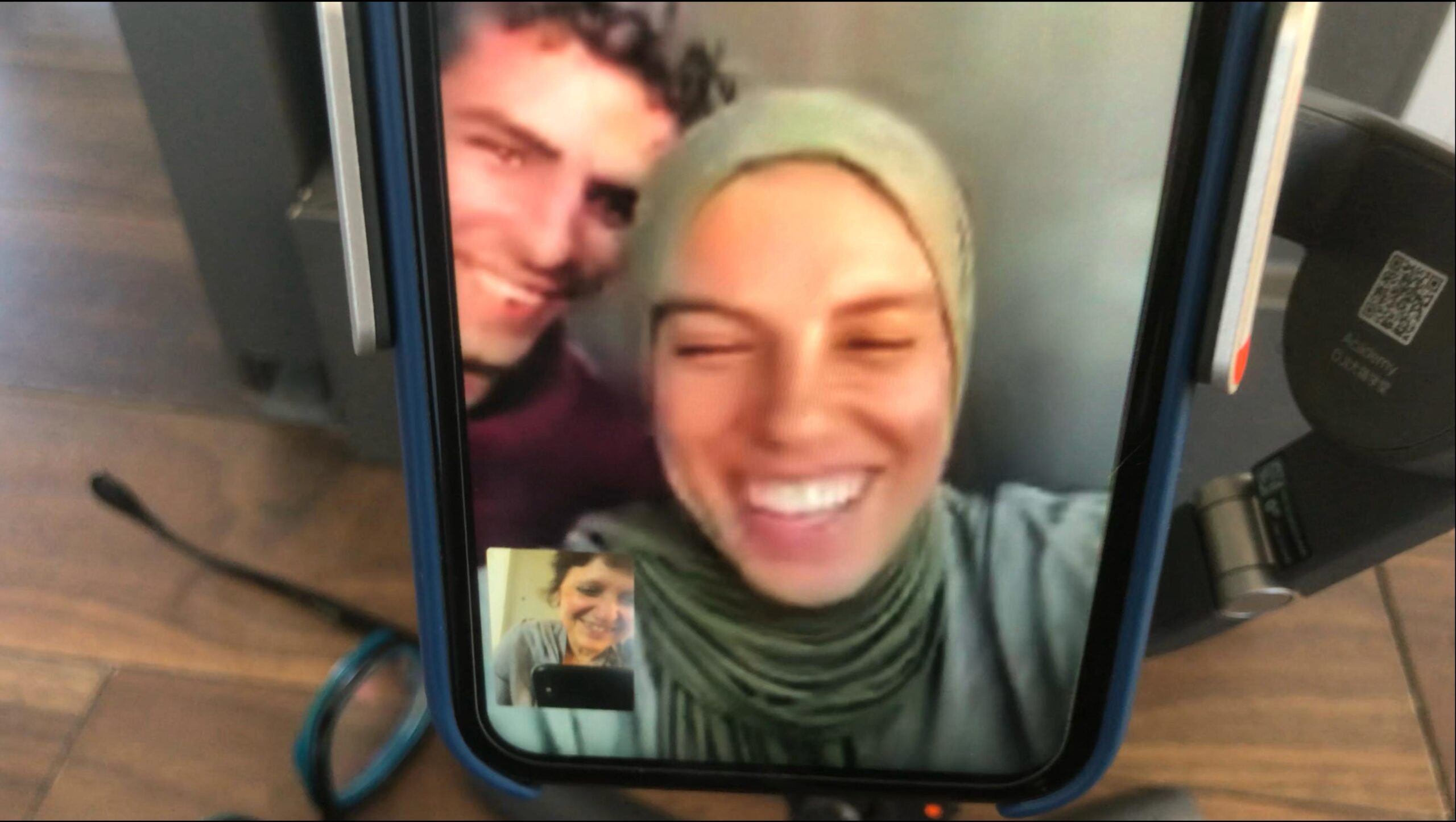
BH: I’m interested in the format of the calls between you and Fatma. Rather than just using the video from the calls, you present the entire screen. There is also a third camera that records the conversation bootleg style, watching you while you call Fatma. What was the impulse behind these decisions?
SF: Yes. Well, the third camera was my commenting on what was going on. I didn’t want to just record the screenshot, the way we are doing now.
That [would make it] a very rigid way of filming. I wanted to be able to play with my icon and her icon, and so I needed a third camera. It’s not a third camera [though really]. There are our two phones, and then one camera that is filming the whole thing. I didn’t want it to be a high end camera in order to match the fragileness of our communication, the low resolution internet connection.
In a way, my feeling was that this is how it works. With the distance, I can feel it more clearly. It makes the image more open and more human. As opposed to a high-resolution camera, which would’ve made it more petite somehow. It’s exactly for the same reason that I use the same way of filming for the newsreels. Instead of using the full-frame videos, I comment on them. In this way of filming, there’s also parts of me printed on her image or on the TV, bits of my glasses or hand or my fingers. It’s a multilayered image that I think is much richer than a classically filmed image.
BH: Fatma was a photographer, and seemed to always be showing you her photos. How would you describe her photos to someone who hasn’t had the chance to see the film?
SF: Her photos contain a mixture of tenderness and rigor. A very, very tender gaze, yet with high stakes aesthetically. I never saw any photos of hers where you would think, “Oh, these poor people!” She always portrays people with great dignity.
There’s always this combination of life and destruction in her work. She says it herself in the film. She says, “I am looking for life in the middle of this destruction and this death.” That’s exactly what she says. There’s always a patch of color somewhere in the photo somewhere, amidst the gray landscape of ruins.
BH: Do you know if her photos are being preserved in any way, beyond the glimpses we see in your film?
SF: Well, I have a few hundred of her photos. A book has been published in France. I hope it’ll be translated into English soon. It is called The Eyes of Gaza.
There are many exhibitions of her work in many countries: France, Belgium, Italy, and Luxembourg, that I’ve helped organize. Hopefully, soon in the States as well. I do as much as I can to make her legacy go around the world.
BH: In your film, much like Palestinian director Carol Mansour’s Aida Returns, there is a sense of how closed-off and isolated Palestine is from the rest of the world. Technology disrupts this, of course. Using filmmaking techniques to replicate this isolation, like we just discussed, is a powerful and unique choice. I’m wondering if this decision might come, in part, from your own experiences in Iran, and experiencing that political isolation and the related need to resort to subversive filmmaking? Do you think your own experiences in Iran influenced this stylistic choice?
SF: Yes, it does. It comes from my experience of being away from my homeland and my family and using any means of communication, at a personal level first, and beyond that, as a censored filmmaker. And then also, using archive images, those produced by citizen journalists, which I did in Red Rose. The film is a kind of impossible love encounter between activists of two different generations on the backdrop of the 2009 uprisings in Iran during the “Green Wave.” The film is all shot in an apartment in Athens. The only images from the outside are the archive images that are filmed by citizens who were filming the events because the Iranian regime had kicked out all of the foreign journalists. And the Iranian journalists were not allowed to film. So people started filming with their mobiles. These are the images that I used in this film that was shot in 2013. Before that, I had done another film, which is called Tehran Without Permission. It is a full feature documentary about Tehran with a very lowkey mobile phone.
It’s a mixture of all of these experiences that formed and guided my intuition in this particular case. The fact that I was blocked out of Gaza myself, witnessing what was happening through the media narratives. It was very disturbing that non-Palestinian journalists were kept out. Israel put a total media blackout upon Gaza since 7 October 2023. And also the fact that the Palestinian voices were not there—nobody was asking them how they were feeling and [telling their stories].
It wasn’t a comfortable thing to film myself while directing the film. I was trying to be with her, listening to her as a friend [yet also function as a filmmaker]. It was a very kind of schizophrenic mode of operating.
BH: Was it difficult to balance the friend and director dynamic? Did the presence of the camera and the recorded conversations change the nature of your friendship?
SF: I couldn’t dissociate one from the other. This is what I’m calling it schizophrenic because I had to deal with both aspects. I could not say, “Okay, now I’m not filming this. Let’s just talk as friends. And then tomorrow, we will [record again].” Because each conversation could have been the last, so I was recording all those moments without exception.
BH: Has the film been shown within Israel at all?
SF: The film has not been shown in Israel yet. But Israelis, yes, and for sure manyJewish people have seen it. They come and thank me afterwards, or send me messages.
BH: I read an article today that said Israel “tested” the peace treaty with missile strikes. That’s not testing it; it is violating it.
SF: Exactly. They broke the ceasefire. This is what I learned today: I spoke to Fatma’s mother today. She just got back to the north of Gaza, and their house– they were living on the second floor of a five-story-building. The targeted attack by the Israeli army destroyed that second floor. Do you know about “Forensic Architecture” [report]?
BH: Yeah. They targeted her family specifically and precisely.
SF: In the conclusion [of the report], through images that were filmed from the inside of the building by a Palestinian crew after the attack, [they demonstrate] that a drone launched two missiles that went through the three top floors of the building and exploded on the second floor. And then, just a few hours before the ceasefire started, they bombed the full building again. Why would Israel bomb the whole building just before the ceasefire?
BH: Were there other people still in the house when that happened?
SF: I don’t know. I lose my breath and then I keep thinking of Palestinians. I wonder how can they be so calm? It’s such an amazing level of resilience.
BH: In my review, I said Fatma had the brightest smile in all of Gaza, and that there’s something about that sounds like a contradiction. It is a contradiction.
SF: That is a mystery to me. I never felt any resentment in her. People ask me [if] she said some harsh things that I cut in the editing process. But she didn’t. There’s nothing that I cut out because I thought I couldn’t put it in the film. She was always like that. This is an amazing thing.
BH: Is there anything else you’d like to say before we close our time today?
SF: I decided to focus on her face. The war is always there and the destruction, not shown in the image, but in the soundscape that we have around her. Her face becomes a territory that I explore, it becomes Gaza… It shows different moments of resilience beyond despair.. Her smile changes and so does her expression.
Somebody asked me once, “why aren’t you using a photo of the destruction for the poster of such a film?” I said it is because her face has become and will remain a symbol of Gaza.
Put Your Soul on Your Hand and Walk
2025
dir. Sepideh Farsi
113 min.