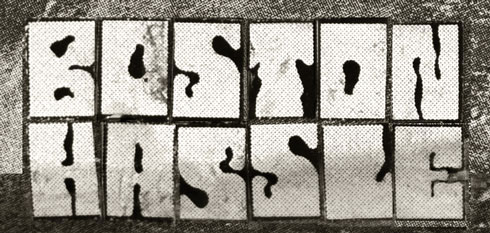
The most distinctive aspect of Nicolas Winding Refn, the Danish enfant terrible behind Drive and The Neon Demon, is his signature. I’m not talking about the signature elements of Refn’s films— neon lights, bone-crushing violence, free-floating ambient horniness— but the hand-scrawled “byNWR” logo which serves as the director’s monogram. Refn emblazons these letters everywhere: on his digital-rental streaming platform, on the opening credits of his films, even diegetically within the films themselves. Refn’s dedication to this trademark goes beyond even such branding-savvy filmmakers as Alfred Hitchcock or Kevin Smith; indeed, it has more in common with the world of fashion labels than traditional film promotion.
Perhaps this is the best way to interpret Refn’s work: not as a filmmaker, but as an atelier. You don’t go to a Nicolas Winding Refn film because you want to follow a story, but rather to exist within his dreamy, cooler-than-thou headspace for a couple of hours. His films aren’t “films” in the traditional narrative sense so much as lifestyle objects. Ryan Gosling’s embroidered scorpion jacket isn’t just the most memorable element of Drive; the film is, itself, an embroidered scorpion jacket.
Whether you read the above paragraph as praise or condemnation will dictate how much you enjoy Refn’s films in general, and his latest film, Her Private Hell, in particular. Her Private Hell is by far the most byNWR film of Refn’s career, given almost entirely to long, neon-drenched shots of attractive people brooding in haute couture outfits. It is, to be sure, thunderously stupid— but I also can’t say I didn’t enjoy it.
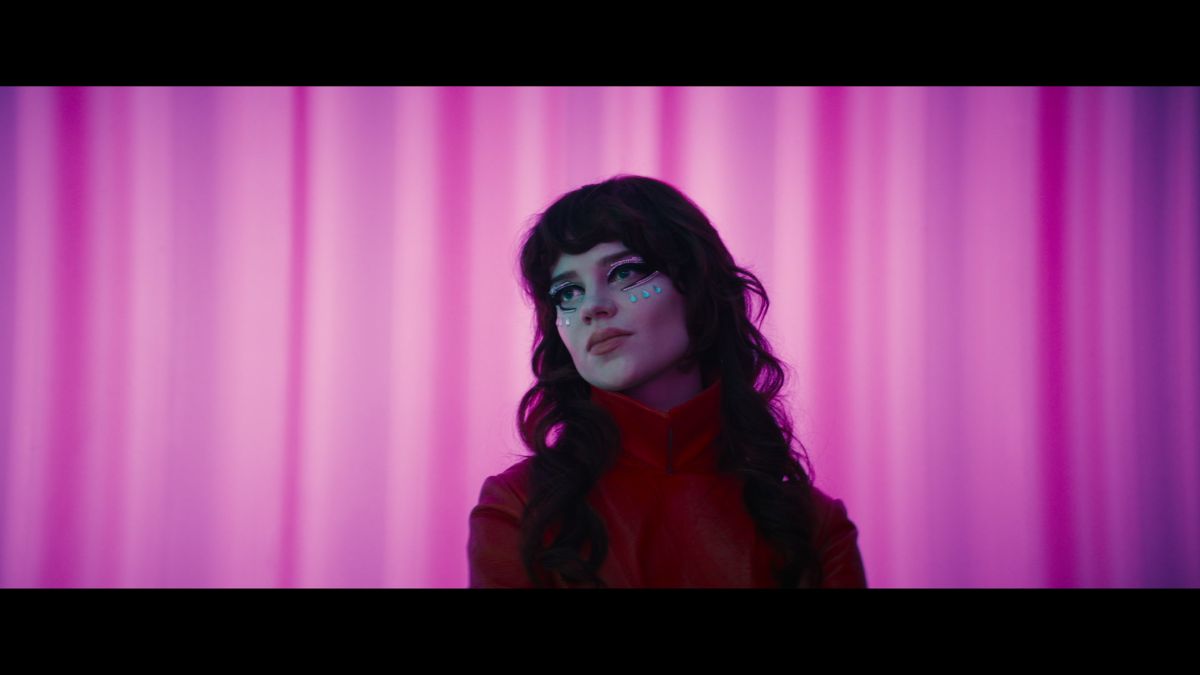
The vibe this time out is “futuristic,” but I’m not entirely sure it takes place in “the future”; the characters live in eerie high rises drenched in Blade Runner 2049 bisexual lighting, but there’s still talk of social media metrics and other contemporary signifiers I pray won’t stand the test of time. Sophie Thatcher plays Elle, a disaffected movie star occupying one of said high rises. For reasons never fully explained, she shares her pad with ditzy co-star Hunter (Kristine Froseth), as well as her young stepmother, Dominique (Havana Rose Liu), with whom she also seems to share a romantic history.
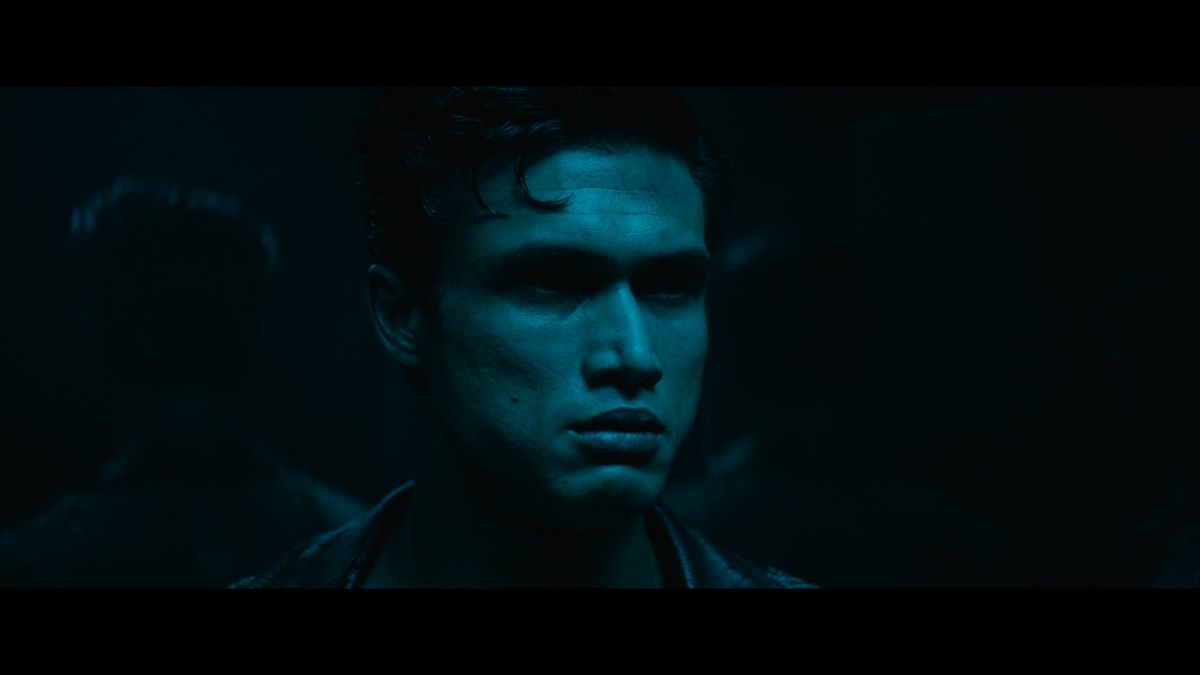
All three are, to some degree, in the thrall of Elle’s father, a skeevy millionaire named Johnny Thunders (not that Johnny Thunders, though Thatcher, with her signature haystack hair, could certainly pass for the New York Doll’s progeny). Johnny ostensibly keeps Elle, along with a harem of similarly nubile young women, cloistered to protect them from a possibly supernatural serial killer dubbed the Leather Man. Meanwhile, in the mist-shrouded streets below, hard-nosed ex-GI Private K (Charles Melton) fights his own one-man war, searching for the Leather Man in hopes of avenging his daughter’s death. Also in the mix are a rival skeevy millionaire named Nico (Babylon’s Diego Calva) and a weary police detective (an underused Hidetoshi Nishijima).
These are a bunch of characters and story elements, but you might notice they don’t quite add up to a plot. There are, to be sure, a few stories swirling around in there— K’s rampage of revenge, the unresolved feelings between Elle and Dominique— but what the film is actually about is how cool Sophie Thatcher looks sighing into a mirror wearing exaggerated cat-eye makeup. There are frequent references to “the mist” as some sort of encroaching blight, but it’s plainly primarily there to enhance the aesthetics of the faux-Tokyo alleyways. In both its neon palette and its black-gloved killer, Her Private Hell owes a great deal to the Italian horror maestro Dario Argento, and, like Argento, Refn is never one to let a cohesive story get in the way of a nifty visual.
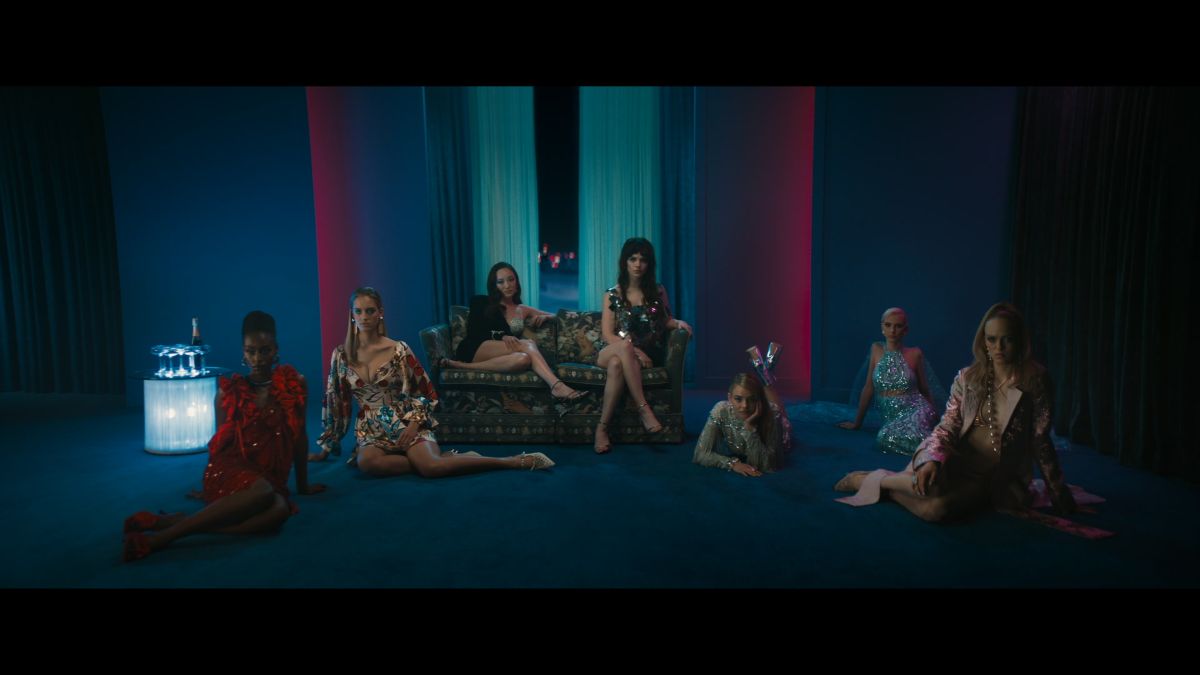
Again, whether all of this is a pro or a con comes down to whether your cinematic tastes prioritize substance or style. If you fall into the latter category, you’re in luck. Even in the (rare) scenes not drenched in neon, Refn knows how to make his images pop in ways the major studios seem to have forgotten. The high-contrast primary colors recall the Technicolor “women’s pictures” of Douglas Sirk, a sense heightened by both the operatic emotions of the characters and the lush, sweeping score by the great Pino Donaggio. As mood pieces go, it’s among the moodiest.
That being said, even the vibes aren’t quite immaculate. While the term “male gaze” has been overused to the point of nonsense in the age of social media, there is something a little unseemly in the way the 55-year-old director’s camera leers at his female stars. A lot of the film’s running time is spent on lithe women lounging about in revealing clothes and pouting like American Apparel models, most of whom are almost certainly too young to get that reference. There’s not much in the way of actual nudity, and only one sex scene, but the film exists in a constant state of agitated arousal. Watching it, I often felt vaguely dirty, and I can’t help but wonder what it will do to the brains of poor, discourse-addled Generation Z.
Then, of course, there’s the matter of substance, of which, again, there really isn’t very much. While Her Private Hell is a theatrical release, I couldn’t quite shake the sense that it was designed to be half-watched while looking at one’s phone— not in the “let’s repeat what just happened” sense which has become a notorious hallmark of made-for-streaming features, but in that, minute to minute, not much happens at all. You can scroll on your Instagram feed during one of Thatcher and Liu’s tete-a-tetes, and when you look up they’ll still be in mostly the same place. Or maybe you’ll be checking your email, only to be snapped back to attention by Melton curb-stomping a room full of Yakuza thugs, and you won’t have to worry about missing the setup because there wasn’t one to speak of. Her Private Hell is a sort of ambient movie, not something you “watch” so much as spritz into the room.
If this all sounds harsh, it’s because I don’t want to give anyone the impression that Her Private Hell is a “good” movie; by any rational critical standard, there simply isn’t much there there. But, again, the vibe’s the thing. If you’re susceptible to the film’s slinky, candy-colored atmosphere, you’ll be in for a good time— and I can’t deny that I did have a good time. While there is a growing sense in cinephile circles that Refn’s brand is becoming passe (accelerated in no small part by his ill-advised embrace of generative AI), he still knows how to activate those hipster-noir pleasure centers. The House of byNWR may remain divisive, but, like any good fashion label, its work is impossible to mistake.
Her Private Hell
2026
dir. Nicolas Winding Refn
109 min.
Opens Friday, 7/24 @ Kendall Square Cinema, Alamo Drafthouse Boston Seaport, and all local AMCs