The Boston Palestine Film Festival runs with a mix of in-person and online availability from October 17 through October 26. Click here for the schedule and ticket info, and watch the site for Joshua Polanski’s continuing coverage.
Our lives are intrinsically connected to those of our neighbors. This is just as true in Brighton, Jamaica Plain, and Cambridge as it is in Haifa.
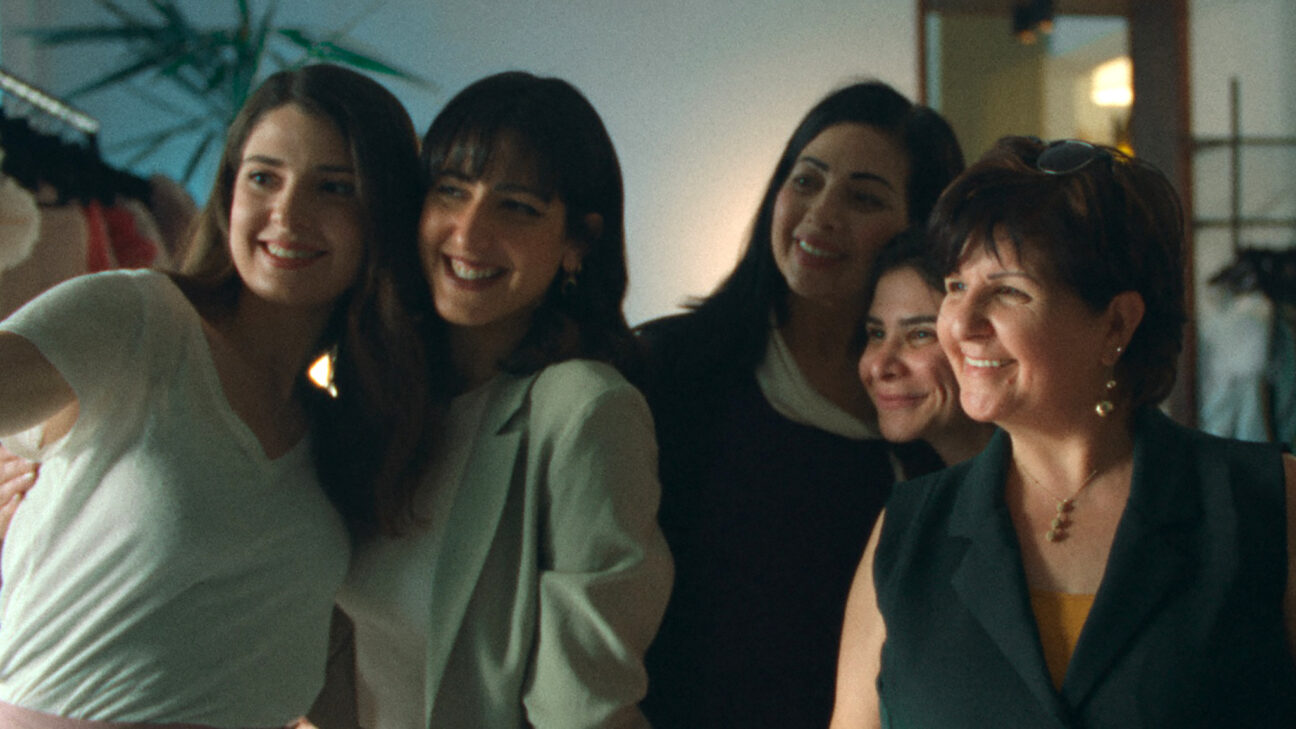
This also seems to be one of the through-lines in the still-fresh directorial career of Scandar Copti, a Palestinian citizen of Israel and currently living in the Emirates. His first feature film, Ajami, was co-directed with Israeli filmmaker Yaron Shani and zeroes in on the interconnectedness of the lives of the diverse people who call Jaffa, Tel Aviv home. Copti’s latest feature, Happy Holidays, which screens Sunday at the Boston Palestine Film Festival, makes a tapestry out of multicultural life in Haifa. It does so with an unchronological and episodic approach that centers around two families: one Palestinian, the other Israeli.
The two families are connected by adult lovers around the Jewish holiday of Purim. Rami (Toufic Danial), the older brother in the Arab family, is dating Shirley (Shani Dahari), whose Jewish family is repulsed by the interracial relationship. Shirley is pregnant, we learn in the first scene, and wants to keep the child—a decision that Rami can’t come to understand. Rami’s affable sister Fifi (Manar Shehab) gets the most compelling narrative as she navigates misogyny and conservative sexual (and privacy) standards while trying to hide her medical records from her mother.
The contradictions in the lives of these neighboring communities most strongly reveal themselves at school. Fifi works in a Hebrew-speaking kindergarten that indoctrinates the youth with nationalism and “pro-security” talking points. Fifi, as an Arab woman, is a possible threat to their safety despite working in the school and is relegated to checkpoints to get in and out. The lecturers often wear military uniforms, instructing the children to love the defense forces by imparting the parental warmth of a school teacher. God and “Bibi” both keep them safe, the students learn.
Shirley’s niece Ori (Neomi Memorsky), an eleventh-grade schoolgirl, shows obvious signs of depression—a mental health struggle perhaps manufactured to escape her upcoming military assignment. The mental health sub-plot works best as a highlighter of inequity: only first-worlders, or in this case, first-class citizens, have the privilege of attending to depression, anxiety, and other important concerns.
The actors are all non-professionals, though you wouldn’t know it from a talent perspective. Maybe Copti is just a fantastic director of actors; he has also written the film in a way that allows the performers to draw from their real-life experiences rather than simply filling the shoes of a character. A real nurse plays the nurse, a doctor plays the doctor, etc. Shehab is particularly enthralling as Fifi. I leaned closer to the screen every time she appeared, prepared to be captured by her emotional depth. She never fully erupts, but she feels like she could at any moment. Shehab makes Fifi both strong and broken and that’s an incredibly thin line to juggle.
The non-chronological and episodic structure is surely the film’s greatest attraction. Copti, who also edited the film, uses brief windows that glimpse the perspectives of one character at a time. Information glimpsed in one window is clarified, complicated, or obscured in the next. It’s rewarding to see all of the information line up like puzzles from one episode to the next: a phone call in the background of one story is heard and recontextualized in the next, or a person who seems nice and cheerful from one perspective ends up being a bastard in another.
The complex editing also works with the film’s key themes to weave the lives together like cross-stitches in a quilt. A linear version of the same story would make the interconnectedness of the Arab and Jewish lives more dramatic cause-and-effect, highlighting the accidental happenstance of it all; the fluid editing of Happy Holidays instead makes the interconnections inevitable and infinite.
And when that’s the case, it certainly (should) change how one group treats the other.
Happy Holidays
2024
dir. Scandar Copti
123 min.
Screens Sunday, 10/26, 2:30pm @ Museum of Fine Arts, Boston
Part of the 2025 Boston Palestine Film Festival
Joshua Polanski is a freelance film and culture writer who writes regularly for the Boston Hassle and In Review Online. He has contributed to the Bay Area Reporter, Off Screen, and DMovies amongst other places. His interests include the technical elements of filmmaking & exhibition, slow & digital cinemas, cinematic sexuality, as well as Eastern and Northern European, East Asian, & Middle Eastern film.