The Boston Palestine Film Festival runs with a mix of in-person and online availability from October 17 through October 26. Click here for the schedule and ticket info, and watch the site for Joshua Polanski’s continuing coverage.
“Should I wait for Palestine to be free to get a divorce?”
The women of Laila Abbas’s feature debut share a financially comfortable lifestyle when compared to most of the characters in any given Palestinian-focused film festival. They have large flatscreen televisions in their living room, toys on the floor, and a house spacious enough that people don’t trip over each other. Their inconveniences are just like the inconveniences in the lives of women all over the world: the men around them and the ones running the country.
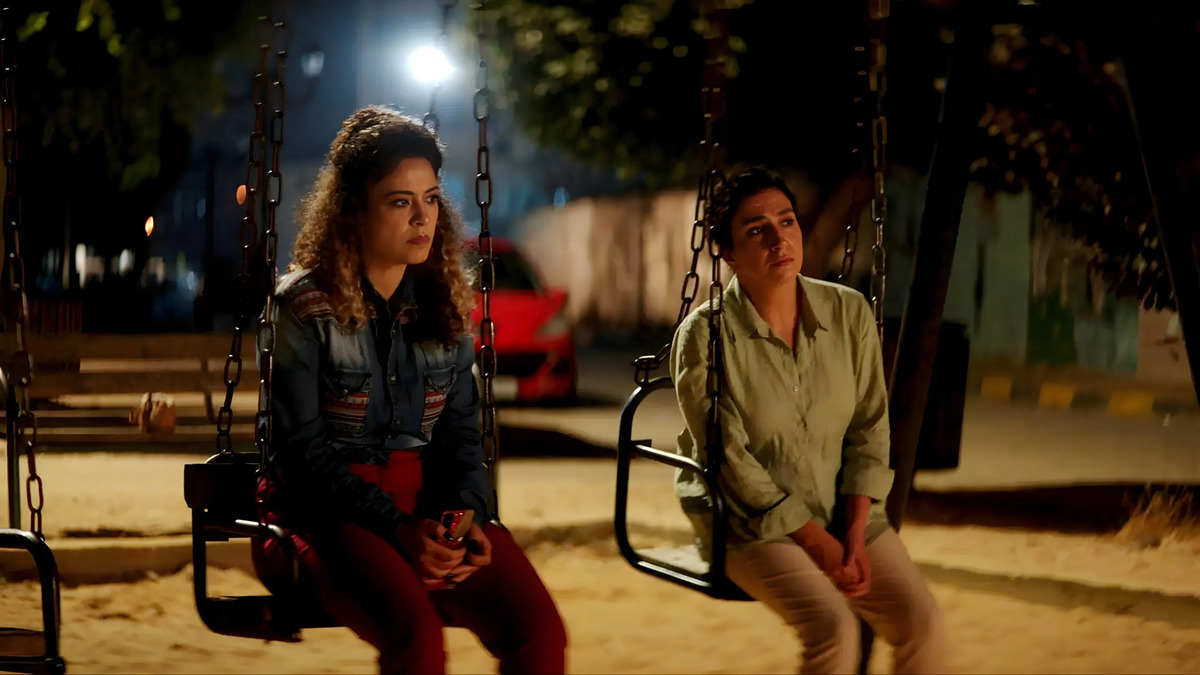
Sisters Mariam (Clara Khoury) and Noura (Yasmine Al Massri) concoct a scheme when their dad dies to cut “his highness,” their distant brother who abandoned them for America and ignores their calls, out of the inheritance that the law determines to leave him. Noura dreams of opening a beauty shop in North America and Mariam sees the money as a divorce kickstart package. Knowing it’s what he would have wanted anyhow makes them feel better about the identity fraud and banking shenanigans they pull off to abscond with the money.
Khoury and Al Massri, two Palestinian actors based in the United States, make the film work. (Al Massri is half Egyptian too.) Their comedic timing provides some levity to heavy themes, and their chemistry comes through in the most emotional scenes. They could be sisters. Both actors deliver more than a conservative share of memorable one-liners that surely will come in abundance in the Letterboxd reviews of the film. The subtitle translators deserve some of the credit here too: it’s a difficult task to land powerful one-liners in two languages!
Khoury struggles to find that same chemistry with the actors playing her children, an unfortunate byproduct of a script that limits the oldest to a rebellious archetype and makes the younger one fully irrelevant. The deteriorating relationship with her husband (Ashraf Barhoum) also struggles to find any emotional relevance amidst the high-stakes identity fraud operation with her sister where the payout funds have a liberatory weight.
My favorite moment comes after the sisters pull off their inheritance heist and celebrate. Noura honks her car’s horn in celebratory repetition, almost imitating the traditional zaghrouta. The modern form on the familiar Arabic sound sonically characterizes the film’s internal dissatisfaction with the conservative cultural laws that restricted the inheritance to their brother in the first place. The moment of jubilance powerfully peeks into the feminist world of Laila Abbas.
Every Palestinian film I’ve ever seen, on some level or another, cannot avoid the Israel-sized elephant in the room, and Thank You For Banking With Us is no different. Protests against Israeli forces erupt in the streets, and the news broadcasts gravitate to the expected topics. The father also built his savings with land he sold, connecting the ability for Palestinians to navigate life in occupation successfully to the forfeiting of their land. Abbas’s film isn’t ultimately about life in an apartheid state, but it also isn’t not about that either. The sisters can’t get a break and a government that sees them as second-class citizens at the least informs the context of their struggle.
Thank You for Banking with Us
2024
dir. Laila Abbas
92 min.
Screens Friday, 10/17, 7:00pm @ Museum of Fine Arts, Boston
Q&A to follow with director Laila Abbas
Part of the 2025 Boston Palestine Film Festival