
I had a lovely chat with one of my favorite directors, Albert Birney, about his latest film, OBEX, which opens Friday 1/16 at the Brattle Theatre. We got into physical media, set design, Zelda, big TVs, and much more!
BOSTON HASSLE: How’s Dorothy [your dog]?
ALBERT BIRNEY: She’s good. When I finish this interview with you, I’m gonna take her on her little afternoon walk.
BH: This was her star making performance, unless she was in Strawberry Mansion.
AB: No, she wasn’t. We didn’t have her at that point, but she would have been.
BH: I knew you were involved in I Saw the TV Glow, but I didn’t realize you were in the Ice Cream Man suit.
AB: Yeah, that was fun. I had done some early drawings with Jane [Schoenbrun] and kind of developed the look of that character a little bit with them, just collaging it together and illustrating it. So it was fun to have the opportunity to actually put the mask on.
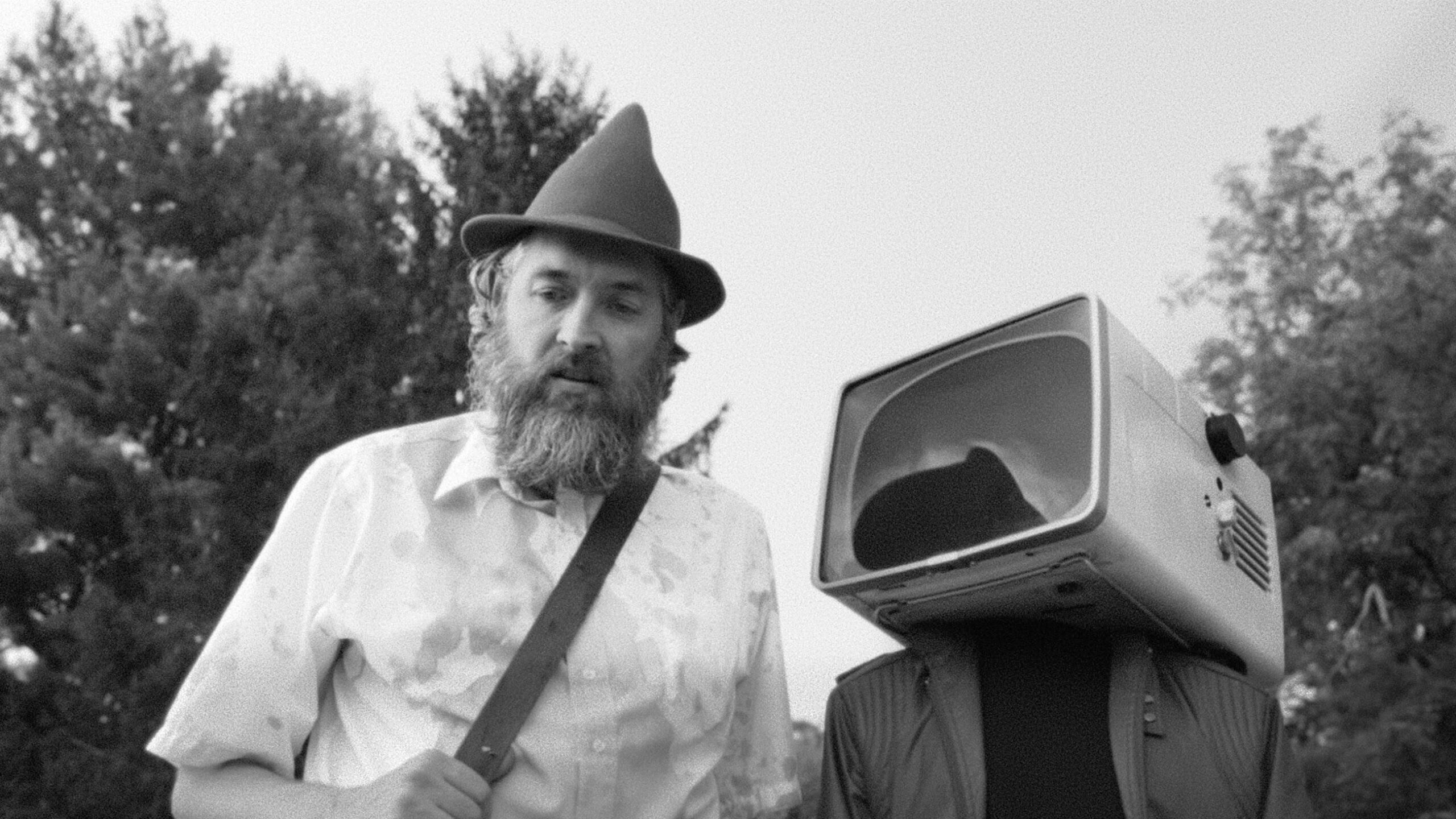
BH: That was a great screening experience. It was really packed at my theater. It made me really happy, since I saw Strawberry Mansion and We’re All Going to the World’s Fair at the same virtual Sundance, and it was so nice to be able to see both of them and TV Glow in an actual theater. I’m really glad to be able to see OBEX at the Brattle, since I watched it last year through Sundance. I’m just kind of laughing, because after watching it again last night, I’m just sitting with the line, “You were my dad’s TV.” It’s a beautiful moment.
AB: I discovered that it really felt big, or just kind of like, this is the emotional moment. I remember sharing that script with Frank [Mosley], who played Victor, who says that line. A day or two later, he texted back. The first thing he texted back was, “I was your daddy’s TV.” And I was like, yes, Frank gets it. Frank understands the heart of this character.
BH: When I was reading your notes, you were talking about not being nostalgic for this technology, but just trying to capture the feeling. OBEX doesn’t feel like that sort of nostalgia. It really is just like, this stuff looks good on film, and it works well in the story, where you put it in 1987. Can you talk more about old video games and why you respond to them so well?
AB: It definitely stems from this feeling of when you’re a kid, when you’re five years old, and you’re introduced to something that blows your mind, whether it’s a computer or a movie or a video game, it just leaves such a huge mark on you. I’m curious about the five-year-olds of 2026, what that thing is for them. I don’t know if it’s, you know, a YouTube channel, or if they’re not allowed screen time. “Screen” wasn’t a word that was in my household growing up. When you set out to make a movie, what I love most is that worldbuilding, and figuring out what that world looks like. I think it’s so magical to be able to turn the clock back and to find these old machines, and these old computers and TVs and VHS. You put them in front of the camera and have that shape the world. As with any movie that I’m making, it’s trying to follow some feeling or desire to know myself or to find some sort of peace or feeling of home. On that journey, a lot of it, you’re going to look back and you’re going to look at the formative moments in your life where you started to become conscious of being alive, or being aware of other art, and other people outside of yourself.
BH: Some of my earliest experience online was really early Homestar Runner stuff and being like, what is this world that I’m stepping into? I’ve been trying to find the DVDs, but they’re a little rare. Similarly, I’m trying so hard to get a TV with a VCR in it, just like one unit. I think people are scooping them up. I think they recognize the value of these things and what looks good on them. I have a bunch of VHS tapes I can’t really watch right now. Yes, I want that damn TV to put in my office.
AB: I mean, you know, five years ago, you could find them everywhere. Ten years ago, they were on the street. I remember when we made The Beast Pageant, every Wednesday, trash day, in Rochester, New York, walking from my house to the studio, I would pass three, four, or five old TVs, some of them with VCRs in them. I would snatch them up because we needed them for props. But I stupidly destroyed them and opened them all up. That’s when everyone was first starting to get their plasma or flat screen or whatever the bigger, better, cheaper TV was at the time. I think word is out now these old CRTs are great for watching VHS or playing old Nintendo. I also have a friend who’s trying to get a TV/VCR combo, and they’re not able to get one. I’m hoping I can find one soon.
BH: Speaking of video games, I feel like you’re one of the only directors that I’ve seen that really understands how to translate video games to film, besides like… have you ever seen Agnès Varda’s movie Kung Fu Master?
AB: I did see that once when we showed at the theater I used to work at. There’s an arcade game?
BH: I mean, there’s a lot going on in that movie, but it’s so funny that the movie is about Jane Birkin falling in love with a teenager, and I was just the whole time being like, why does Agnès Varda understand how arcade games look and feel if they were translated to real life, like when he’s doing the jumping and punching? I see this with OBEX, since he’s going into a video game world where he’s following a fairy, all this Zelda stuff that I really like.
AB: I wonder if Agnès Varda enjoyed that arcade game. For her to be able to translate that into the film, there must have been some sort of understanding of what it was, or, if not her, maybe one of her kids loved it, and she could see through them. I grew up playing these games. They’re just as formative to who I am, as any of the films or music or TV I grew up watching and listening to. When it became time to make this movie, it felt very natural. And there were even moments where I was like, I have to maybe pull it back a little bit. At one point, when Mary, the fairy woman, gives Conor the sword, I think she was originally gonna say, “It’s dangerous to go alone,” which of course is a Zelda line.
BH: I was kind of waiting for that.
AB: Yeah. And I think that would have been fine, but at some point, you’re like, maybe that’s too on the nose. Let’s leave that in Hyrule in the original Legend of Zelda and make our own version of that line.
BH: Was the film always meant to be in black and white? How do you work with that? So much of early video games is like the four or five colors and how those mix together. With OBEX, you’re removing that. But it looks really good in black and white, which maybe you wouldn’t expect for something so computer heavy.
AB: There was definitely a moment when I said I wanted to do black and white, and Pete [Ohs, the producer/cinematographer] said, “Are you sure? We could film color and you could make it black and white later if you’re not 100% sure.” And I said, no, I’m sure, let’s do black and white. Let’s not even give ourselves that option. Certain stories, when they start to take shape in your head, they just have a certain look. With Strawberry Mansion, it was super colorful, you know, the pink room, and all of that. And that was an important part of that story. But this one, it felt like Conor’s world is a little bit small, it’s just white walls behind him. One thing I brought up to Pete when we were first starting to design was how the hospital feels in Bergman’s Persona. It’s very stark and blank. In some of my other movies, I’ve always thought more is more, let’s put everything on the wall– like behind me, you can see I’ve got all my shit. But with this one, I was like, you know what, I think Conor isn’t like that. All of the images and things for him are on the screen on his computer and on his TV. He has his wall of VHS tapes, but the actual house he lives in, it’s pretty barren, which was new for me. I had to take things off of the walls.
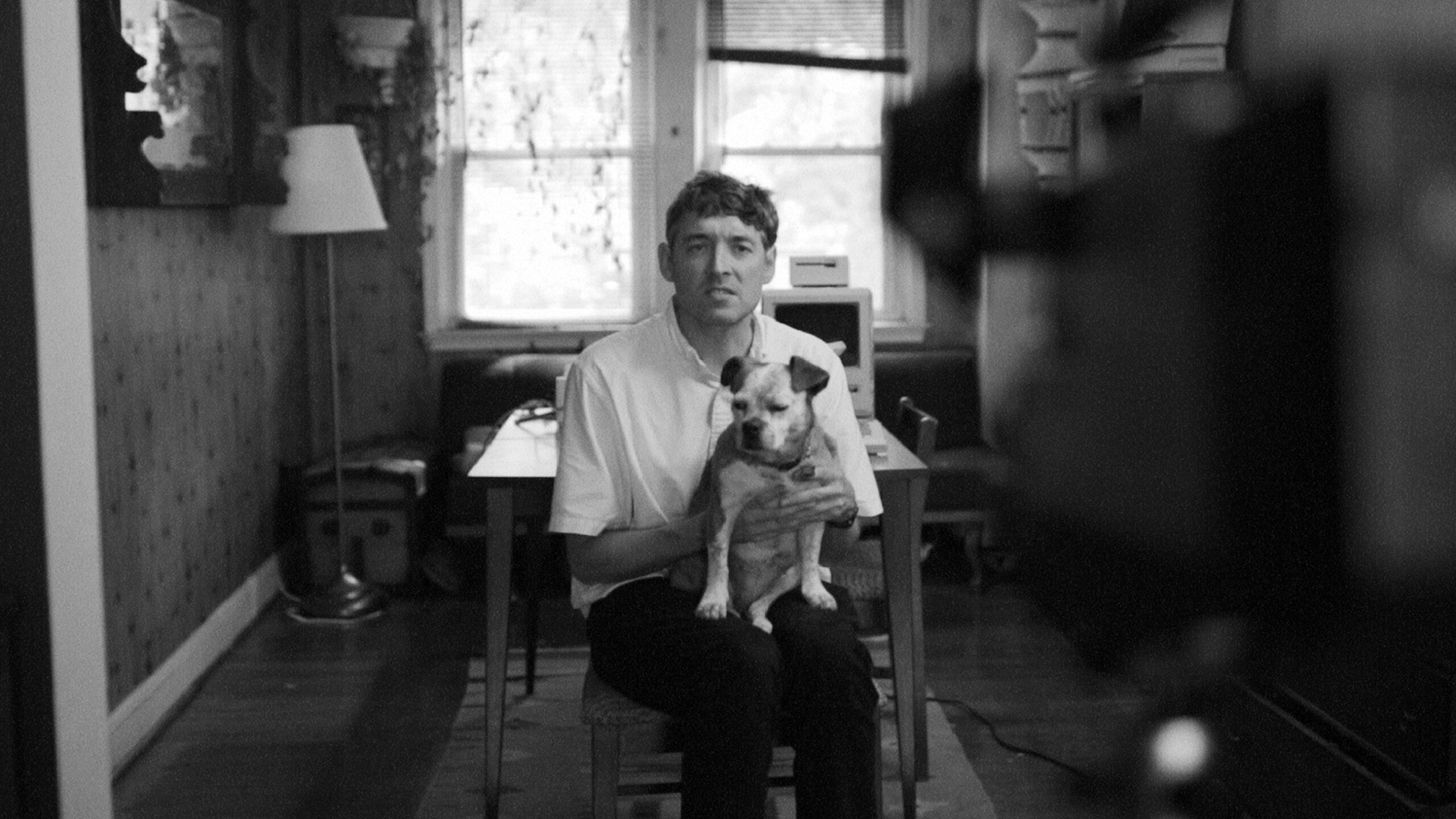
AB: But yeah, black and white, just the feeling of the static on the TV, the feeling of the old VHS, even the feeling of the old Macintosh computers, which were black and white, that’s his world. Knowing that it would just allow us with the special effects to get away with more sloppiness, or a DIY feeling. If it’s color, you’ve got to do a little bit more work, but with black and white, you’ve got a little bit more of that blurry border to work with.
BH: Yeah, it adds to the surreality too. Can you tell me about True Friend, is that a production company?
AB: That’s actually my friend and producer, Emma Hannaway. That’s her company. She was a producer on Strawberry Mansion. She lives in Baltimore here, right down the road. I think she’s had it for a couple years, but we brought her onto OBEX. I don’t know if this is the first True Friend movie that’s come out, but it might be. Look for more True Friend stuff in the future.
BH: It feels like there’s really exciting indie film stuff going on. And I really appreciate that you were able to make this in Baltimore and really use that homegrown feeling.
AB: I love making movies here in Baltimore. That’s why I moved back here 11 years ago. I grew up here and then left for college and lived other places for years. But Baltimore presented itself as a city where you can make stuff with your friends. There’s not a lot of barriers in your way. You can dream out loud together. I hope to continue doing that for many years.
BH: It reminded me of last summer, one of my theaters here did a screening of Pecker, which is a film I love. And it was just so nice to see that in the theater and that version of Baltimore.
AB: Yes, I love that movie and also recently rewatched it. It takes place in Hamden, which is less than a mile from where I’m sitting right now. It was fun to watch because Hamden has changed, as most places do change, in the 30 years since that movie was filmed. But you can still recognize some things and you’re like, wow, that is no longer a sub shop, it’s now like a hair salon or something. But yeah, that’s a fantastic film, as all of John [Waters]’s films are. Recently I also rewatched Serial Mom. That’s another one where it’s the perfect movie, just seeing Baltimore captured in that moment in the ’90s. There’s this old video store, Video Americain, featured in the film. And just like, God, this is even before DVDs. It’s still VHS. And this old radio station I used to listen to I saw a sign for which has been gone for many years.
BH: I need this sort of texture and physical stuff. What I love about OBEX is this guy walking around with an actual TV on his head. You need that stuff. It can’t all just be soupy, strange CGI, or AI or anything like that. Things need to be real.
AB: I think you can just tell when something is real. Humans respond to things that we can touch. And as good as special effects get, I think there’s still that thing that we respond to. So real, in-camera things are always interesting. It’s just more fun. You get to create this mask and you get to have an actor wear it. Frank, who put the TV on, his character comes through his movement and his performance and the way he moves his body and all these things; I think if you just make that a CG computer head or CG character, maybe you’re at risk of losing it. It’s more fun to do it. What would I have done if I was 12 years old? How would I have done it? That usually puts you on the right path.

BH: OBEX feels like elevated backyard cinema in the best way, a different way from Strawberry Mansion. It was closer to Beast Pageant.
AB: They’re all swimming in the same waters to a degree. Beast Pageant was about 15/16 years ago now. Maybe every 10 years I’ll make a black and white movie that is kind of this hero’s journey or this journey into the unknown type of thing.
BH: I’m excited to see it in the theater.
AB: I love the Brattle. And I hope it’s a good crowd. Hope you get some people out there. Because, as with any theatrical experience, it’s fun to have other people.
BH: The people come out for these things. It’s exciting. One more note about Pecker. I don’t know if you’ve seen Yi Yi recently, but when I saw it in the theater, I thought it was a beautiful movie, but I noticed there’s a Pecker poster in the background in one scene. I forget when it is because that movie is like four hours long, but they’re at a mall and there are movie posters. I was just like, that’s Pecker. There’s a Pecker poster. It took me out for a second, but in a good way.
AB: I’m gonna have to look for that. I’ve been meaning to rewatch that. So yeah, that’ll be a fun little Easter egg.
BH: It’s so jarring, but in a good way.
OBEX
2025
dir. Albert Birney
91 min.
Screens Friday, 1/16 through Sunday, 1/18 @ Brattle Theatre – click here for showtimes and ticket info!