
Grappling the urge to resist homeostasis can be easy if you think about its benefits: waking up alive, having a support system around you, and the occasional comparisons to another life that could be worse. Yet, when Florence (Karine Gonthier-Hyndman) tells her husband David (Mani Soleymanlou), “Being balanced doesn’t mean that I’m happy” before stopping her antidepressants cold-turkey, she is declaring and welcoming the mess that will come her way. But sometimes the way to get over something is to get through something, and Two Women (French: Deux femmes en or) will certainly allow their characters to go through it.
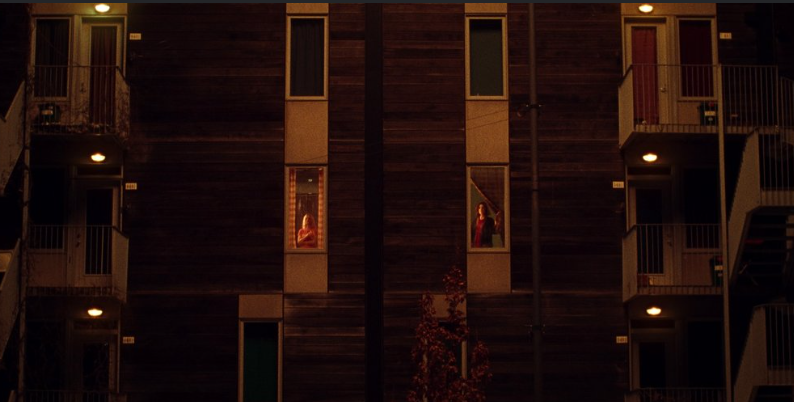
The dawn of realization first starts when Florence is visited by her next-door neighbor Violette (Laurence Leboeuf), who tries to complain about Florence’s loud sex noises, which she cryptically describes as crow noises. Florence’s initial reaction is of tremendous confusion, until she realizes what Violette is insinuating and shares that she hasn’t had sex in years. Embarrassed, Violette returns to her apartment, which is generally inhabited by her, her infant, and the ghost of her always-traveling husband Benoit (Félix Moati), who is revealed to have an affair with his co-worker. The sound of the crow, which to my untrained ears sound like it belongs on the opposite spectrum of carnal pleasure, is utilized as a sort of swan-song to the pursuit of desire – or it could be a wake-up call to something that needs to be stirred inside.
Even though the film’s titular orbit indicates the growth of Florence and Violette, it expands the width of the conversations and doubts to their husbands, who adjust to their growth in various ways. In well-written and flawed characters such as these, it feels less like forced emotional responses and learning to listen to the characters, which is exactly what this film needs and succeeds in. No one is perfect: Benoit is continuously ridden with guilt by his affair with his co-worker Eli (Juliette Gariepy) who seems to have a better grasp on his wife’s state of mind than he does, David is so fearful of his wife’s new behavior that he starts to take her antidepressants, and the women’s revolving door of extramarital affairs. The depicted sex that the women pursue is a bit metaphorical: they create maintenance issues for repairmen to come in and fix, only to add a quick rendezvous as a service tip at the end.
The women share their experiences with each other in coyly-phrased anecdotes. Though they never quite name what they’re doing or what they want to find, it’s easy to understand that self-discovery can mean a lot, at any age. The dialogue between everyone is delicious, whether it’s drunken bantering or stinging, righteous jabs. It may not be a perfect movie nor even the movie of interest for people who refuse to accept that women go through menopause, but I can promise that it resonates ever so much to feeling stuck.
Ahead of the Boston premiere of the film, I had a quick chat with director Chloé Robichaud and the two co-leads Karine Gonthier-Hyndman and Laurence Leboeuf about reverting the male gaze and rediscovering yourself. The conversation was edited for clarity.
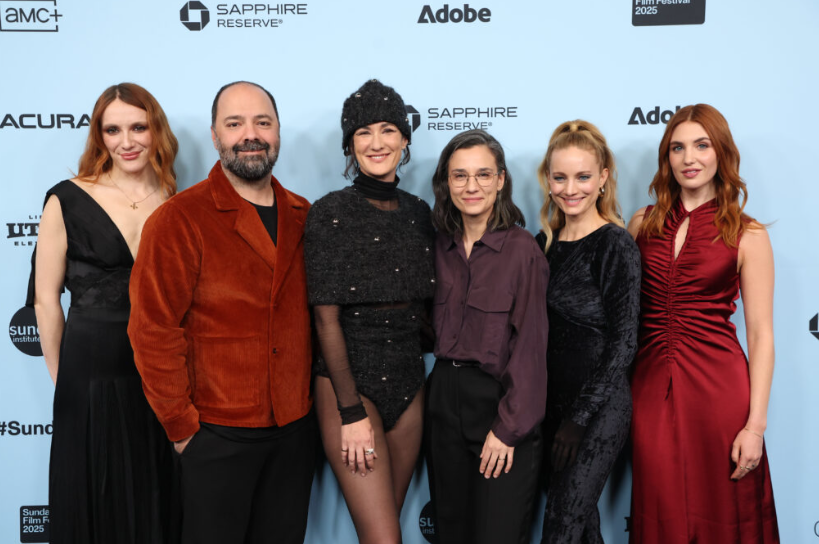
BOSTON HASSLE: This is an adaptation of a movie from 1970 [Claude Fournier’s Two Women in Gold], which is crazy to think about because that’s fifty years ago. I wanted to know if you remember your first time watching it and how you felt. Secondly, what were you excited about when you knew that you were gonna adapt it for today?
CHLOE ROBICHAUD: I saw it in film school, actually, and I remember how the teacher spoke about the film. It was mostly about this sex farce at that time, and the film was not well-received in the ‘70s. It was a huge box office success, I would say, mostly because it was the first time that people would go see nudity in film. But the critiques were a disaster. I remember the teacher mostly speaking about that, but when I saw the film, there’s a bit of a male gaze for sure. But you have to bring yourself back to the ‘70s. I was struck by these two women who would take control of their sexuality like that. When [writer] Catherine Léger contacted me six years ago, I was like, “I want to do a remake.” I was all in and was excited to bring my female gaze to it.
LAURENCE LEBOEUF: I remember the aura of the film. When we were approached to do it, I started watching it and then I didn’t finish it. It was kinda to protect my own reading of the film without being too affected. I got an idea of what the film was and why it got so many reviews that weren’t great. I knew that we weren’t gonna go there with Chloé and Catherine. My family was like, “You can’t do this film,” but I was like, “No, this is not the same direction.” So then they were okay.
KARINE GONTHIER-HYNDMAN: I hadn’t seen the movie, so I was really seduced by the script. I think that sometimes in a career, but not often, that I felt like I had to do it. I could recognize some parts of myself in that character, and I loved how complex she was and the idea of shooting as a woman who is a mother, sinful, not perfect, weird. I could see what I could bring to that character, and I saw that it was beautifully written and the tone very precise. I could hear the voice of the writer and I could see how that was a match with Chloé as well.
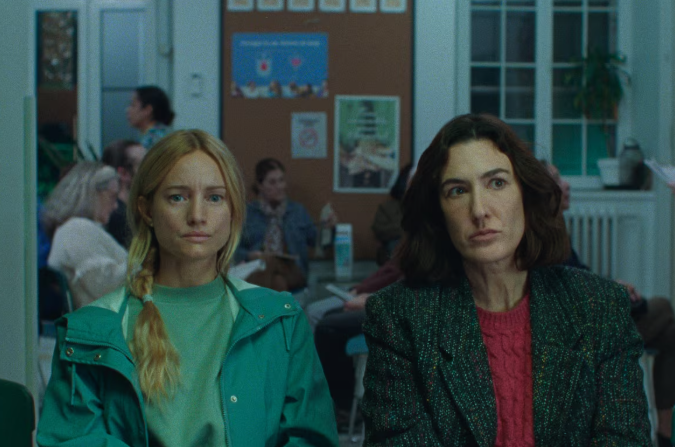
BH: Absolutely. I feel like it’s one of the best written scripts I’ve seen in a long time because the tone is so precise, balancing between the funny and the knowing of these characters who feel trapped. I knew this movie was for me once I saw Florence and Violette interact for the first time when they’re discussing the crow sound. Laurence and Karine, what informed your performances of these characters?
LL: I think their meeting is cathartic for both of them. Violette is fascinated by this woman and is like, “Oh my God, I can actually maybe emancipate myself with this.” They’re teeming with this energy, which I think stays throughout the movie and feeds these characters. The arc is nice in that way for my character because she really awakens throughout the movie. So it was this friendship that I carried with me.
KGH: As you were asking your question, I was thinking — and maybe this is a basic answer — but all the answers were in the script, to be honest. Everything was really well-scripted, so there wasn’t much thinking to do. For my character, the thinking I had to do with Chloé was, “How does she emancipate physically? When is she naked? When is she not naked? How do we present the sex scenes? What’s that like?” It was important for us to make sure that those bodies of those women and their characters weren’t objectified, so it was interesting to think about the little details. Are we going to show the breast, or are we going to show the lower part of the body? We mostly decided for my character to show the lower part of the body because it’s somehow less fantasized, I think. We wanted to anchor the nudity in a day-to-day process, and that informed the way to act.
BH: I’m glad you brought up the nudity, because the dialogue is so precise and so well done between the characters. It’s filmed in a very limited space. It’s two apartments, basically, and you have these conversations that happen in front of children, but you also have to be sly about how you’re talking. Chloé, did you have a sense on how these conversations were gonna happen, or were you improvising?
CR: Like you said, the script was so precise that it’s not a film that I was not going to improvise in terms of dialogue. When we tried, it didn’t make the cut. For the scenes with the kids being around, it was fun to play with because it added to comedy. I’m thinking about the famous scene in the trailer where Florence talks about monogamy. It was written when the kid was there, and that was the only thing that was in a script. Since the apartment was so small, I had this idea of having the kid being near the space, but with headphones. The husband is also in the office, and he has headphones, too. And he’s working, and it adds so much to the comedy.
BH: I think we could go on about the script, because I really loved it. There was one line that Florence says about being balanced doesn’t exactly make you happy that really spoke to me. This question is for Karine and Laurence: were there any lines that spoke out to you personally, or anything that you were excited to do on screen? Not because it was shocking or transgressive, but maybe something that felt freeing.
LL: There are so many good lines in this movie. We still sometimes say –
KGH: -“C’est beaucoup.” You know, the line from the book of Catherine Dorion where she [excitedly exchanges lines with Lebouef in French]
LL: Something like “Il y a une panoplie infinie de types…” and my character is not sure if she understands.
KGH: To be honest, I don’t even remember. [to me] You have to understand, we shot that two or three years ago.
LL: What about the one with your husband? The one that she or he says, “Our relationship is better off when one of us is on antidepressants.”
KGH: I think this is the first time that I said this in an interview, or even to [Chloé and Laurence], but a part of me was excited to have these weird sex scenes. I was really curious to see where we’d go with that. What’s always exciting for an actor is to do something that they haven’t done before, right? In that movie, there was a lot of that, for many reasons, but all these intimacy scenes and having to be naked, like how are we gonna do that? All those details were frightening and exciting.
BH: What has been the reception [for this movie] like? Do you hear from a lot of women or men?
CR: I knew that we humbly had a good film, but I was surprised how much it resonated with different people. Even the younger generation, like 18 to 25, went to see the film in theaters. I just thought, they don’t have kids, they’re not married yet, but I don’t know, maybe they project themselves and what they see in Florence and Violette is inspiring for them. I had a lot of comments about younger mothers, for sure, and how it spoke about motherhood. But also from men that went through divorce or in stagnant relationships that felt compelled by the film.
KGH: It also reached the generation before us, like our grandparents, because the movie was done in the ‘70s.
BH: That’s so cool. I think this movie allows exploration of being able to try something, even if there’s no reward for being good, as the movie says.
KGH: I also want to add one last thing. It’s a movie about reconnection with yourself. In a world where we’re always running to do everything and to be perfect, we have so much on our shoulders. I think it resonates for everyone when you have that moment where you stop and you’re like, “Wait a second. Am I happy? Is this what I really want? I feel like I’m on cruise control. I think I’m in depression, and what do I need to do to reconnect with myself?” It’s through their bodies that they’re gonna do it. I think that’s why we got such a wide range of people watching that movie, because it’s a very universal theme.
Two Women (Deux femmes en or)
2025
dir. Chloé Robichaud
100 min.
Opens Friday, 4/24