Bob Odenkirk has long sat at the intersection of comedy and drama. He made his name in the ‘90s as the co-creator and star of the cult sketch show Mr. Show with Bob and David, in which he played the most absurd characters with such conviction that you couldn’t help but believe them. More recently, he has reached a new level of fame as unscrupulous lawyer Saul Goodman on TV’s Breaking Bad and its spinoff, Better Call Saul, injecting the grim proceedings with a streak of unpredictable humor. In the years since, the revered comic (who cut his teeth in the writer’s room of Saturday Night Live in its heady early ‘90s days) has enjoyed a second career of sorts as an unlikely action star, most notably in the 2021 beat-em-up Nobody and its sequel.
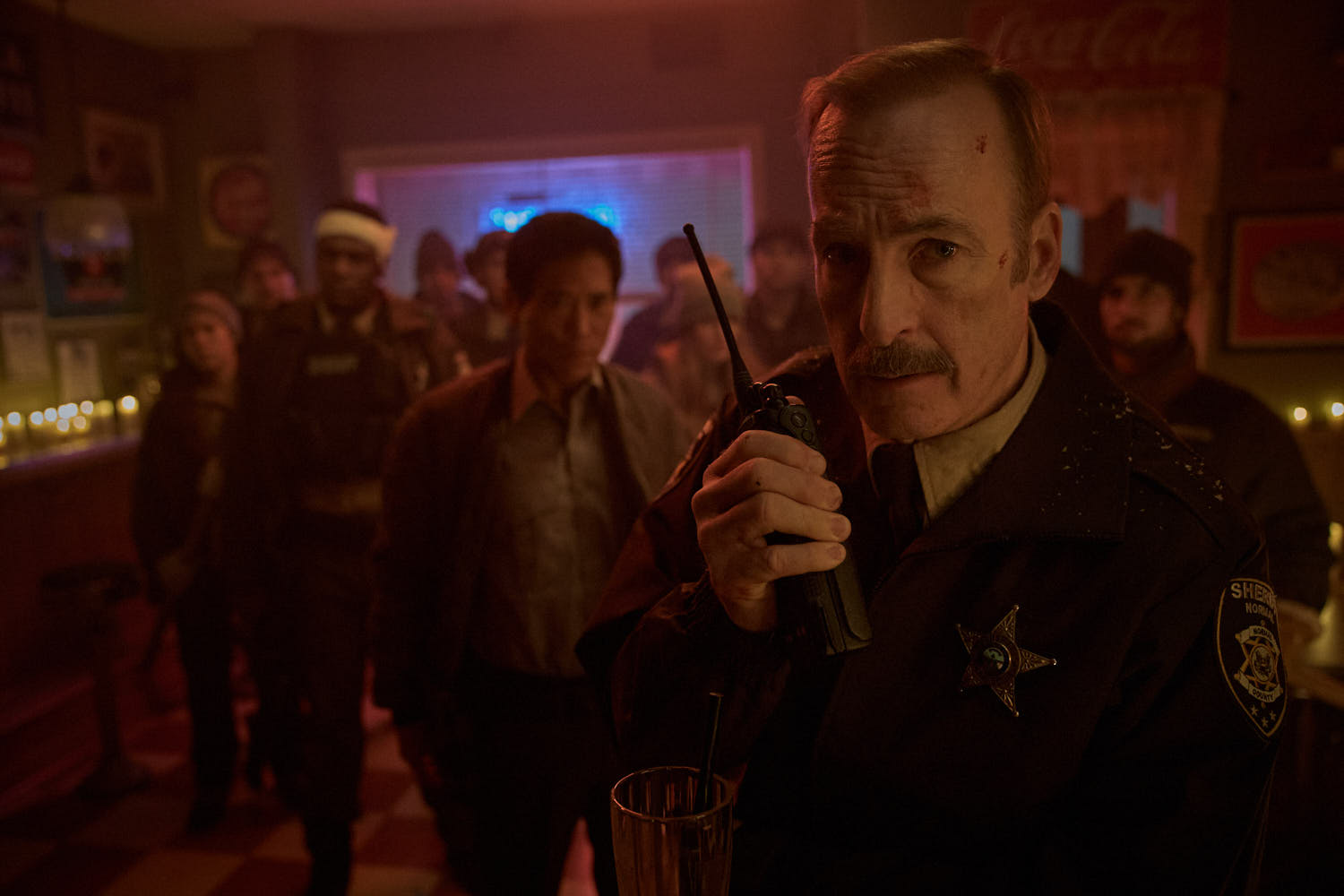
Odenkirk’s latest film, Normal, is perhaps the clearest intersection yet of these parallel career arcs. Created with Nobody screenwriter Derek Kolstad (also the man behind the John Wick franchise), Normal casts Odenkirk as the soft-spoken Ulysses, who takes a job as interim mayor of a sleepy Minnesota town— only to realize the town is not quite as sleepy as it appears. I sat down with Odenkirk and Kolstad on the morning of this year’s Boston Underground Film Festival (where Normal screened as the opening night selection) to talk about the delicate balance of action and comedy, working with director Ben Wheatley, and the joy of blowing up cars. (This interview has been lightly edited for clarity and flow.)
BOSTON HASSLE: You guys are both credited on the screenplay, so I’m curious how the movie came about.
BOB ODENKIRK: [to Derek] Well, I wanted to talk to you about this, because I’ve been telling that story, and you’ve probably been balking at my version. I remember you sending me three, not full outlines, but three paragraphs on different stories. And I was like, “That’s the one.” The one that has the suspense element… This one had a town, [and] a temporary sheriff. Something’s weird or different about the town. They have money. And I don’t want to give away the movie in the article here, but I called you and said, “This has this suspense chapter of my character, Ulysses, trying to figure out what’s going on in this town.” And that really made me excited, and that’s the part that I contributed to, story wise: here’s the ways in which he’s hanging out in the town and discovering something is a little amiss. I was given story credit by Derek, who then wrote the screenplay all by himself. But you remember it differently. And they both may be true,
DEREK KOLSTAD: They’re both true, because I remember sending you that, [but I also remember] we were on the set of Nobody with Mark Provissiero, who’s our producing partner here. And he was like, “What are you working on?” I was like, “I wrote this thing last night.” And then time had passed. It was the strike, and we couldn’t do anything. You get spec. And [Bob’s] like, wanna do that one? I said yeah. And so we blew it up and rebuilt it. And what I really like about it is, it exists in a world that John Wick and Nobody could exist in, but it’s very different. Because I think Hutch [from Nobody] would run towards danger, and Ulysses would stand there going, “Nah.” You know, until you become the begrudging hero.
BH: Speaking to the setting, I know you guys both grew up in the Midwest. Did you find yourself drawing from any sort of real experience when building the world of this town?
BO: Definitely. I kept thinking about the towns in Nebraska. When I made the movie Nebraska, the Alexander Payne movie, [I was] driving through all these towns that were half shut down, or maybe more than half shut down, and that was the kind of town I was picturing. But [this] town has this secret. It’s half shut down and it’s half totally fine. Really nice! People are chipper. They’ve got a nice yarn shop with a lot of yarn in it. They’ve got a good old fashioned hardware store. They’re kind of doing okay. So something’s wrong, because in the real towns like this, if it’s a farm town, the factory farms have taken over, which means there’s fewer people to work the farm, fewer jobs. And if it’s not a farm town, it’s a factory town, and that is probably worse. I definitely drew from the towns I’ve seen and been through the last 25 years.
DK: A lot of towns I knew growing up, the only chain was maybe a Hot ‘n Now, or a Subway in a gas station outside of town. And then you go through the town, and there’s maybe a diner, and a bunch of closed storefronts. So we talked about the rust belt all the time.

BH: I love the opening scene where you’re going through and it looks normal, but then you see the signs, like, “We raised $16 million!” And it’s one of those things where you look at and you don’t think of it, but then it’s like, “Oh, wait, that’s a lot of money!”
BO: Yeah. We went with 16 mil, because 16 mil felt like… There are government grants and things that a town could get maybe a mill or two. It could be a rich person who used to live in the town. You could get a million or two, but 16, almost $17 million? I don’t know, man! Where’s that coming from?
DK: It gives you pause.
BO: That’s just a couple million too many.
BH: I really like the balance in the film of optimism and cynicism. Everyone’s really cheerful, and then you have this very, very dark underbelly. What was it like, balancing those two tones?
DK: It’s tough, but it’s fun.
BO: It’s a shift, and that’s the thing. It’s a big turn. This is a film with chapters to it. Again, one of the reasons I wanted to do it is, I haven’t seen that many action films. It is a new area for me. They can be great as a pure chase scene, or as a one-note exploration. But my feeling is, I’m attracted to a story that has these chapters that are quite different from each other. It’s fun to do the first half, which I call the Lake Wobegon half, and do the cute small town people with their minor key problems, with some kind of unsettling air running through it all.
DK: And the other thing too is, [Bob’s] a writer, man. We gave the script supervisor a heart attack the first couple of days where he would give me notes 15 minutes before the scene. And I still remember, Ben [Wheatley] called me on the fifth day of shooting, and he’s like, “We’re about 15% [too dark].” And so we went through, and we just kind of redesigned in such a way that the balance worked. But it was every day, every scene, going like, you don’t want to go too far one way or the other, and ultimately give the editor what they need. It was a joy, but it was tough.
BO: One of the challenges is, the town has a secret. You want an audience who’s paying attention to smell that, but if they know it for certain, or if they know what the secret is, then it’s not a secret anymore, and you blew it. So it’s got to have this unsettling undercurrent of, “Something’s wrong here, but I can’t put my finger on it.” It can be very hard to decide. There were scenes and moments that pointed to it a little more in that opening chapter, where Ulysses is getting to know the people and the town’s vibe. It’s early in the movie, but that armory is the biggest tell, with the amount of munitions in there. Of course, the audience knows, “Oh yeah, all those guns are gonna be put to use!” [laughs]
BH: That’s a lot of Chekhov’s guns!
BO: Isn’t that great? People who know story are like, “Oh shit, they’re gonna pop all those guns out of there! When? How?”
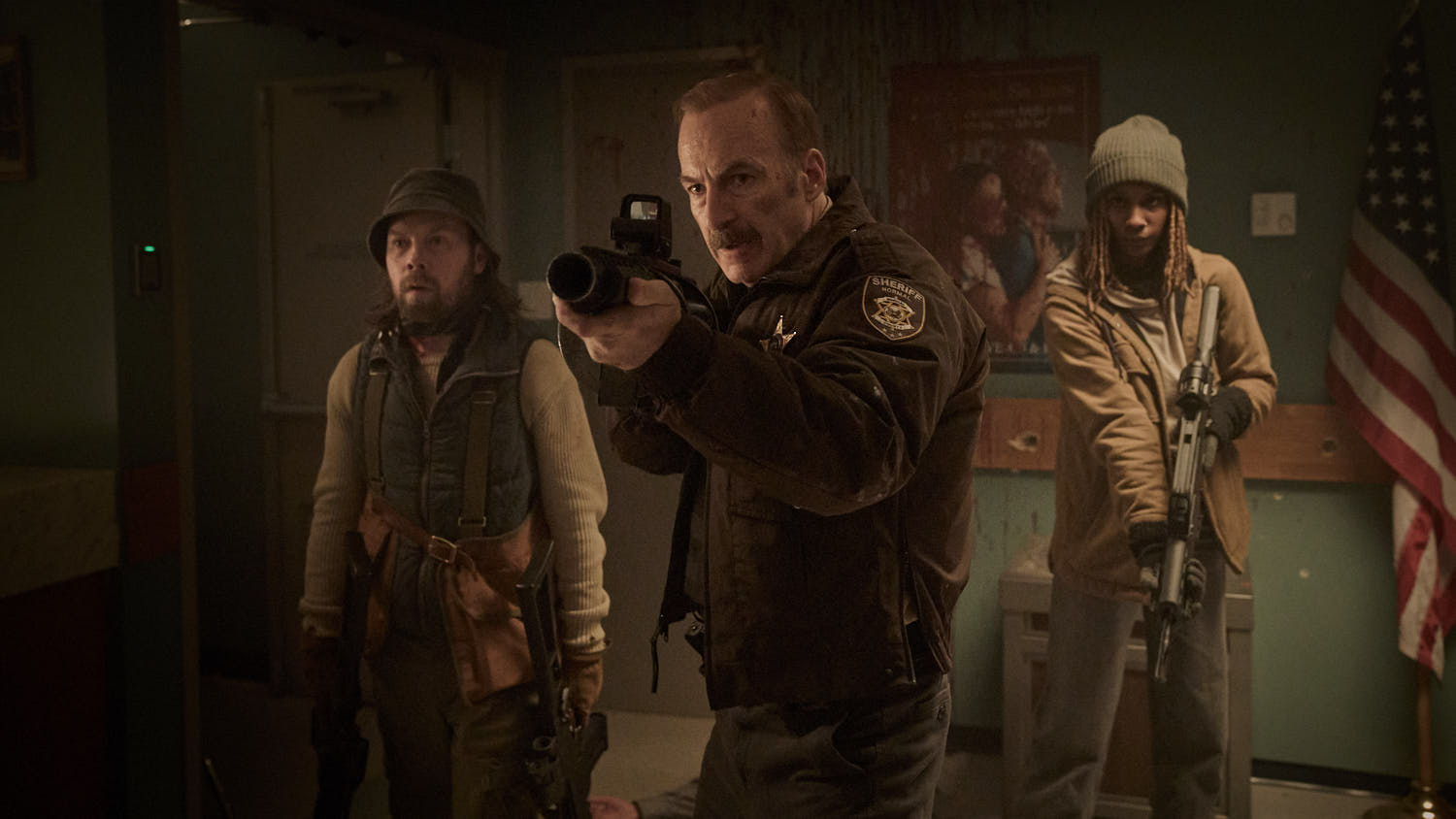
BH: The other major force in the film, of course, is Ben Wheatley.
BO: Ben made this his own. If you know any Ben Wheatley films– and if you don’t, you should go watch some of them. He’s just great, funny, always entertaining.
DK: His filmography is like a bingo card across the genre-scape. You watch one like Kill List and you’re like, “I am so depressed.” And then you watch Free Fire, [which] was the one that we watched. We were like, “Fuck yeah. We need this guy for this.” And we had talked to a bunch of directors, but he was the guy. Within 30 seconds we were texting each other, going, “This is our main man.”
BH: Did he shape the film at all? What would you say were his contributions?
BO: I think he shaped the film to make it a Ben Wheatley film. But, Derek, you could probably speak more specifically to the way he does that, because the script has all of these elements that he used. Derek, have you ever written a script that was meant to be as much of a comedy as this one?
DK: No. That’s where Bob and Ben came in. And the other thing too about Ben is the heart attack a director gets when you read a screenplay and the whole thing takes place during a snowstorm. Like, shit, how am I gonna do that? But the joy about Ben is, we want to do as much practical [effects] as we can. There are three or four establishing shots that are miniatures. There’s a scene that takes place on a plane, and he shot raw footage on the flight over from the UK, and then threw it up on a TV we got at Costco and put it outside the window. At a certain point he had made cotton clouds that he hung outside. And we’re shooting it, and he’s like, “What do you think?” I was like, “It looks like Pee-wee’s Playhouse!” And he’s like, “That’s not a bad thing!” He’s bringing in the stuff that you did in Film 101, but to the level that is Ben. It’s just awesome.
BO: He’s an incredibly inventive filmmaker. And he’s been making movies since he was, like, 12.
DK: And he was open on set to everybody. He wasn’t cloistered up in the video village. We would be watching a scene, and he would then say, “Remember that scene in Long Kiss Goodnight? And we would riff on that, and that was his love language. He was open to “best idea wins,” which is a tough thing to get to.
BH: Derek, we talked a little bit about how this is one of your first comedy-comedies, and of course, Bob, you have such a strong background in comedy. I’m curious how both of you applied the one strength to the other– bringing action to comedy, and then bringing your comic background to this action movie.
BO: Well, it’s probably a little bit harder for me, because I would just do full out comedy, and I’m very aware that if you do that, you probably break the level of tension that you need to have for the movie to work. I just know that, left to my own devices, I want to make fun of every single thing that I’m doing and [everything] that is around me! [laughs] But you can’t make an action movie where it’s just ridiculing itself all the time. Unless that’s all you do– unless that’s your movie, if it’s Naked Gun. So it’s a tough one for me. I think the comedy in this came from me saying, “What about something here?” and then Derek writing the line, or me saying, “What about this line?” and him rewriting the line.
DK: One of the things we talked about on the first Nobody is realizing that a great action sequence is about the same length as a good sketch comedy bit. And iron sharpens iron, you know?
BO: Yeah, we were able to help each other. But in the end, Derek and Ben have to make those choices that you’re asking about. I mean, you know what I’ve done, you know Mr. Show— it’s just silly as fuck. You can’t do anything serious without making fun of it, you have to make fun of it right away. But you can’t do that in an action film. You have to have believable fear and tension.
BH: Speaking of the action sequences, did you have any particular favorite scenes?
BO: Oh, the kitchen fight. I love the hardware store fight as well, but the kitchen fight’s my favorite. Having this gun that’s loose, and then we have to both try to get it, and then using all the implements of the kitchen– the drawer, and the meat pounder. That to me, where you’re inventing stuff, where you’re doing close-up fighting, those are the most fun to me. Far away, shooting guns, it’s fine. It can be a laugh. You feel like a kid. But it’s the up close fights that are the most fun to me.
DK: What I love about Bob is, when you look at an action scene [in most movies], as soon as the camera goes behind an actor’s head, you know it’s not them. [But] he’s doing most of it! And that’s what I love about watching movies. The audience is smart enough to go, “Dude, that’s really him!” So all the action scenes are fun.
BH: And I’m sure it was even more fun with the practical effects, with everyone getting their hands dirty.
DK: We really blew up cars!
BO: Cars were flying in the air, man!
DK: You can taste it when you watch a movie going, “Oh, dude, they did that!”
BH: At the end of the movie, it feels like you definitely leave the door open for more adventures with some of these characters. Do you guys have any plans for any further stories?
DK: I had a long breakfast yesterday with Ben, and we talked stories, and we kind of broke it. But I love this character. And, again, we did this independently, so it’s ours. But I would do this forever, man. It’s been a joy.
BO: It’s a great team. We’re all aiming for the same target, this mix of humanity and humor and gritty action. So it’d be great to get carry on with this guy. I also like a character who’s my age. I’ve played a lot of people who are 15, 20, 30 years younger. Saul Goodman, at times, I was playing a guy who was probably 28, and I was 55, and that was not easy to do! So I really, genuinely love playing a character who’s around my age and maybe has seen a lot of life, is a little exhausted, and definitely a little wise to himself. And that’s Ulysses.
Normal
2026
dir. Ben Wheatley
90 min.
Opens Friday, 4/17 @ Kendall Square Cinema, Apple Cinemas Cambridge, Alamo Drafthouse Boston Seaport, and AMC Boston Common