It was perhaps inevitable that this seemingly endless cycle of corporate synergy-driven blockbusters would eventually make its way back to He-Man. The original Masters of the Universe represented a bold leap forward in merchandising: the toys came first, the animated cartoon crafted around them as a sort of weekly infomercial. Likewise, the new live-action Masters of the Universe movie (produced, appropriately enough, by Amazon) could be seen as an advertisement of sorts, but this time the product is not a line of action figures. Rather, what’s being sold is the memory of playing with action figures, to an audience mostly long past action-figure age. It’s diverting enough, as jokey popcorn pictures go, but it’s hard to shake the sense that its time has come and gone— a couple times over.
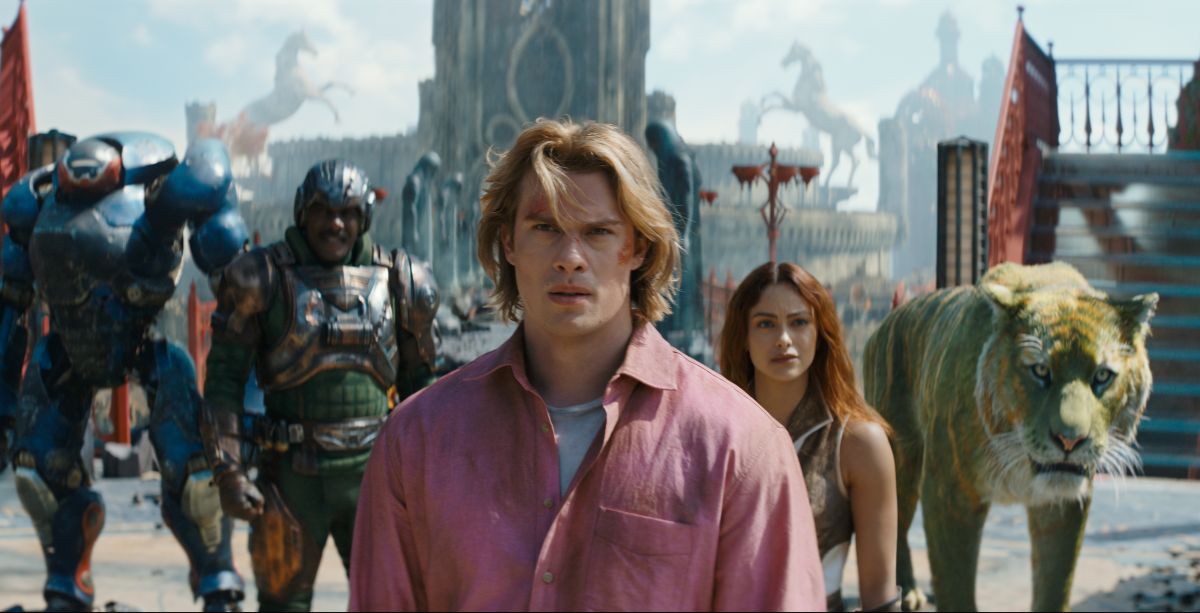
We begin in the fairy tale kingdom of Eternia. Young Prince Adam (played as a child by Artie Wilkinson-Hunt) is a goodhearted weakling, much to the chagrin of his father, King Randor (James Purefoy) and royal guard Duncan (Sir Idris Elba). Adam’s training is interrupted when the kingdom is attacked by the legions of the wicked Skeletor (Jared Leto, who’s certainly taking his sweet time to get cancelled) and Evil-Lyn (Alison Brie). The prince is whisked away to safety, along with the Sword of Power which serves as his ticket home. Unfortunately, Adam loses his grip on the sword in the wormhole, leaving him stranded in a place worse than purgatory: Oklahoma City.
Fifteen years go by. Adam (now a beefed-up Nicholas Galitzine) has grown into a mild-mannered himbo, working as an HR manager in a generic office block while desperately spamming Reddit with posts reading “HAVE YOU SEEN MY SWORD?” Improbably, he gets a hit: the sword has been incorporated into a cheesy display in the back of a local comic shop. Adam retrieves the sword and returns to his home, only to find that Eternia isn’t what it used to be— and that life on earth has made him even softer than he was before.
Masters of the Universe has taken an even more torturous route to the big screen than its musclebound hero takes to Castle Grayskull. It’s been in one stage of active development or another for over 20 years, with a revolving door of attached talent and studios; the final version has no fewer than six credited screenwriters, with god knows how many decades’ worth of script doctors behind the scenes. Perhaps understandably, the result is overstuffed, with characters and themes passing in and out of the narrative (a seven-foot-tall killbot voiced by Kristen Wiig tends to fade into the background of scenes, something I would not think a character by that description would be able to do). Counting the rings, I found I could detect trace elements of at least four different drafts: one written after Lord of the Rings, one after Thor, one after Guardians of the Galaxy, and one after Barbie. Taken in this light, Masters of the Universe is somewhat fascinating, a history of 21st century blockbuster filmmaking trends condensed into a single, somewhat ungainly film.
Of those hypothetical drafts, the Barbie version is the most successful. Even the most ardent fan will likely admit that Masters of the Universe is more than a little ridiculous, and the film is at its best when it leans into this cartoonishness, both in the “real” world, which seems to be populated mostly by Edgar Wright-style caricatures of normality, and in Eternia, with its flamboyant warriors and their gonzo superpowers (in a clever touch, these characters’ doofusy code names— Fisto, Ram-Man, and soforth— are revealed to be Adam’s childlike nicknames for the grownups in his life). Also like Greta Gerwig’s playing-with-dolls opus, Masters reveals a surprisingly thoughtful streak interrogating the gender roles reinforced by the steroidal action figures. This isn’t the Pride Month camp classic it might be (though it does feint in that direction more than once, particularly in the lingering shots of Galitzine’s loincloth), but there is some real stuff here about what it means to project traditional masculinity while staying true to yourself and striving to be a good man. Really, it should be no surprise that He-Man is a sensitive sort; he was decades ahead of the curve in clearly stating his pronouns.
Unfortunately, the Barbie draft can never quite overpower the quippy iterations penned during the Marvel era. Nearly every character speaks in Chris Pratt patter, constantly winking to the audience and letting them know they’re in on the joke. The result is a film which too often feels embarrassed by its excess; introducing the Sword of Power in the opening narration, Adam sighs, “Yeah, I know. That’s what they called it.” For every outlandish fantasy concept, there is an extended scene of the characters smirking at how stupid it all is. And look, it is stupid, but this sort of material is a lot more fun when it owns its own stupidity— consider Steven Kostanski’s gloriously boneheaded Deathstalker reboot, which clearly delights in its own excess. I’d never ask a Masters of the Universe to take itself seriously, but it can at least have the guts to keep a straight face.
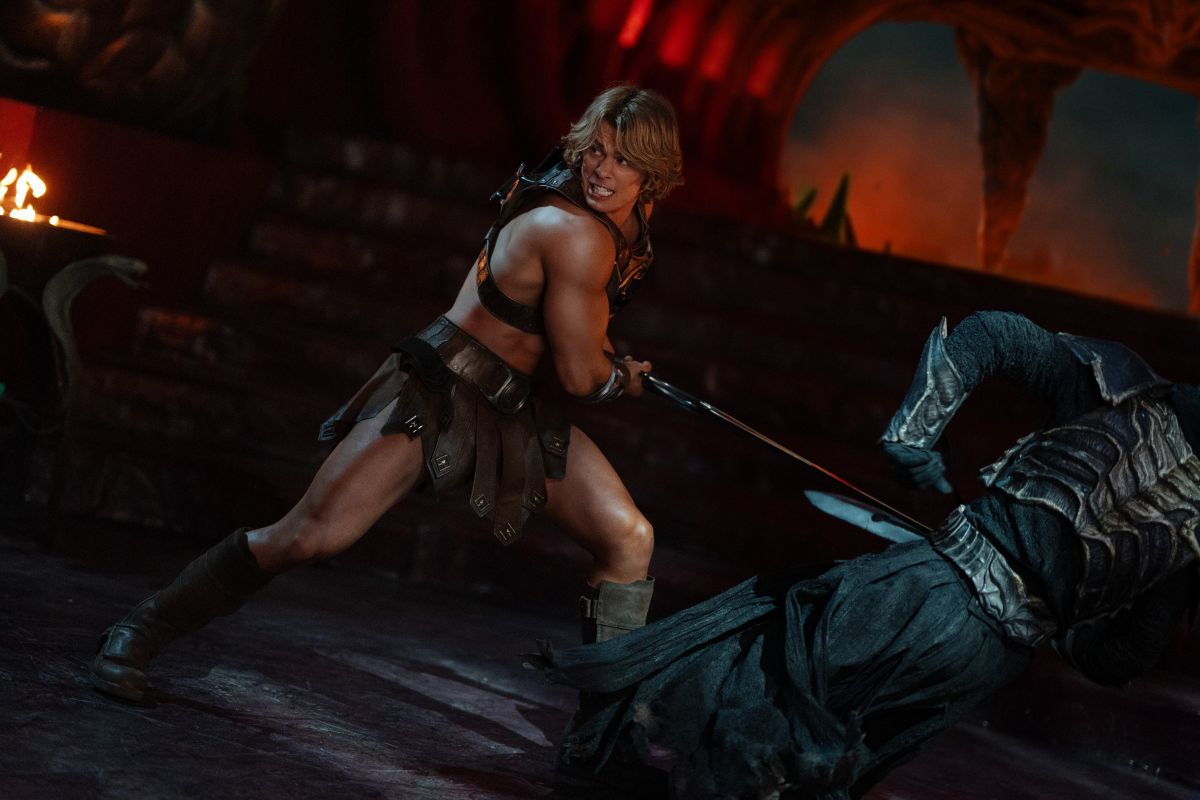
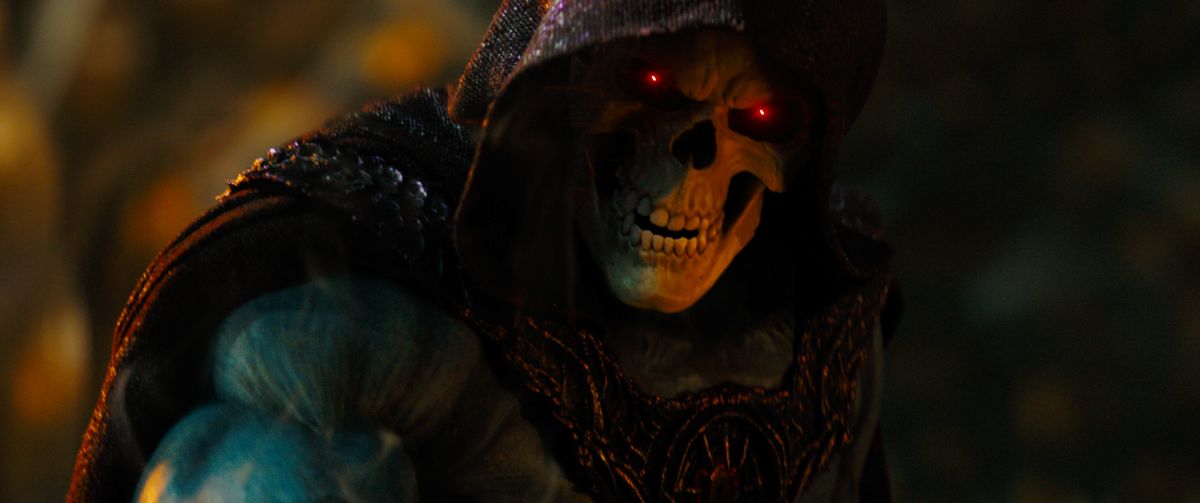
That being said, the decades-long development did allow the producers to land on the right He-Man. Galitzine has a dopey earnestness that even the snarkiness of the script can’t deflate, and it’s largely thanks to the conviction of his performance that the film works at all. Of the supporting cast, Brie comes closest to capturing the manic energy the material demands; she vamps and mugs, but keeps the winking to a minimum. Leto, for his part, delivers something of a Ship of Theseus performance. His physical presence is mostly replaced by a CGI cartoon creation, while his voice is pitched down into a strange British baritone, creating the relieving effect of not really watching a Jared Leto performance at all. Not coincidentally, this is the most entertaining the actor has been since his similarly unrecognizable turn in House of Gucci. Still, one wonders why the producers didn’t simply cast Matt Berry, an actor who actually sounds like that, and who people actually like, and whose salary is probably magnitudes lower than Leto’s. There’s probably some internal calculus that dictates that an actor of Leto’s fame guarantees x number of ticket sales— but who’s buying?
The same question might be asked of the Masters of the Universe audience at large. This is a nostalgia play through and through— but whose nostalgia? I’m a few years too young to have been swept up in the original wave of He-Man mania, and I’m on the wrong side of forty. Hollywood has been chugging along on IP and reboots for the better part of two decades now, and for the most part it’s been a lucrative business plan. But nostalgia is a non-renewable resource; the original audiences grow old and die, and younger audiences can only forge so much emotional connection to warmed over medleys of hits. It’s tough to shake the feeling that Masters of the Universe represents the end of the old way— but what happens next?
I got a possible answer immediately following my press screening, which also included members of the public. The event was well-attended and -received, the audience spilling out into the aisles discussing various Easter eggs and callbacks. But then a funny thing happened. A screening of Obsession let out at precisely the same time— seemingly packed, despite it being a Monday night three weeks into its run— and the difference in energy between the two crowds was eye-opening. The dozens of twentysomethings who had seen Obsession were palpably buzzing: picking apart the final scene, trying to remember the last time they’d been that scared, wondering how poor, stupid Bear managed to fumble two baddies so badly. To see a wave of moviegoers that excited, not by marketing or fan service but by an actual good movie, was heartening. Can this sort of unforced word-of-mouth enthusiasm at long last effect a vibe shift in the Hollywood-industrial complex? To turn a phrase: we have the power.
Masters of the Universe
2026
dir. Travis Knight
140 min.
Opens Friday, 6/5 @ Capitol Theatre, Kendall Square Cinema, Apple Cinemas Cambridge, Alamo Drafthouse Boston Seaport, and all local AMCs