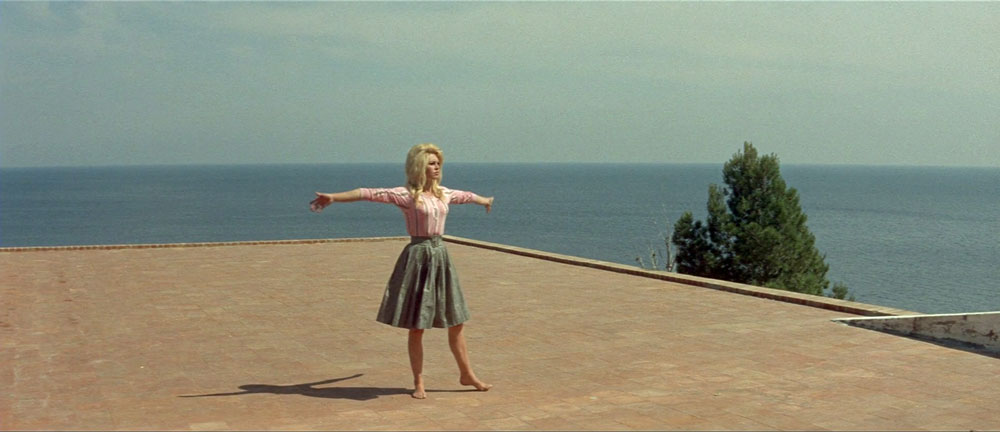
Jean-Luc Godard’s Contempt (Le Mépris) is a strikingly modern, depressingly intersectional romance drama about sex, death, destiny, and life’s miseries, and a breathtakingly shot/composed romance drama about a filmmaker’s lost love. Backboned by a current-day take on Homer’s Odyssey that Godard both utilizes and criticizes, Contempt is as distinguished in its socio-cultural, interpersonal, and religious understandings as it is depressing in its central duo’s gutted-out relationship. Paul Javal (Michel Piccoli), a young French playwright whose Roman commercial success has earned him some attention, is offered a role in helping rework legendary real-world filmmaker Fritz Lang’s screen adaptation of Homer’s Odyssey by a piggish American producer named Jerry Prokosch (Jack Palance). Immediately facing trouble due to the producer’s and Lang’s conflicting views on Odyssey’s sex scenes on the big screen, Paul’s professional conflict quickly turns personal as his stunning wife, Camille (Brigitte Bardot), becomes disconcerted by his involvement. With Camille’s eventual admission that “I don’t love you [Paul] anymore…[;] I’ve changed my mind about you” surfacing, Paul loses himself in the chaos of both as Odyssey begins to parallel his own desires and dynamics with his wife. He’s got nothing but the serenity of Capri Island’s many earth-carved hills, bottomless blue seas, painterly bright skies, and some culturally opposing filmmakers to figure out the next steps.
Contempt questions everything many presume as given in their daily lives, and far too much to cram into any one piece on it. While much may not shock the averagely educated moviegoer, Jean-Luc Godard’s ahead-of-his-time perceptions of our reality—from religions and the true, educationally introspective purpose of their gods, to the very foundations of our personalities and goals when contrasted with life’s end—nevertheless hook with their comforting discomfort. With Paul himself not the most likable protagonist as he melodramatizes his production difficulties and slaps Camille when she refuses to communicate her issues, Godard sticks viewers in an observational chair as he narrates the film’s opening credits with André Bazin’s conception of cinema: “The cinema substitutes for our gaze a world more in harmony with our desires.” We’re angled to interact with both the film’s demonstration of a desire-harmonious world through cinema and its criticisms of how we make everything much grander for ourselves than it is. In both examining Odyssey and extracting its characters’ human traits, Paul (with much-needed guidance from Fritz Lang’s wisdom) knocks the gods down a peg to mere reflections of humans’ deepest traits and most valuable lessons: “Greek tragedy was negative in that it made Man a victim of Fate, as embodied by the Gods, who abandoned him to a hopeless destiny.” While that “negative” gradually fades into this set of Contemptuous characters’ lives—Camille says the above in reference to her and Paul’s love reaching a fateful end—Gods become little more than embellished figments of depressing realities: sometimes we have to do things we don’t want to do, as fate calls for. In God’s absence, as Fritz reminds Paul, it is “Strange, but true” that those faithful find reassurance; if created in His image, we have the “arms and wile” to fulfill each other and resolve complicated issues. Unfortunately, as His lessons (or those of the Greek gods or whoever else comes to mind) continue to feel too human, it’s all too clear that such “absence” actually means we’re entirely on our own to figure ourselves, each other, bodies, and the world out.
Amid all its haze, Camille becomes the real lover in Contempt’s Odyssey-esque romantic tragedy that viewers root for. Unlike the rest, except maybe Lang, her priorities are more practical: she works as a typist to help her once-passionate husband achieve his dreams so they can eventually live happy, stable lives. No confusions about any holy existences or moral grayness dwindle in Camille’s mind. When Paul accepts the filmic Odyssey rewrite, she immediately recognizes in him what perhaps Penelope did in her husband: disinterest—”absence.” Even so, she sticks around, though not without eventually admitting her change of heart on her increasingly superficial husband when he insists she come to Capri with him (because, apparently, if she doesn’t communicate or support, “Why’d I marry a 28-year-old typist?”). She merely resigns to her fate in their corner-cut furniture’d apartment: “It’s not you that’s forcing me. It’s life.” If we can create entire gods to help cope with life’s pits, can we not do anything to avoid at least some of them, or is it life uncontrollably “forcing” us through the thick of it? For Camille, the answer speeds into view the same way her feelings changed: in a fast car driven by a bone-headed American. Regardless of Paul’s next steps, Camille’s fate shouldn’t be a tragedy, but perhaps life has different plans for her.
Contempt is thus an engagingly introspective film begging viewers not to self-prescribe unwanted fates. Things are more in our control than we think, and the longer we ruminate over the same useless moral dilemmas and turn inwards, the worse our lives and relationships become. Earth’s natural beauties and those of living fade when one turns inward. For Jean-Luc Godard lovers, ’60s European cinema fans, romance-tragedy enthusiasts, and those looking for an intellectual but seductive sting, Contempt is a depressingly intimate pick about choice versus destiny.
1963
dir. Jean-Luc Godard
102 min.
Screens Sunday, 5/31, 2:00 p.m. @ Coolidge Corner Theatre
Double feature w/ Nouvelle Vague
Part of the ongoing repertory series: Take Two