One might be tricked, in the opening scenes of When Fall Is Coming, into thinking they’re watching a cozy, somewhat wistful slice-of-life drama; in fact, if they’re not paying attention, one might maintain this belief through its entire running time. It certainly feels like the sort of movie you might take your grandma to see; its French countryside locations are gorgeously shot and accompanied by tinkling-piano soundtrack cues, and its characters by and large come off as pleasant and likable. But writer director François Ozon plays a tricky game, and there are currents of darkness swirling underneath that cottagecore exterior. It’s a thriller in which the thrills are nearly subliminal.
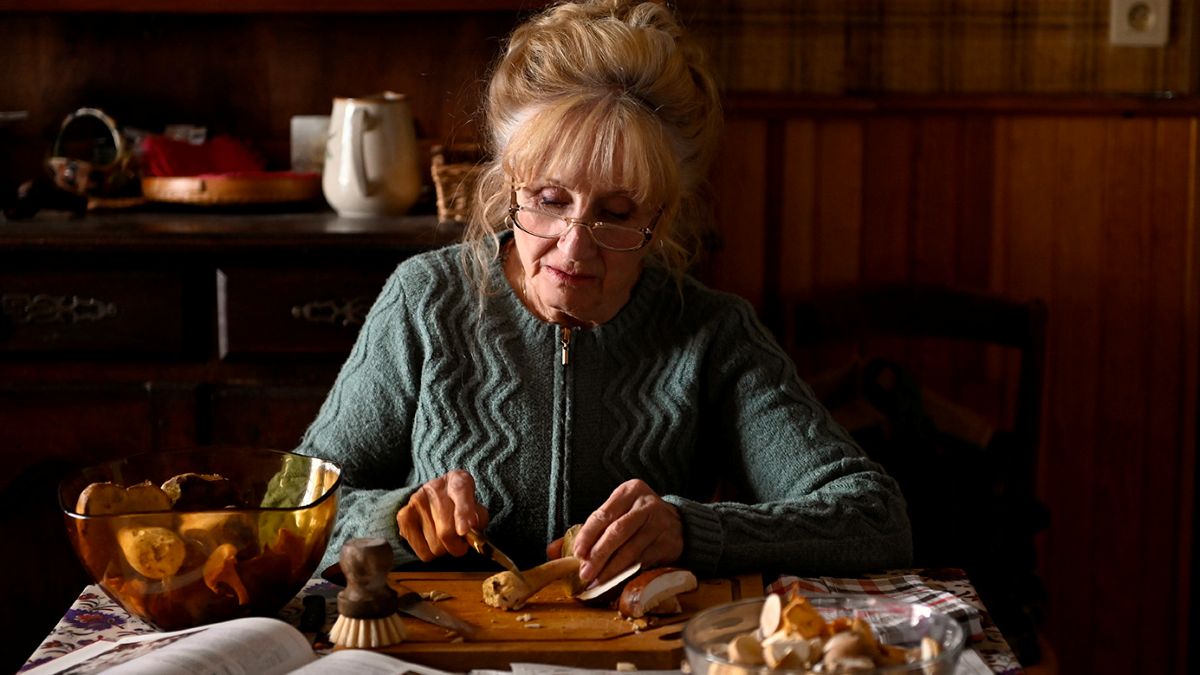
Grandmother Michelle (Hélène Vincent) lives a quiet life in her remote farmhouse, making tea, foraging for mushrooms, and driving her best friend to visit her incarcerated son. Her high points revolve around visits from her daughter Valerie (Ludivine Sagnier) and grandson Lucas (Garlan Erlos); Valerie, we clock early on, is distant and borderline hostile toward her mother, but the two seem to have drawn a truce over their shared love of the boy. What little peace there is is shattered, however, when Michelle accidentally serves her daughter some poisoned mushrooms; Valerie survives, but responds by cutting her mother out of her life. To reveal much more would be to spoil some of the cryptic pleasures of When Fall Is Coming, but suffice to say the relationships between these characters grow even more complicated as the situation develops.
When Fall Is Coming plays in a similar narrative space to the “Did she do it?” mystery of Anatomy of a Fall (right down to the title, which forms a pun I’m not sure is present in the original French). Ozon’s film, however, is even more slippery; as the story progresses, it becomes less clear who the “she” would be that question, or even what the “it” is. The characters are plenty talkative, but most of our real clues lie in meaningful glances or pregnant pauses (there is a brief gesture early on involving a telephone which I would be curious to revisit having now seen the entire film). No film should be watched with a phone in one’s hand, but that goes double for this one; it would not be an exaggeration to say that anyone watching with one eye on their feed would be getting less than half the story.
With a film of this nature it’s difficult, as a critic, to know how much of the plot I should reveal; my inclination in this case is to err on the side of caution, which means this may be a somewhat shorter review than usual. It’s no spoiler, however, to acknowledge that Vincent delivers a quietly powerful performance. When we first meet Michelle she is the embodiment of the sweet little old lady— supportive friend, loving grandmother, habitual tea drinker. As the film progresses, it’s not that any of that changes, necessarily, but we gradually learn more about who this person is— her past, her relationships with those around her— which makes us question our perceptions of her actions. It’s a tricky balance, but Vincent sells every moment of it. She is a sweet little old lady, even as we begin to suspect she might also be something a bit darker and stranger as well.
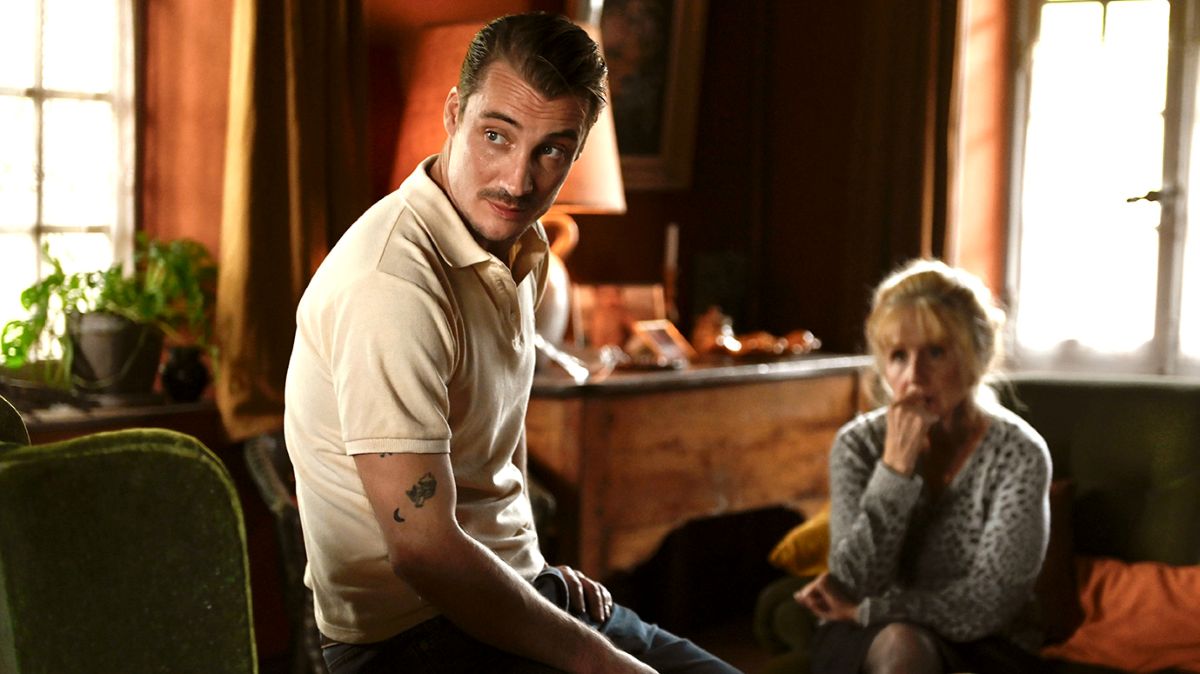
Vincent is matched by her supporting cast, which is as it should be; in a film like this, where so much lies in the unspoken, the performances need to be as finely tuned as possible. Ludivine Sagnier is darkly hilarious as Michelle’s daughter, who comes across so instantly unlikable and narcissistic that you find yourself rooting against her even in situations where she’s clearly the victim. Pierre Lottin, as Michelle’s best friend’s reprobate himbo son, is her counterpoint, clearly amoral yet so rakishly charismatic that one can see how those around him might gloss over his unseemliness. All of these characters are fundamentally broken in so many different ways that the fun of the film— if you want to call it that— lies in the fact that pretty much any answer to its central mystery feels more than plausible.
When Fall Is Coming has the peculiar distinction of being this season’s second understated psychodrama set in rural France with a notable subplot involving mushroom foraging, following Alain Guiraudie’s Misericordia. The two film are, at their core, quite different— Guiraudie’s film focuses on free-floating desire, while Ozon’s is more concerned with unspoken guilt and resentment— but they share the certain cryptic gauziness that tends to hang over a small town in which everybody knows everybody whether they want to or not. They also share a bone-dry sense of humor, and that feeling of uncertainty when you realize you’re not entirely sure which movie you’re watching. Between the two of them, I have a feeling I’ll be watching my back the next time I find myself in a village outside of Paris.
Films of this opacity aren’t for everyone, of course, and those with little patience for subtext (or with a limited attention span) may find themselves getting antsy. But Ozon has crafted a deceptively intricate little puzzle of a film which sticks in your mind; in the days since watching it, I’ve found myself landing on a few different explanations for its events. As thrillers go, this is an uncomfortably plausible one; few of us will ever find ourselves dangling off Mount Rushmore or helming an explosives-laden city bus, but the dynamics here are so familiar that the more dramatic events are even more horrifying. It is, if nothing else, an apt release for this Mother’s Day weekend— though you may feel awkward bringing your mom to see this one.
When Fall Is Coming
2024
dir. François Ozon
104 min.
Opens Friday, 5/9 @ Coolidge Corner Theatre