
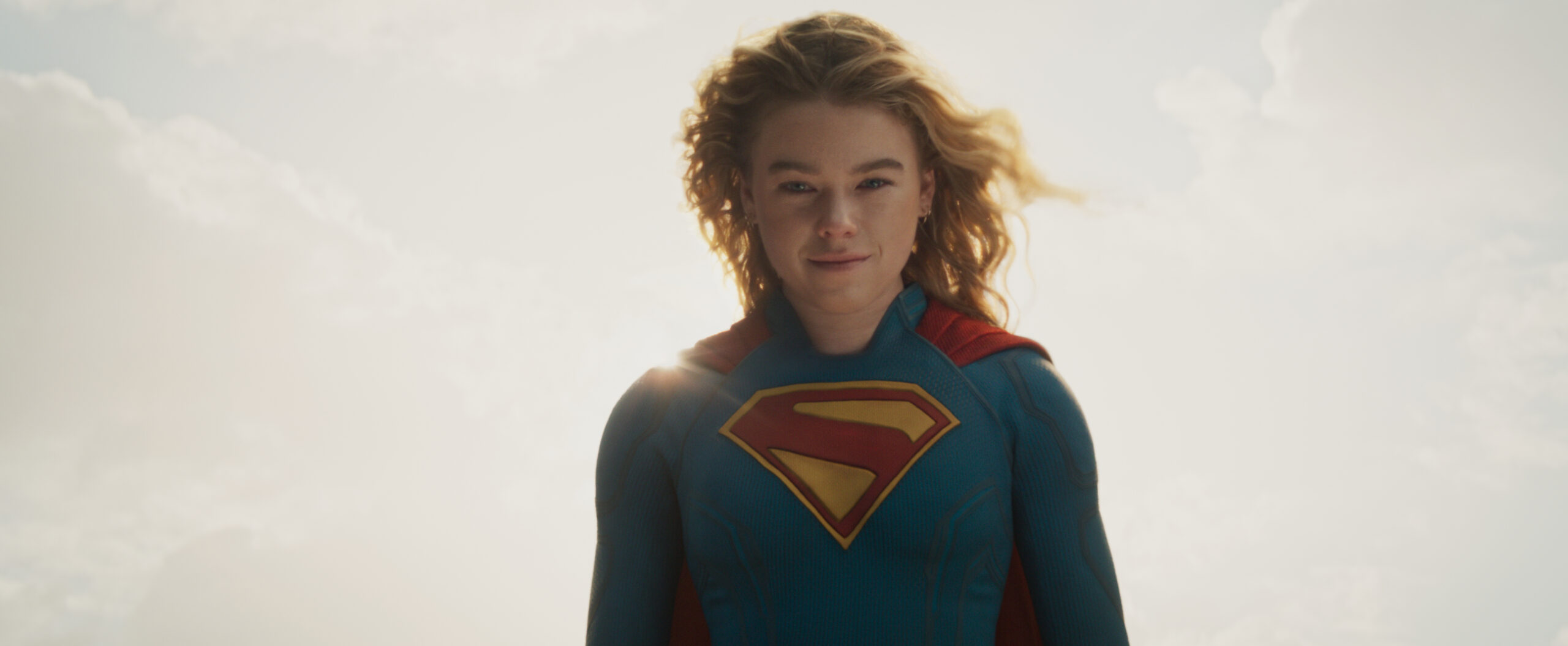
Youth can be more stressful than given credit for. People like to romanticize it as a “simpler” or “better” time when they get older—especially when looking at their childhood, teenage, and young-adult years—but in reality, it’s often just as difficult as the rest, if not more so. On top of the normal coming-of-age stresses like puberty, social anxieties, school, future-building/career planning, and the piling-on of new responsibilities year after year (not to forget the endless bills and eventual debt!), non-age-related problems also shape people and how they interact, act and react. Sometimes, life doesn’t care how old you are when it kicks your ass before leaving you eight shots deep in a dive bar. It sure didn’t for Kara Zor-El (Milly Alcock), Supergirl’s starring super-alcoholic and the more jaded cousin of Kal-El/Clark Kent/Superman (David Corenswet), whose arrival on Earth as a late teen occurred under more brutal circumstances than her Kansas-raised family. Jump to now and beyond the events of James Gunn’s Superman, and it’s clear Kara’s still not adjusted or coped with her loss; she drinks and faux-laughs the time away on a planet where her powers are inert in the name of celebrating her 23rd birthday for way longer than just a night. Supergirl thus delivers a rudimentary yet relatably bittersweet gaze at a girl wedged between two horrid phases of life. While stuck in misery, a warrior-looking younger girl, Ruthye Marye Knoll (Eve Ridley), pleads in the same joint for someone to avenge her family’s murder at the hands of Krem of the Yellow Hills (Matthias Schoenaerts) and his band of space-pirating, human trafficking Brigands. Initially indifferent, Kara quickly becomes vengeful herself when Krem paralyzes her super dog, Krypto (last seen in Superman), who can only be cured by an antidote wrapped around Krem’s neck. Agreeing to help Ruthye, the pair explores different realms in an angry search for their shared foe and, although unknowingly, new ways to cope with loss without losing control of themselves or their futures. May they find better means of survival so they can finally start living.
One thing should be clear from the start: Supergirl is not as well-composed as Superman. Dialogue is more often bloated—”I hope I never end up like you, ever!” Ruthye says, begging for big violin strides that never arrive—the storyline’s a bit more generic, and Supergirl’s certainly less refined in its thematic interplay vis-a-vis the villains this time around. Does that mean Alcock’s solo time with the cowel thuds? Absolutely not.

Supergirl accurately demonstrates the pains of being forcefully displaced to a world you don’t belong to, and what that and vengeance look like in a young soul. Kara has all the telltale signs of a troubled youngin’ as advertised in anti-vaping or mental health advocacy blurbs; opening on a montage of party scenes, drinking, fights, and other dumpster-spelunking chaos, it’s clear she’s running from… something. But what, exactly? Unlike her good-for-goodness-sake cousin, she doesn’t see the universe or its inhabitants for their purity, but expects their flaws to ugly things in the universe: “Clark? No, he’s a fricken nerd…. I don’t know, he sees the good in people, [and] I see the truth,” she says when asked what’s so different between them. She sees his positivity as a blinding veil that she avoids entirely (whether that’s in part a reaction to him or not is up to the DCU’s future to demonstrate). Unlike Clark, Kara’s life is marked by tragedy and disappointment (not to be spoiled here, of course!), and the only true companion she has, Krypto, can’t even speak her language. It’s easy to remember one’s own lonely struggles we all face time and again, as Kara pontificates in Supergirl’s opening intergalactic pub, “Maybe this is home,” fiercely demonstrating how separate she feels from her supposedly new “home” on Earth.
Once Kara embarks on her and Ruthye’s quest to kill Krem, rage over her dog’s paralysis isn’t her only driver of vengeance: at different points, even when she laughs or one-liners it off, it’s abundantly clear that she partly believes this cruddy life is what she deserves. Even with the pleas of her desperate father bouncing around her skull—“We do not choose our paths. Your path will be one of great purpose. Where you are going, you will have great power. Use it to help those who can’t help themselves,” he says before permanently jettisoning her to Clark’s ice fortress—she refuses to see past the blows she’s been dealt. It takes fighting alongside Ruthye and seeing the worst parts of herself in the kid to begin comprehending that her traumas do not define her. While Supergirl can sometimes squander the weight the rest of the film builds toward in its various payoffs, the buildup is emotionally didactic and varied enough to alleviate some of the film’s clunkier monologues and stumbling attempts to pluck heartstrings. Add in what is arguably Jason Mamoa’s born-to-play role as the hilariously brutish, constantly cigar-smoking bounty hunter Lobo, and both Kara and Ruthye gain another example of who they don’t want to be: bloodless mercenaries who smile at pain and laugh at murder.
Supergirl may not soar as fast or high as its predecessor, but touching character work, intuitive performances, and (mostly) stunning visual flair ensure it’s still a damn fun and relatively meaningful anti-hero flick. It’s enticing to see someone who, as Ruthye herself says, is “… not always nice, but you’re kind. And you’re not always perfect, but you’re good” begin finding her inner peace when she’s got the same laser eyes, insane strength, and other abilities usually only equated to her golden-hearted cousin. Powers and the responsibility that comes with them don’t make you good; they just overwhelm until you figure out what to do with all of it. Goodness comes from within and is partially a choice, one in which Kara seems to be finally, slowly, and grudgingly understanding. We are not our pasts or our tragedies. For superhero fans, DCU hopefuls, Milly Alcock and Jason Mamoa lovers, and those struggling with their teenage years or early 20s (like yours truly), Supergirl is a reassuringly fun pick, even if it’s not as profound as it wants to be.
2026
dir. Craig Gillespie
108 min.
In theaters Thursday, 6/25—get tickets @ Alamo Drafthouse Cinema Boston Seaport, Apple Cinemas Cambridge, Capitol Theatre Arlington, Cinema Salem, Landmark’s Kendall Square Cinema, Patriot Cinemas, Showcase Cinemas, and West Newton Cinema