It’s tempting to say that only Christopher Nolan could direct The Odyssey, but that isn’t quite right. Any journeyman Hollywood director, given a large enough budget and a staff of overworked overseas CG animators, could probably turn out a serviceable adaptation of the Homeric epic, hitting all the beats we remember half-reading in high school and molding them into the form of an off-the-rack 21st-century tentpole. It all but writes itself, a point made literal by an AI-extruded mockbuster (slopbuster?) announced earlier this week. There was always going to be a Hollywood Odyssey, and in every universe but this one it probably looks a lot like 2004’s Troy.
But only Christopher Nolan could have made the version of The Odyssey currently unspooling on America’s premium-format screens. For one thing, he’s one of the few directors currently allowed to make real movies on this scale; his last film, Oppenheimer, was an Oscar-pleasing midcentury biopic which also managed to be a gigantic summer blockbuster and one half of the defining cinematic event of the 2020s. But it’s also difficult to imagine another working filmmaker so successfully making this millennia-old material his own. Nolan’s Odyssey is so big, so weird, and so surprisingly personal that it’s at times difficult to believe it exists. If we get a more satisfying Hollywood blockbuster this year, I’ll be very surprised.
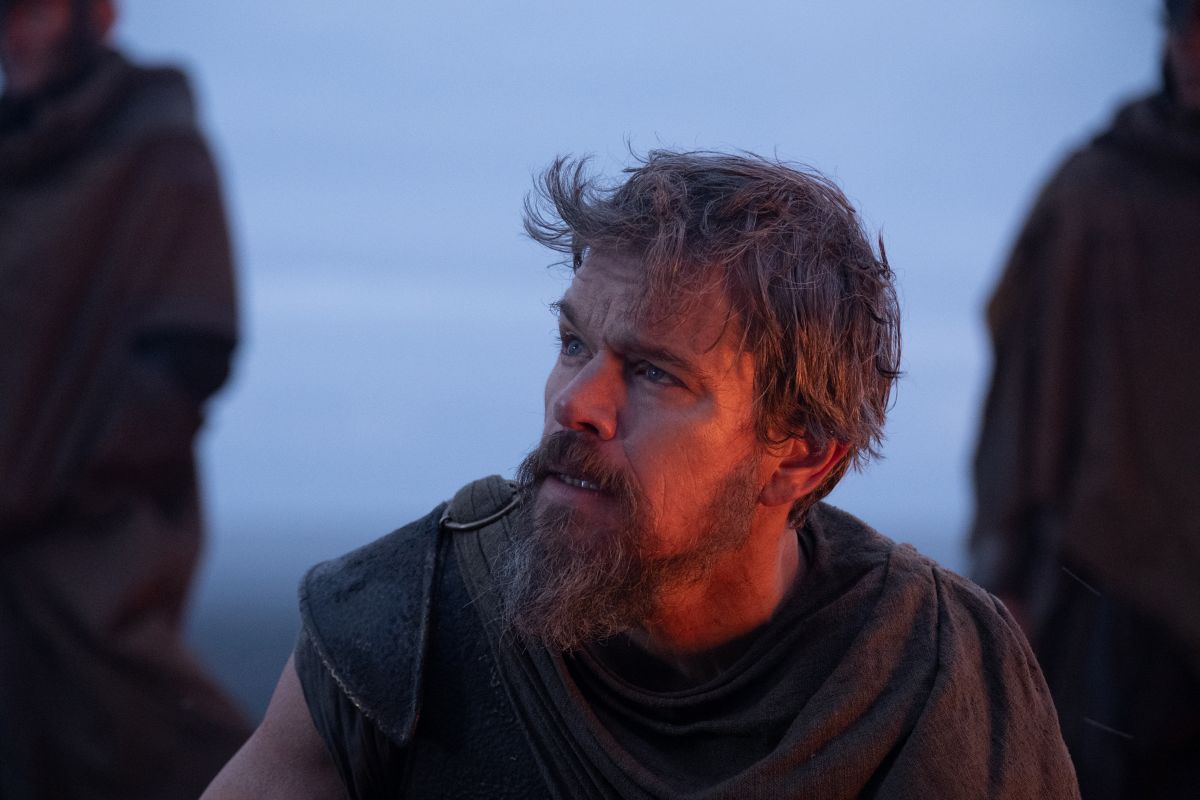
Nolan finds his Odysseus in Matt Damon, who, having almost certainly ridden the 66 from Mission Hill to Harvard Square once or twice in his life, knows a thing or two about arduous journeys home. The story begins in media res: Odysseus, having left his home in Ithaca to fight in the Trojan War, is nearing the 20th year of his absence. His wife, Penelope (Anne Hathaway), still holds out hope for his return, even as her home is overrun by venal suitors (chief among them a deliciously reptilian Robert Pattinson). Odysseus, meanwhile, has been waylaid in an opiate-induced haze, growing a long, white beard and wolfing down lotus petals in the cave of the mysterious Calypso (Charlize Theron). As he slowly regains his memory, Odysseus relates to Calypso the ordeals he’s gone through in the wake of the war, and struggles to get his head together to finally return home.
The most immediately arresting thing about The Odyssey is the way in which Nolan captures the awe-inspiring weirdness of ancient mythology. Nolan’s cyclops, embodied by the great mime and character actor Bill Irwin, is a pale, feral cave-dweller, an enormous version of the subterranean creatures from The Descent (even his face is twisted and alien, with a sideways eye that can only be described as vaginal). Later, when Odysseus’s men are cursed by the witch Circe (a terrifyingly deadpan Samantha Morton), their transformation is realized via gruesome latex effects worthy of Screaming Mad George. It is, per a solitary opening card, “a time of apparent magic,” and Nolan fully realizes how deeply strange it would be to see such magic in the flesh. It’s a bit like the woozy psychedelia of The Green Knight, blown up to the scale of Lord of the Rings.
At the same time, Nolan has crafted an adventure epic as rousing as any that have come in the wake of Peter Jackson’s Tolkien trilogy. While Nolan is not exactly a filmmaker known for his light touch, it’s clear that he grew up on the stop-motion swashbucklers of Ray Harryhausen, and the rollicking energy of those films finds its way into even the grimmest moments of this one. This Odyssey is not for children (though I’d say most teens should be able to handle it), but it bounds along in an episodic enthusiasm that reminds me of the Saturday morning cartoons of my youth. It all builds to one of the best all-comers fight scenes since Kill Bill, which had the audience in my preview screening cheering out loud on at least five separate occasions.
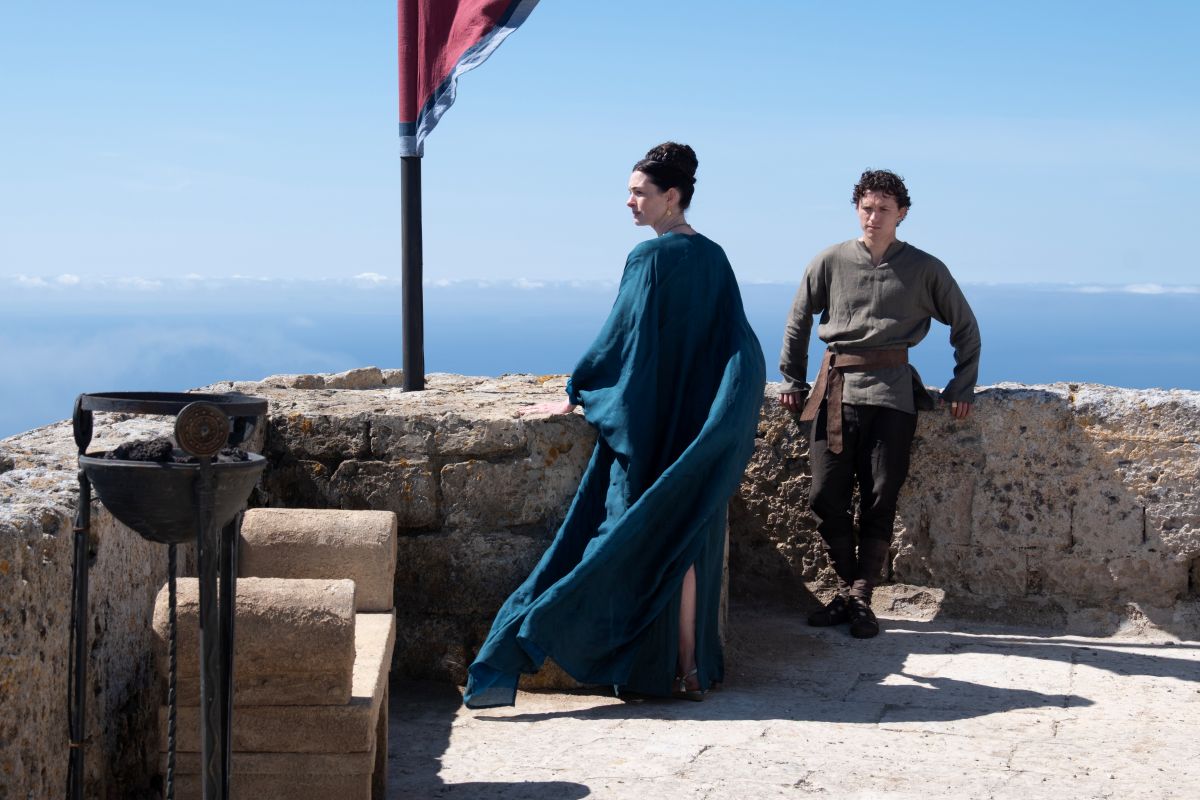
Like Martin Scorsese in The Last Temptation of Christ, Nolan has his actors speak modern, conversational, American English, even those whose natural British accents would seem better suited to the epic material (the sole exception here is Hathaway, who instead does that appealing transatlantic number she’s gotten so good at these past few years). The effect is, at times, mildly jarring; Tom Holland, as Telemachus, repeatedly refers to Odysseus as “my dad,” and Damon even drops one delightfully Bostonian F-bomb. Once you become acclimatized, however, the film’s mildly anachronistic rhythms prove to be a feature rather than a bug. Dialogue which could have come off stodgy and stilted instead is instead easy, natural, and even at times surprisingly funny (the MVP in this regard is John Leguizamo, who plays blind swineherd Eumaeus like a sort of Hellenic Peter Falk). The actors are clearly having fun with the material, while never tipping into winking self-parody.
Of course, this perceived revisionism has drawn the attention of the armchair scholars who rank among the most tiresome figures on social media. While, as a rule, I rarely feel it necessary to weigh in on the online discourse surrounding a given film (Twitter was a tertiary text even before it became a nazi bar), I do feel I should address the army of alt-right snowflakes, led by the most theoretically wealthy man in the world, who have spent the better part of the last couple of months screamingly triggered over The Odyssey’s deployment of non-white and non-cis actors. This “controversy” is, needless to say, ridiculous; Helen of Troy is a fictional character, and Lupita Nyong’o is not significantly less Greek than Matt Damon. These people are, to a man (and they are almost all men), unserious, and not worthy of good-faith argument.
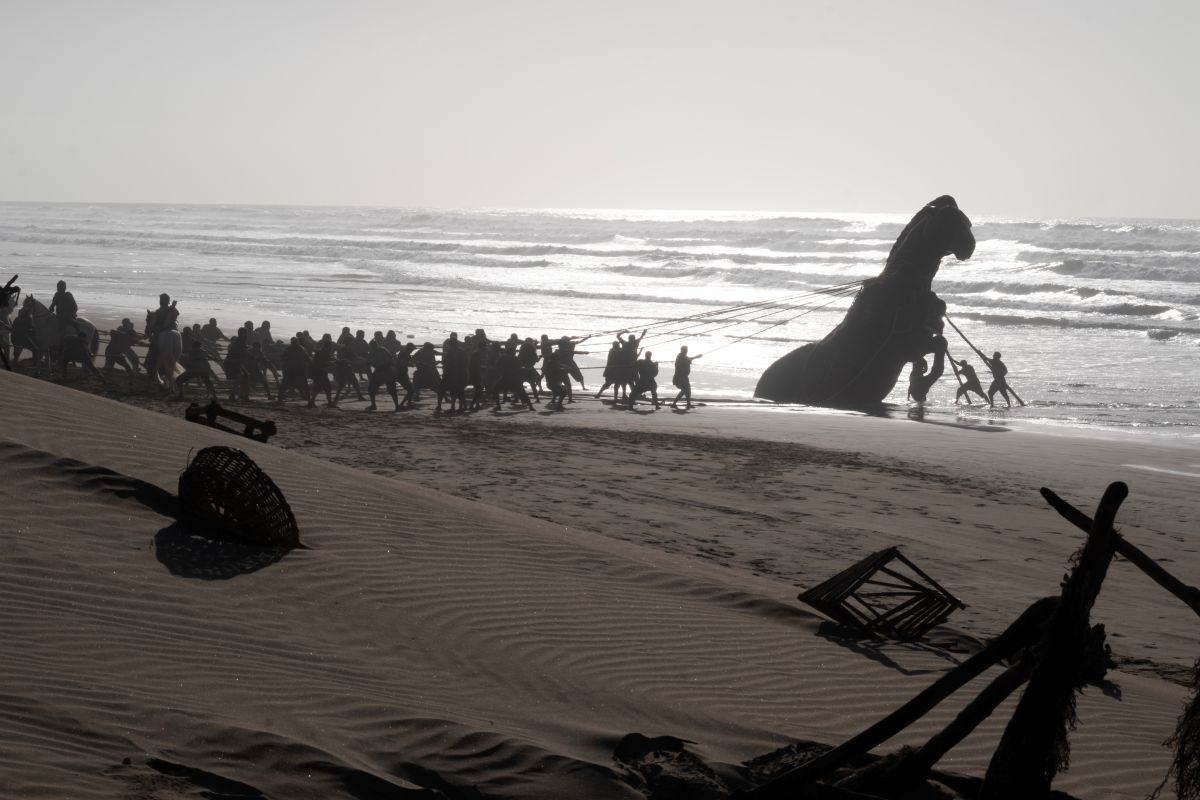
The really funny thing, though, is that this army of marble-statue chuds should have saved their breath for the film’s actual and specific rebuttals to their brand of mouthbreathing chauvinism. Zeus’s Law, the film’s most oft-cited philosophical tenet, is not the sort of he-man warrior’s creed favored by the think-about-the-Roman-Empire-every-day set, but rather the moral imperative to be kind and generous to strangers. Moreover, the frequent flashbacks to the Trojan War reveal it to be a far more morally dubious victory than it’s generally portrayed; the violence Odysseus witnesses committed by his fellow soldiers haunts him even more than the literal monsters he encounters in his travels. Even the Trojan Horse itself is portrayed as a sort of original sin, the ultimate sacrilege against Zeus’s Law— not to mention a deeply unpleasant experience for the sweaty, stinky men crammed inside the damn thing.
Christopher Nolan’s popularity (particularly among the dread cohort known as “film bros”) at times makes his work easy for more erudite cinephiles to dismiss. He is, to be sure, a pop filmmaker first and foremost, and the depth of his work does tend to be overstated in the bombast which characterizes modern discourse. But The Odyssey is a stellar reminder of what makes Nolan so popular in the first place. All of the filmmaker’s strengths are on display: the pulp thrills of The Dark Knight, the gonzo sensibility of Interstellar, the heady sobriety of Oppenheimer. Nolan has taken a tale nearly as old as the written word and made it into something fresh, exciting, and alive. Could another director make Nolan’s films? Perhaps— but why would you want them to?
The Odyssey
2026
dir. Christopher Nolan
172 min.
Opens Friday, 7/17
Screening on 70mm @ Coolidge Corner Theatre & Somerville Theatre, IMAX @ AMC Boston Common & Assembly Row, XL @ AMC Causeway, and standard digital @ Kendall Square Cinema, Apple Cinemas Cambridge, and Alamo Drafthouse Boston Seaport