
The Boston Baltic Film Festival ran from Friday, 2/28 through Sunday, 3/2 at the Emerson Paramount Center, and will continue through 3/17 virtually. Click here for the schedule and ticket info, and watch the site for Joshua Polanski’s continuing coverage!
Two sisters take their husbands and kids to the family lakehouse in Drowning Dry, and in the great tradition of European summer films (Knife in the Water; La Piscine; Afire), something awful happens. It’s not the predictably bad thing that happens but something else, something totally random and a distant butterfly effect from the original, almost-tragedy.
The emotional aftereffect of the first almost-tragedy changes the world for the characters in Drowning Dry though; what happened (or almost happened, or perhaps did happen but not as horrifically as the viewers originally think) makes them see the world differently. The Slovenian Marxist and cultural critic Slavoj Žižek would call this “an event.” That is, “something shocking…out from nowhere” or an “effect which exceeds its cause.” For Žižek, the material reality of the event, the thing that happens and changes the world, is not the point; it is that we believe it to be true.
The couples at the heart of the Lithuanian director Laurynas Bareiša’s new film all respond to what happened that day at the lakehouse in their own, very-gendered ways. The editing follows suit, breaking with the normal cinematic experience of time. That’s what tragedy and depression do: they alter the way we interact with the world and the way the world interacts with us. Bareiša, who works as his own cinematographer, shields us from the “violence” of the lake and even the details of what happens. We see no more than the characters do. He shoots the “drowning” in a still and slowly zooming long shot and creates a serious voyeuristic window with a shrinking frame. It keeps an emotional remove by not actually moving the camera any closer and, contradictorily and curiously, at the same time peers into the intense emotion at work in the scene. The quiet soundtrack and non-invasive score complement the photographic direction well. By leaving the soundscape in the realm of potentiality during the tense moments, Drowning Dry builds more of a dramatic cliff for the family to fall from.
In this interview conducted over Zoom, I talk with Bareiša about the pseudo-scientific idea of “dry drowning,” gender, the strange editing and his editorial influences, and more.
The following interview has been condensed and edited for clarity. Read Joshua’s full review of Drowning Dry here.
Boston Hassle: You choose not to show what actually happens on that day at the lake right away. Instead, you let the audience piece it together as the film goes along. Where did that artistic impulse come from?
Laurynas Bareiša: For this film, I wanted to have a structure that relates to the whole problem of the film. And for me, when I started doing the film, I was interested in investigating this relationship with a moment that is almost tragic. Something [bad] could have happened, but then it didn’t, and [something bad] happens in a different way anyway. I wanted to tell [the] story not chronologically but more emotionally. I wanted to split it because this moment does not affect you in the moment. When something bad happens, [if the girl drowns,] you realize that it’s bad, and you already feel the consequences if the girl drowns. But if the girl doesn’t drown, then it becomes a state where factually everything ended well but emotionally [things are traumatic]. [There is] this strange post-traumatic stress and some kind of emotional trauma. So we wanted to create a story that is true to this emotional fact, the emotional fact of loss, which you already imagined when [you thought the kid drowned and her being resuscitated]. You cannot unimagine this kind of relationship with what you already put yourself through in your mind.
We wanted [our] story to reflect this relationship [of the moment and emotional reality] to the viewer. This first time jump is the moment where the characters get this kind of gap in their reality between what is [felt] and what actually happened.
BH: Maybe it’s a good time to talk about the editing. For the first half, the editing’s kind of straightforward, not disruptive. It’s in the background the way most films are edited. Then something bad happens, and after that, the sense of time is distorted. This is mostly accomplished in the editing. Can you speak about the process of editing and working with your editor to create this feeling of time being broken by what happens?
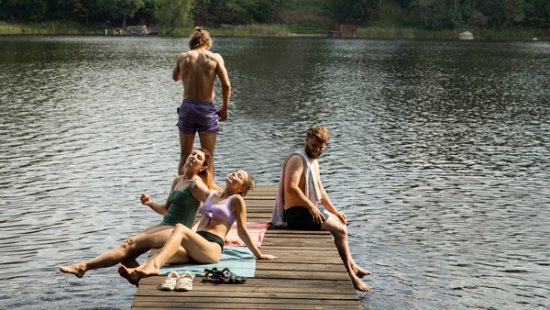
LB: This was already in the structure in the script. I had this time jump, all of the time jumps, and all of the connections between the lake and pool, ambulance and ambulance. It’s all in the script so we could prepare and have this because it was shot in two different times. We shot some in the summer and then in late autumn. So it was in the script.
The relationship with the editor was a curious one because it was [my] first film having an editor. Previously, I edited myself and I was kind of very protective of how I was going to approach [the process] and how I was going to let someone else in. Silvija Vilkaite edited the film. We knew each other from a previous film called Slow by Marija Kavtaradze. I was the director of photography, and Sylvia was the editor.
She is a very capable editor. I really enjoyed her work. I thought that if I would work with an editor, it would be her, because I really admired her. For this film, I was a DOP and camera operator, and we improvised a lot. I [needed] an editor because it would be too much. It would be stupid for me to edit. I was a bit tired of the footage because it was so overwhelming for me. Even though we had all the jumps and the structure, the chronological structure of the film in the script, we also had a lot of space for improvisation, especially the part after the first jump, after we go back to the summer vacation house. We have these different moments where we’re all alone. This was mostly improvised.
There was a lot of this kind of thing. So, I wasn’t sure how I wanted to approach the footage. The first talk I had with Silvija [Vilkaite], I said, “Try to approach it as a documentary film, try to find the strongest moments, put them in, and don’t worry if they’re not too [exact]. Try to find some flow in their emotions.”
BH: I could see that. Especially when you jumped to where they’re visiting the family of the woman that got one of the organs from the husband. It’s so sudden. Where are we? What are we doing here? That’s one of the most disturbing parts of the film. When she puts the boy’s hand on her husband’s stomach and says, “Your dad’s in there.” At that point, we don’t know for certain who is dead, who’s alive, or anything. [The edit brought us into this world with no context. We are fish out of water.]
LB: As I wrote the film, there were different stages because I started writing the film as a coping mechanism. I had a similar accident, not a drowning accident, but a similar accident with my own kid. I started writing the story [to] somehow to get it away from me and to understand it.
This scene, when I wrote this, I thought [it was] a bit disturbing and fucked up and strangely funny, but also very, very sad.
[The] combination of feelings in the scene [was very complicated.]
There is this kind of paradox where she says to her, “Your husband has really good muscles, and they protected the organs.” It is so bizarre but also very humanistic in some kind of strange way.
BH: It’s funny in a weird way, too.
LB: It’s really funny. In a sick way, in a bit of a sick way.
BH: I’m wondering about the personal story that the film seems to have flown from. Would you be willing to share about that?
LB: It wasn’t very dramatic. It was me alone, and it was a choking accident, but I had the same kind of feeling that something bad would happen [if I didn’t do something.]
I already had this [habit of thinking that the] bad situation [would go] from bad to worse. And so I had this moment when I [had] already seen [the bad thing], like in the movie, I already saw her dead, so everything ended for me. But then we know that the girl is not dead. I had a similar feeling. How can I unsee this moment?
But as I started writing, I realized that it’s not a story about me, one person. I realized that there are very different kinds of relationships you could have with this moment. And that’s how the four characters, the four adult characters, were born. They have different relationships to this one kind of moment.
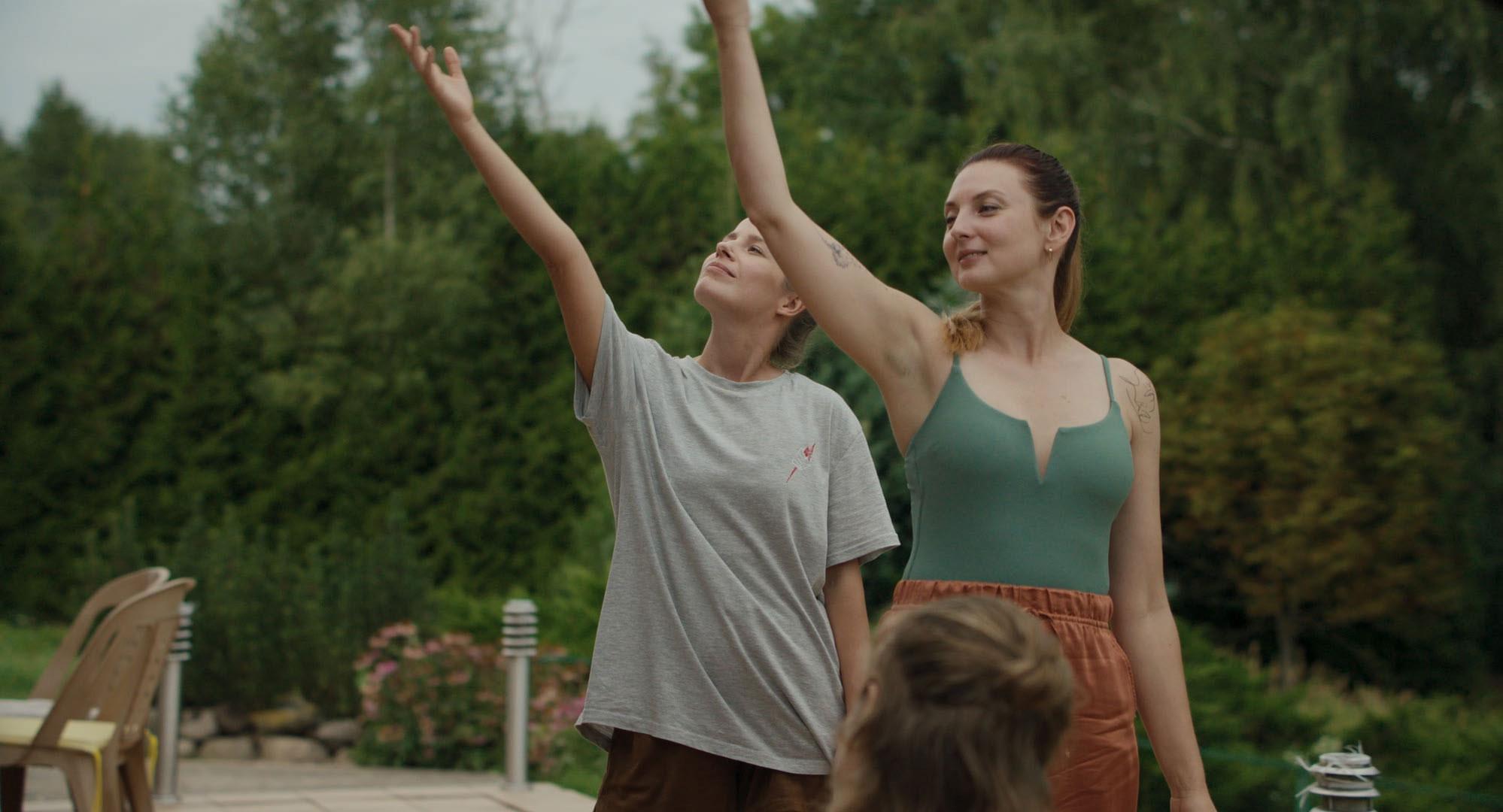
BH: To switch to the title, I noticed on the Wikipedia page that it mentions that you worked with medical consultants to learn more about dry drowning. What did you learn from them, and why did you think that was important for your process?
LB: Yeah, the Lithuanian title is just Sesės (Sisters), but it would be suicidal for international titles. So I tried to find something in my story, and I found Drowning Dry. I thought that it’s a good metaphor for what’s happening, and it’s also in the script as a fact. This second drowning, or dry drowning, is a condition that is a bit of an urban myth. It’s also connected to this show, an American show where a kid drowns in his sleep after going to a pool. But actually, it’s factually untrue. You couldn’t drown like this. I had the discussions with five or six ambulance crews, and I went to the ER and also some doctors in the ER, some doctors in clinical hospitals, and nobody they had ever met in their practice had this condition. It’s quite rare.
The standard procedure after someone drowns and gets resuscitated is to take them to the hospital straight away. What happens in dry drowning is [that] some water gets into your lungs, and the little amount of water starts to affect the lung tissue, and the tissue gets swollen, and you have a gradual process of [making it more] difficult to breathe. It’s impossible to sleep because it’s also basically impossible to lay down.
That’s what happens in the film. She tries to go to sleep, but then she gets restless, and it’s very gradual. You can notice it. So it was important for me to show it clinically correct but also to have it as some kind of randomness because this whole weekend is random. You start with an MMA fight and end in the future when we’re selling this family vacation house. [It’s random.]
BH: The title also works as a metaphor for what’s happening to the family after, of course: they’re getting divorced, tragedies are happening that are a butterfly effect from the original tragedy, and all this other stuff. They’re drowning.
LB: The family is drowning in this inability to see each other, this kind of sexual thing. Especially the scene where the MMA fighter tries to get romantic with his wife; he doesn’t see when she is being gentle, and he doesn’t realize [when] his gentleness is inappropriate. They drown in an inability to see each other.
BH: Maybe that’s a good point to transition to talking about the gender dynamics of the film. As you mentioned, the Lithuanian title is Seses and translates to Sisters. There’s also a lot really important going on with gender and sexuality in the film, whether it’s the MMA fighter or his horny brother-in-law who’s trying to touch his wife at all the wrong times. And, of course, there is the important relationship between the sisters. How important were the gender dynamics to the ultimate fate of the family for you?
LB: It’s important because the gender dynamics that I tried to put my emphasis on was an inability to understand the other person, an inability to understand the other person’s intentions through a fixation on who you are or who you want to become or how you see yourself putting on a shield. I’m especially talking about the male characters with this kind of fixation on status or your place in the world [that] makes them blind to each other. The physically strong MMA fighter is unaware of how everybody around him feels. Everybody’s trying to find their way to be this kind of 21st-century man. One way out [is] this modern masculine maze.
The other male, the non-MMA fighter, realizes how he looks [and] is afraid of what’s around him; he sees competition in everything. He sees danger. He is trying to compete with someone who’s not competing with him.
I find this problematic and wanted to put it in the film. When we show the film with an audience back in Lithuania, I realize that when you see it on others you realize it [easier]. [It’s a] very modern type of male existence: kind of protective but also very brazen; prone to self-reflection, but sometimes it’s too much; sometimes you’re ignorant.
The sisters are an important dynamic because the whole film is about [how] something bad happens and you have difficult personal relationships, and there’s also randomness in the world that can affect you in very tragic ways. I wanted to have one relationship in the film that is true and unquestionable. That’s the sisters. I didn’t want to dramatize this relationship.
Coming from Lithuania, when I was preparing for the film, I read this cultural study by this Lithuanian sociologist [Vytautas] Kavolis. He studied how different cultures have different basic relationships that go through the culture. The study is from the start of the 20th century or mid-20th century, so it’s very speculative about different cultures. But it had this idea that every culture has this one main relationship that goes through ages and forms the worldview of the country.
For example, the Chinese would have a father-son relationship, very hierarchical, patriarchal, and giving respect to elders. For Lithuania, he realized that through stories and national myths, they have this kind of horizontal brother-sister relationship. It’s the main relationship in stories and myths. It’s always brother, sister, brother, sister. And it’s very equal. It’s not a romantic relationship, not a hierarchical relationship. More of this unconditional support, like Hansel and Gretel. I wanted to have this kind of relationship in the film, which could be a solution if something was happening to them [and] not something that they overcome as characters through their own growth or something. [It would be] something that they already had.
BH: Their relationship is inevitable.
LB: Yes. [Exactly].
BH: We only have a few more minutes, and I wanted to ask if there are any films or specific filmmakers that shaped your passion for cinema and maybe especially the way you make movies?
LB: This film has one really, really definite reference: Nicolas Roeg. I remember when I saw his Bad Timing. I love this what-the-fuck editing. When he cuts it’s very strong and you don’t know why, but then it comes back and then you know why. It is exhilarating. I didn’t use it that much here, only for a couple of cuts. But I always remember Nicholas Roeg when I think about this. So for this film, it was him.
BH: What was the most challenging aspect of the production, and what was something that you learned from that you would like to pass on to younger filmmakers or that you wish you knew heading into the production?
LB: This film had this kind of strange combination of [scenes]. It’s [mostly] a family drama but [there are also] a lot of set piece scenes with [things like] the crash and also the drowning. [We had stuntmen for these.] It would be [to know] how do you manage these different modes of filmmaking, one being very much improvisational and a very close-knit actor group. And then the other one being this stunt, special effect [type scene]. Also, it is important to have a clear mind at the start of every day. It’s not going to be the same and every day is different. How do you achieve the result that the film requires?
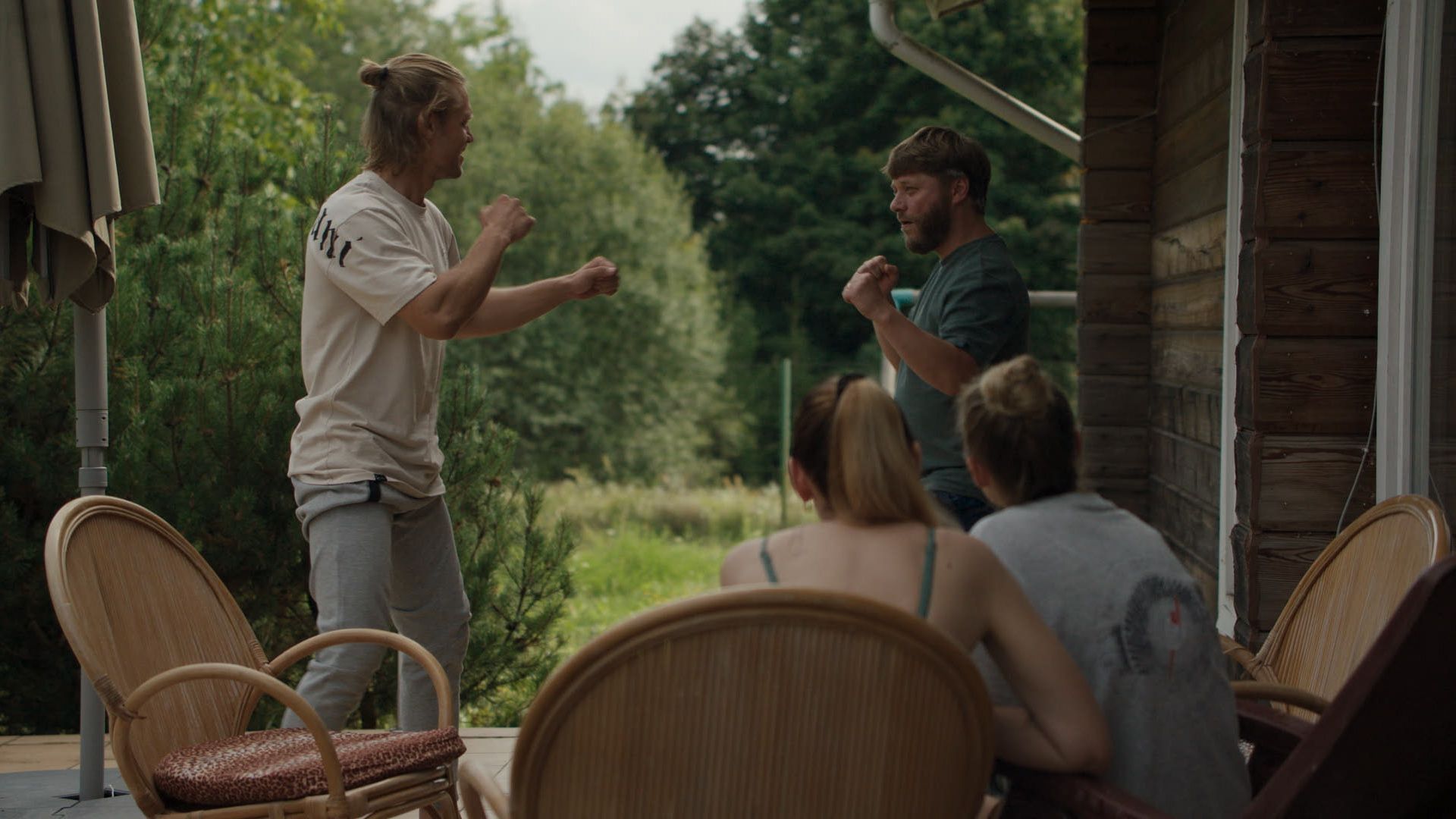
I felt it a lot with the MMA. The first scene in the film is the last we shot in summer. It was after a month with the children and all of our crew in the summer house. [The gym was a] testosterone-filled hall and they’re all MMA fighters. The referee is also an MMA coach and he started directing the film and I had to wrestle control from him in there, being more alpha than him. He started cutting the shots and everything and I said, “No, I have to be in control.” So [my advice] would be just being ready because every day could be different.
BH: Fascinating. Thank you for doing this interview, and thank you for making a good film.
LB: Thank you very much.