
The Boston Baltic Film Festival runs from Friday, 2/28 through Sunday, 3/2 at the Emerson Paramount Center, and through 3/17 virtually. Click here for the schedule and ticket info, and watch the site for Joshua Polanski’s continuing coverage!
The following dispatch features reviews of Drowning Dry & 8 Views of Lake Biwa.
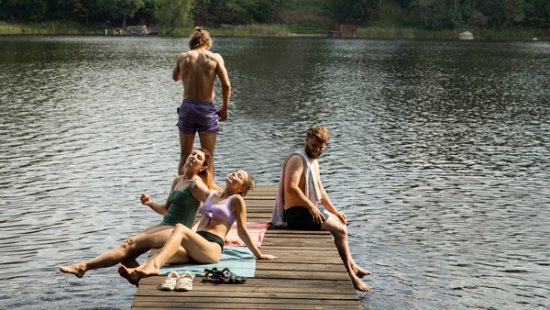
There are a few types of scenes that, even if nothing is semiotically tragic about them, their presence looms large and indicates the ultimately tragic teleological end the film is heading for. The opening MMA scene with a bloodied Lukas (Giedrius Kiela) triumphing in the ring certainly gives us no hope that Drowning Dry, a film with an even more hopeless title, will not end unfortunately for the two families vacationing together. Has any MMA film evaded tragedy?
Even though her husband wins the fight, we meet Ernesta (Gelminė Glemžaitė) with tears running down her face: watching your husband out-clobber another man isn’t exactly the same as cheering for a basketball-playing spouse. The hyper-masculine combat sport walks much closer to the edge of insanity and belligerence than basketball or soccer ever could. She worries something terrible will befall Lukas and her family. And something terrible inevitably does happen on their lake house vacation with Ernesta’s sister Juste (Agnė Kaktaitė) and her slobbish horndog husband Tomas (Paulius Markevičius). Both couples have a kid, and one of those kids almost drowns, or does drown, in the lake. The tragedy isn’t simply the agonizing event that catalyzes it, but also the butterfly effect that follows.
Bareiša, who works as his own cinematographer, shields us from the “violence” of the lake and even the details of what happens. We see no more than the characters do. He shoots the “drowning” in a still and slowly zooming long shot and creates a serious voyeuristic window with a shrinking frame. It keeps an emotional remove by not actually moving the camera any closer and, contradictorily and curiously, at the same time peers into the intense emotion at work in the scene. The quiet soundtrack and non-invasive score complement the photographic direction well. By leaving the soundscape in the realm of potentiality during the tense moments, Drowning Dry builds more of a dramatic cliff for the family to fall from.
The gender dynamics fascinate and end up too elusive to neatly untwine. The Lithuanian title Sesės translates to “sisters,” a title more reflective of how the film spends the latter half of its run-time with Ernesta and Juste jumping back and forth between the past (lakehouse) and present (life after the tragedy). Their sisterhood grows deeper as it gains new scars with age, and their growth inspires a life change for Juste who divorces her husband to evade what appeared to be a passionless marriage. The men, and their jealousy of one another—Lukas of his brother-in-law’s healthy financial situation, Tomas of the former’s proven masculinity and muscular body— have been the gravitating pull most reviews have focused on. But any attempt to frame the tragedy that begins with Tomas playfully throwing his daughter Urté (Olivija Eva Vilune) and nephew Kristupas (Herkus Scrapas) into the lake with a toxic masculinity-grounded interpretation grossly oversimplifies the roles of gender and sexuality in Drowning Dry. No one is at “fault” for what happens, which is also not what the viewer may suppose based strictly on what I have described. What does happen is much more random and much less explainable. Instead, we watch a family drown again and again and again.
There is an old Hong Kong style of editing action shots to show the same shot or choreography from several angles, not advancing in plot time and instead rewinding the spectacle from alternating angles like tomorrow’s highlights on ESPN. The sequential non-linear editing by Silvija Vilkaitė works similarly—only instead of reliving exhilarating action, she forces the family to relive their trauma as the screenplay slowly reveals more and more facts about what happened, who died, and how the family has been irreparably changed. The structure will jar with many viewers. And that’s probably for the better, since tragedy too jars those who it pesters.
8 Views of Lake Biwa is the weirdest movie showing at this year’s Boston Baltic Film Festival. Estonia’s submission for the 97th Oscars, 8 Views of Lake Biwa has nothing to do with Lake Biwa, a large lake in Japan, but Lake Peipsi, the massive body of water separating Estonia and Russia. Years ago, a boating accident on the titular lake took the lives of several teenagers. Only Hanake, played by Elina Masing, who plays Mariann in Lioness (also showing through the BBFF), and one of the adults survive the accident. Like a rock skipping across the water, this creates a ripple effect throughout the community. The social bonds of the small fishing town become manipulated and perverted in the face of a shared tragedy.
An isolated remnant of an Orthodox Russian community who fled 17th-century homeland oppression presides over the lake and makes due as a fishing community. Modern geopolitics intrude upon the fairytale luster, such as with the mandated military service of a young man; for the most part, the village carries on with a lifestyle that could be lifted from either the 17th or 21st centuries. Much like Atom Egoyan’s quintessentially Canadian The Sweet Hereafter, the shared tragedy fractures the social bonds of the community. Also like Egoyan’s film, the central tragedy concerns the unexpected death of several teenagers after an accident involving the town’s central body of water.
The Baltic geography has nothing to do with Japan, but the film does. The title references an East Asian art tradition of “eight views.” Imported to Japan via China (and now translated to Estonia), the label describes paintings depicting eight perspectives of one locale, which are predetermined and include things like the returning sails at Yabase and the evening snow at Hira, in search of the essence of the place. The “views” are divided into chapters, adding much-needed structural integrity to the quasi-experimental film. Without any structure, 8 Views likely descends into perpetual ambiguity and becomes completely obscure without much time passing. The actual dependency on Japanese culture is probably too removed to tread into the Orientalist waters, though such dangers are never too far away either.
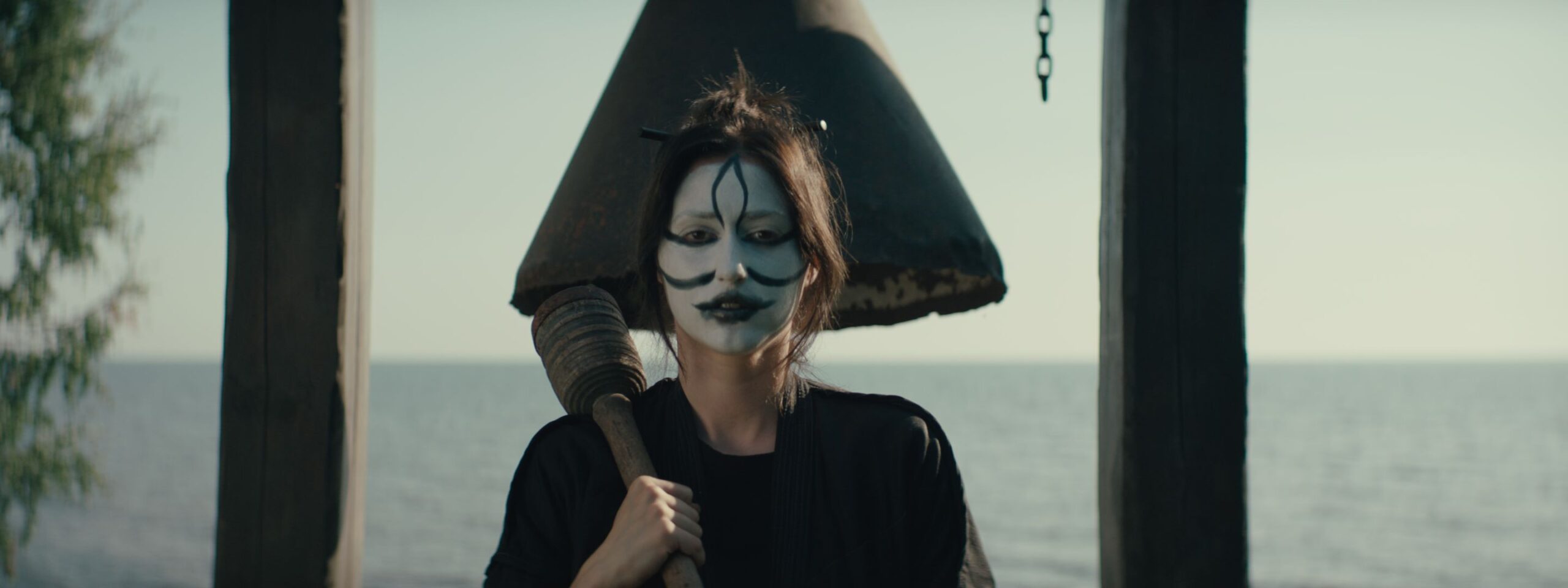
8 Views of Lake Biwa is most intriguing as a formalist project. It’s full of whispers, especially from the internal monologues of Hanake, that at the same time always comes across as incredibly personal, as if she is conversing with you. Certain things aren’t meant to be said too loud here. The wrong ears may hear. The whispering is also reflective of the strange notes the actors all hit, especially Masing and Maarja Jakobson (as Jänesesilm), the former of whom wears curious face paint not unlike a geisha and the latter sloppily wears her lipstick in a way vaguely reminiscent of Heath Ledger’s Joker. Most good actors can only summon a few times in their careers the quality of vulnerable silliness and strange intensity demanded here, and Raat is capable of getting that performance out of most of his actors when the moments matter most.
The visuals are also memorable. Sometimes it is for their alienating strangeness. Other times it is because of their painterly beauty. In one of the more memorable visuals, a man asks the lone painter in the community to paint his new wife. He asks intending to impress his new spouse, and also to help him warm up to her (they have a strange relationship). The painter creates a monster out of her. The woman in the painting has more in common with a victim of Pablo Picasso’s “Guernica” than the “Mona Lisa.” What is even stranger is that nobody takes offense, nor does anyone find the painter’s attempt dishonest. The people of the lake are doomed and they know it.
The review of 8 Views of Lake Biwa is adapted and modified from this writer’s previous coverage of the same film at In Review Online.
Drowning Dry
2024
dir. Laurynas Bareiša
88 min.
Screens Saturday, 3/1, 12:30pm @ Emerson Paramount Center
Q&A session with producer Klementina Remeikaite to follow screening
8 Views of Lake Biwa
2024
dir. Marko Raat
125 min.
Screens Sunday, 3/2, 10:00am @ Emerson Paramount Center
Q&A session with actor Simeoni Sundja to follow screening