In 2009’s An Education, Carey Mulligan plays Jenny, a teenager who is swept away from her schooling and concerned parents by the flirtatious hands of an older conman. In the conversation where she is about to quit school in front of her headmaster (played by a patient Emma Thompson), Jenny rues the pipeline from droning academics to monotonous stability. Even though you, Thompson, and I can see that Jenny’s inexperienced youth is the underlying tone of her rant, we raptly watch this scene knowing where she is coming from, that her stubbornness isn’t out of idiocy but of naiveté. “It’s not enough to educate us any more, Mrs. Walter,” Jenny nearly pleads. “You’ve got to tell us why you’re doing it…you never know, someone might want to know what the point of it all is, one day.”
There are moments as a teenager, or even as a young adult, where we are tethered to both self-confirmed truths and the masked fear that we actually don’t know much about the world. Life at this age, matured only by choices and consequences (fuck around and find out, if you will), feel both palpable and mysterious. As the years go by, pushing me farther away from that stage in my life, I see successive films about teenagers as a moving balance: do I understand it as a former teenager, and will teenagers understand it as current teenagers? Sofia Coppola, whose explorations have gone to the peripheral orbits of teenagers in dreamy-static suburbia or in the Southern gothic woodlands, brings her characters to a dimension that is generally unreachable to me by sympathy or similarity. I thought I understood Coppola with the respectful space to not love her films. But with Priscilla, it finally clicks.

If we are talking about the lives of teenagers, selecting one who was placed on a grand scale is one way to do it. Priscilla sections off and tailors the story to the eclipse of Priscilla Beaulieu and Elvis Presley when they are stationed at Germany (her, an army brat, and him, of the army) up until their divorce. The ick of it, about which I presume a lot of people will share preconceived ideas before watching the film, is not shied away from the screen, but it’s also not a message that swallows the tone. A soldier — an older man, at that — spots a 14-year-old Priscilla at a diner and insists that she meets the 24-year-old Elvis at his rented home. The soldier may have tried to connect them together through Elvis’s overseas loneliness; additionally, we see that this man is happily married to a woman who takes Priscilla to Elvis’s house without hesitation. Priscilla’s parents reluctantly give their blessings, knowing that they aren’t meeting for friendly coffee (most of the dialogue from Priscilla’s mother, played by Dagmara Domińczyk, questions why Elvis couldn’t hang out with someone his age). Even though we live in the period where “grooming” exists as a legitimate term, we may warily accept that this is just how it was back in the day (or, alternatively, there is little practiced parental guidance when the King of Rock n’ Roll requests the presence of their daughter).
The review-elephant in the room is that Priscilla trails behind Baz Luhrmann’s Elvis, a dazzling spectacle that aimed for authenticity and showmanship. Elvis, for all intents and purposes, is directed as the King’s curriculum vitae; we see Elvis at birth, his hips ordained at church, and the blue-eyed sadness that follows him to his grave. Gracefully, Priscilla doesn’t give a shit about the fame. Coppola is more focused on Priscilla’s perspective after her collision with the biggest star, which is often physical solitude and emotional abandonment once she follows Elvis to Memphis. Cailee Spaeny is Priscilla, from doe-eyed to cat-eyed, and Jacob Elordi is Elvis, from clean-cut idol to Vegas-sideburns. Even though Spaeny and Elordi are only a year apart in real life, the costuming and makeup magic brewing behind the scenes help accentuate their age differences while knowing that there is supposed to be a dynamic at play (unlike Call Me By Your Name, where the age differences are further widened by casting Chalamet and Hammer). Elordi’s stature (which is a few inches above Elvis’s estimated height of six feet), disarmed by his military politeness, seems to initially play into the teenage fantasy; a sweater-prepped Elvis waiting to pick you up for a date invokes the ever-after dreams of riding off with Jake Ryan in Sixteen Candles.

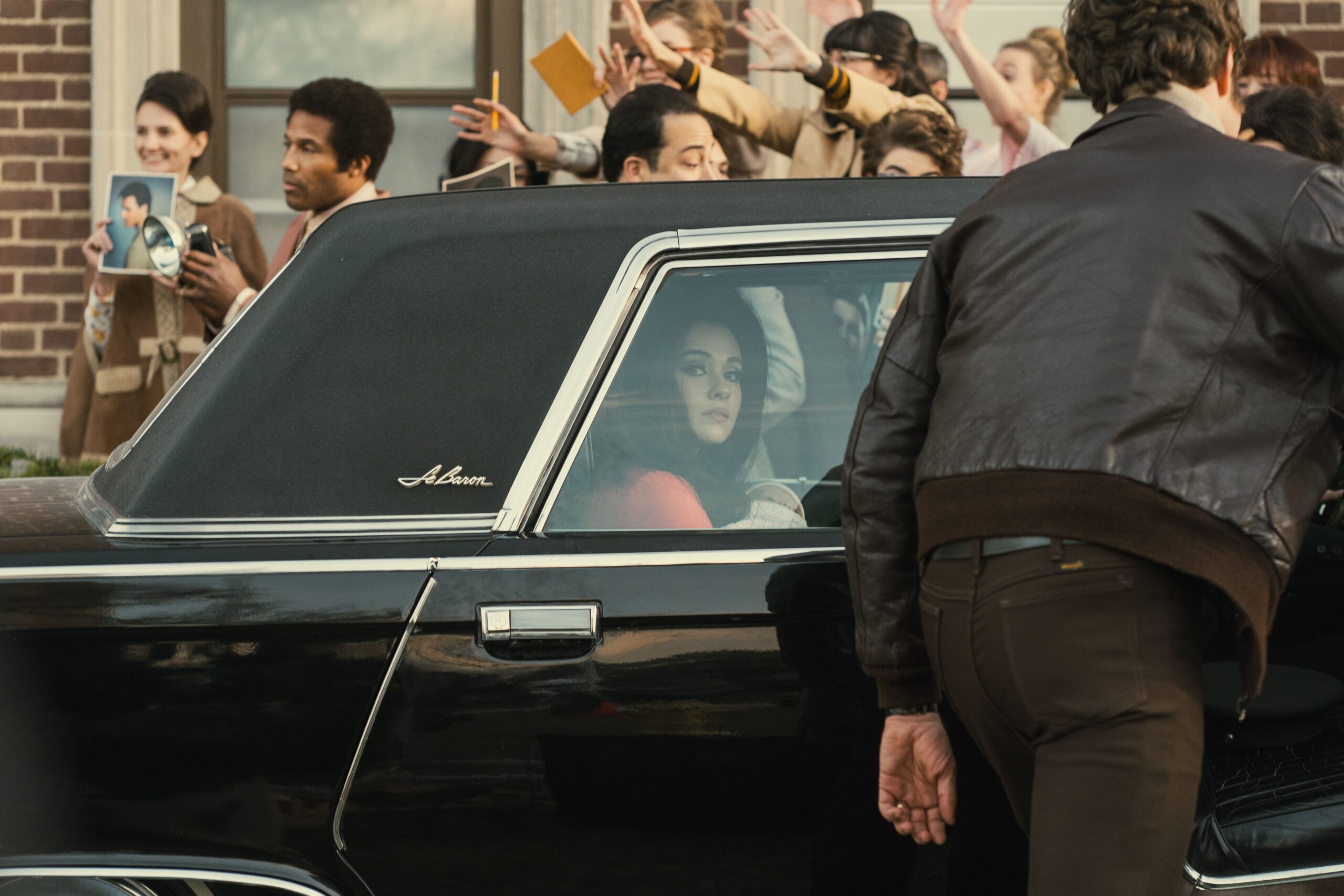
As mentioned before, the fame which parallels Elvis’s romance with Priscilla is not shown. By the time Priscila enters his life, we are told through conversations that Elvis’s mother has died and that he misses home. But the aspect of him being removed from the world that had propelled him to unprecedented success is downplayed in contrast to his feelings of loneliness. When he offers Priscilla pills to help sleep at night, we might not know the context of his barbiturate addiction surfacing. His comings and goings from Memphis to Hollywood are not depicted outright; instead, Priscilla hears news through gossip mags and whatever defensive comforts Elvis has to say over the phone. It’ll be interesting to know if reactions to the film will stand as a division between those who know Elvis and those who don’t (probably a small subset of people who had been able to avoid Luhrmann’s Elvis, celeb-lists about people who died in unusual circumstances, or the origin story behind peanut-butter-banana sandwiches) when watching Priscilla, as the dearth in Elvis might skew expectations. Arguably, Coppola and Luhrmann represent Elvis similarly through the lens of another. Colonel Tom Parker’s perspective might feel like the type of embellishing story that places Elvis on a pedestal. Through Priscilla, Elvis is an enigma even in marriage, a shadowy figure that beams in love-mania and deflates for days on their bed after a bender. Priscilla is a great example of show/don’t tell, and if you are coming to watch Priscilla for a Elvis bio, then that’s gonna be tough.
In Coppola language, speaking doesn’t come from dialogue. Priscilla’s initially soft, innocent-sweetened voice (phone conversations where she ends with “Okay, thank you, bye” elicited a few chuckles from the audience because she sounds that young) against Elvis’s deepened mumbling (sometimes shy, sometimes shady) are checkmarks to their character depiction. But it’s cinematographer Phillippe Le Sourd (who has worked with Coppola previously in her last two films, On The Rocks and The Beguiled) that invigorates their story into one that resembles young love plastered on the screen. The usual cotton-candy cardigans of a teenage girl in the ’60s are electrified by homemade fireworks in the night, the provocative lighting of a roller rink, the roaring wheels on dirt that could only mean automobile mayhem. In one blink, we wade with a lonely Priscilla in a musty yellow haze of Graceland’s interior. In the next blink, we see Priscilla and Elvis (accompanied by his buffoonish yes-men, emulating a high school jock with his posse, sometimes utilized to humorous effect) committed in this whirlwind romance, despite the fights prior or Elvis’s snide comments. Coppola gives this fated love a fighting chance, and we separate the known wrongs and the enjoyment in this cinematic safe space. Don’t ask me about the Second Amendment, but the scene where Priscilla matches her ornamented handguns with her dresses is the vibe.
If there were lessons to be learned, neither Priscilla nor Coppola has to lay out the answers. Where I had missed Coppola’s previous intentions, I think her vision works perfectly in Priscilla, a film in which we don’t need to be directly told how and why someone could get in this situation. There might be resistance to thinking that there are strong performances in this film, but Spaeny and Elordi dance in these characters to a familiar tune of wronged passion without giving in to the informed knowledge of this famous marriage. By inverting the idea that we need to know the point by the end of the story and instead knowing what the point was and dismantling it to delectable empathies, Priscilla had really figured out that balance — if not for the audience of former/current teenagers, then at least between the visionary and the storyteller.
Priscilla
2023
dir. Sofia Coppola
110 min.
Opens Friday, 11/3 @ Somerville Theatre and Kendall Square Cinema