
Within the filmography of its famously genre-hopping director, the English language films of Bong Joon Ho– Snowpiercer, Okja, and now Mickey 17– represent an oeuvre unto themselves. All three are bitingly funny works of science fiction satire, using fantastical conceits to present an acrid (and staunchly left-wing) view on social issues of the day. Mickey 17, Bong’s first film since Parasite conquered the world in 2019, is his most out-there yet, a giddy space-com involving computer-assisted reincarnation, space colonies with “sex-encouragement campaigns,” and barbecue sauce extracted from the anuses of gigantic, shrieking pillbugs. It also hits so frighteningly close to home that it might as well be a documentary.
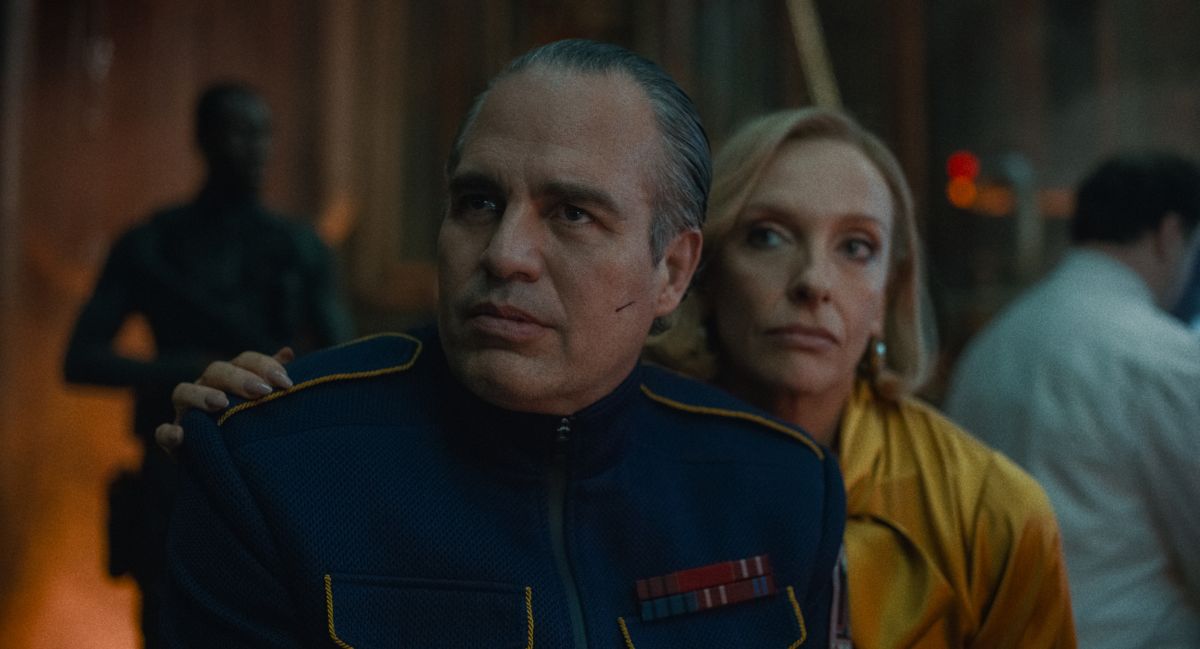
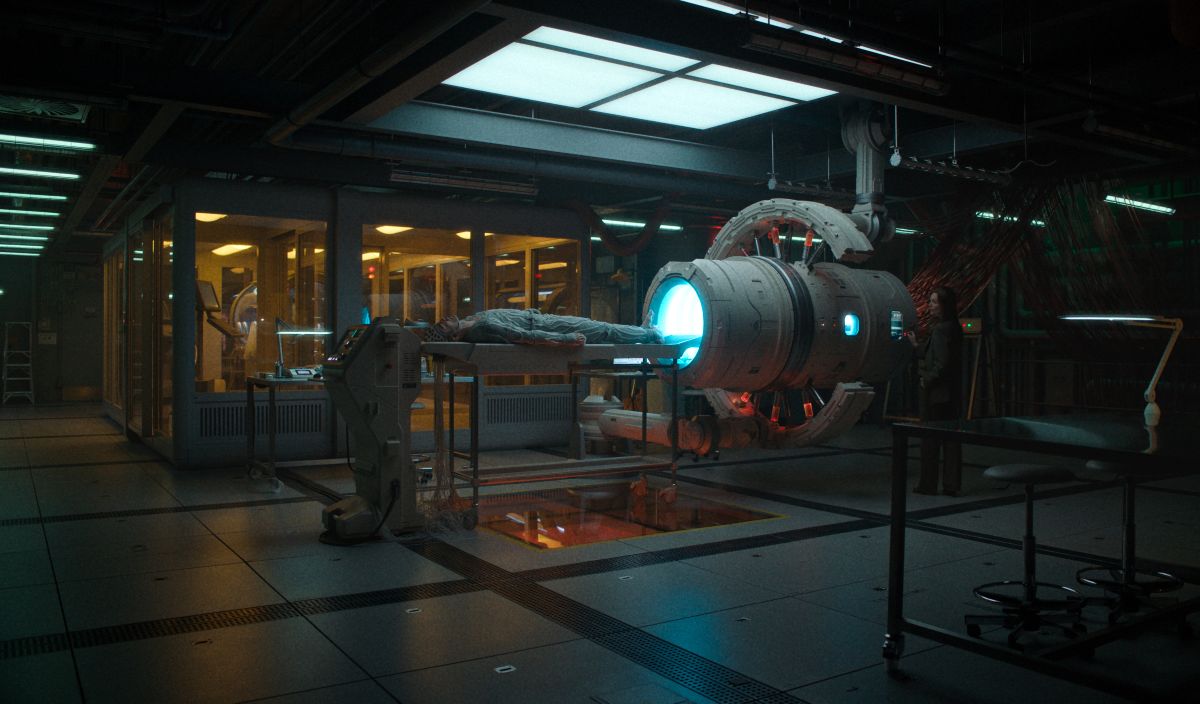
Mickey 17 represents Bong’s first collaboration with Robert Pattinson, marking the actor’s return to his proper calling of oddball character work with international auteurs following his turn in 2022’s The Batman (which I don’t begrudge; you have to keep the lights on somehow, and Bruce Wayne has deep pockets). Pattinson plays Mickey Barnes, a sniveling lowlife in the year 2054, on the run from wealthy thugs after falling prey to a macaron shop pyramid scheme. In desperation, Mickey applies for an off-world colony run by pop-fascist politician Kenneth Marshall and his ambitious wife Ylfa (Mark Ruffalo and Toni Collette, both wearing comically large dentures and painted a Trumpy bronze). With no qualifications and no family, Mickey signs up to be an “expendable,” a sort of human lab rat whose role is to submit himself to all manner of fatal conditions. That’s “fatal,” not “dangerous”; each time Mickey perishes on assignment, a new Mickey is generated from a sort of 3D printer of human tissue, his memories restored from a backup housed in a (literal) brick.
Mickey shrugs off his lot with the “it’s a living” resignation of one of the Flintstones’ living can-openers; his life on earth wasn’t especially fulfilling, and he gets to pass the time between deaths trying out new sexual positions with his girlfriend, Nasha (Naomi Ackie). Complications inevitably arise, however, when Mickey’s seventeenth incarnation proves surprisingly durable, surviving both a fall into an icy crevasse and an encounter with a family of monstrous, scuttling beetle-things known as “creepers.” By the time he gets back to the colony, he finds his replacement already occupying his bunk– thus placing both Mickeys in violation of the law of so-called “multiples,” the punishment for which is termination of all copies. Each Mickey comes to the same realization: it’s him or me.
Even if you were to go into Mickey 17 with no knowledge of Bong and his work, it would be clear from the outset that this is not your typical star war. Most distinctive at the outset is Pattinson’s performance, easily his weirdest and funniest since The Lighthouse. Mickey 17 is a snivelling dullard, whose rambling narration owes less to the current blockbuster standard than to the fidgety New Hollywood likes of Dustin Hoffman and John Cazale (Pattinson has said he came to his distinctive whine by trying to combine the voices of Ren and Stimpy). Mickey 18, meanwhile, is more of a confident himbo psychopath, meaning we get two gonzo Pattinson performances for the price of one. The world of the film follows suit, with a suitably bonkers sense of humor; even when one nutty idea doesn’t quite land, Bong has two or three more in the chamber.
As in Snowpiercer and its enormous, mobile metaphor for class injustice, the satire of Mickey 17 is willfully and gloriously unsubtle. Ruffalo, playing to the rafters, is a melange of any number of regrettably familiar figures: a mush-mouthed tyrant bozo with a self-aggrandizing TV show, a spacefaring white supremacist with a sinister natalist bent, a zonked-out psycho weirdly obsessed with his subjects’ nutritional intake. Even more familiar, however, is the colony, which treats its occupant as human chattel, grist for the machinery of a wealthy uberclass. Mickey is a literal expendable, but one senses none of the jumpsuited working class are considered much less replaceable. This is a miserable outpost on an ice planet in a dystopian future, but it’s also the unmarked Amazon warehouse across the highway, whose workers toil day and night and pee in bottles so you can receive your generic toe socks in less than 24 hours. Mickey 17 was filmed in 2022, its release delayed by the Hollywood strikes, and I really wish I could say it felt a little more dated.
This brand of snotty social satire used to be de rigueur for sci-fi movies back in the days of Paul Verhoeven and Terry Gilliam (both clear influences on Bong’s genre work), but it has become a rarer beast, at least on such a grand, IMAX-ready scale. It took a hit post-9/11, when Hollywood blockbusters became increasingly incentivized toward jingoism, but it has become critically endangered over the past few months, as one billionaire-owned media corporation after another has lined up to kowtow to the incoherently hateful caprices of President Trump and his hangers-on. In a world in which Disney replaces a transgender character with a Christian one and the former home of Woodward and Bernstein scuttles reporting critical of the president, even the most MAD Magazine of satire begins to feel miraculous in its subversion. It’s no wonder, then, that David Zaslav, president of Warner Brothers and known collaborator of the current regime, reportedly hates Mickey 17 and did his best to bury its release. If the Zaslavs of the world had their way, there would be a lot fewer Bongs trying to tell it like it is.
It is perhaps because of this rumored intra-studio unrest that Mickey 17 lacks the focus of Bong’s previous work, its strangely muddled edit bearing the sickly odor of studio interference. Mickey’s unscrupulous best friend, played by Steven Yuen, appears and disappears from the narrative seemingly at random, suggesting swathes of subplot left on the cutting room floor. Odder still, the early stages of Mickey’s romance with Nasha is largely consigned to montage and voiceover; I’m not positive we hear her voice at all until the second act, at which point it’s difficult to parse out the shape of their relationship prior to the complications introduced by Mickey 18. I have little doubt in the existence of a significantly different director’s cut. If and when we get to see it, I suspect we’ll file the Zaslav cut of Mickey 17 alongside the infamous “Love Conquers All” cut of Gilliam’s Brazil– or, more to the point, the Weinstein cut of Snowpiercer.
All the studio chicanery in the world, however, can’t mask the fact that this is the work of a world-class filmmaker. Consider, for example, the eerie beauty of the hoards of creepers which encircle the colony toward the film’s end, and compare to the garish weightlessness of the typical blockbuster’s CGI monstrosities. Likewise, there is an actual point of view to the film’s commentary, one which extends beyond the usual black-and-white talking points and into a space more strange and personal. It’s also, quite simply, a great time, with more ideas and wild turns in any ten-minute stretch than most big-screen blockbusters do in their entire runtimes. Despite its high budget and big-name stars, Mickey 17 is a work of maverick inspiration with a genuinely subversive streak. One sadly suspects we won’t see its like again out of Hollywood for at least another four years.
Mickey 17
2025
dir. Bong Joon Ho
137 min.
Now playing @ Coolidge Corner Theatre, Capitol Theatre Arlington, and theaters everywhere