Salem, MA is an unlikely location for an exploration of the psychic woes of a post-colonial India. The Peabody Essex’s MegaCity: India’s Culture of the Streets provides a visual exploration of spiritual questions of modernity, big picture, civilizational questions building on intimate psychological musings.
On a personal note, it was slightly unnerving to find myself an observer of a history that inevitably links to my own sense of identity and history. None of us can be objective observers of enormous cultural change, tangled in the social norms that came before us, though my connection to this exhibition felt especially complex. As a young Indian-American, I was undoubtedly a distant observer of the themes of the exhibition, but unable to fully separate myself behind a glass pane of cultural distance.
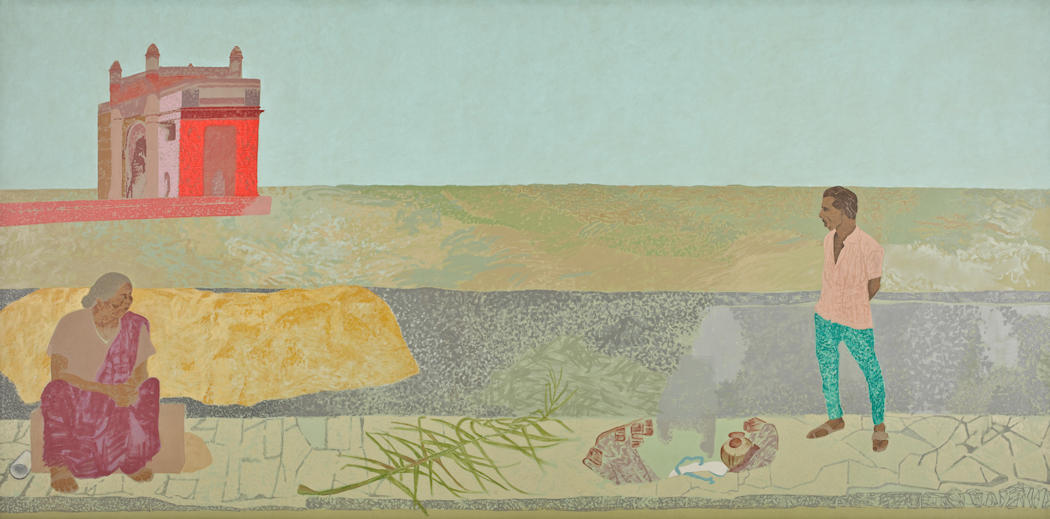
Gieve Patel, Gateway, 1981
Gieve Patel’s “Gateway” is a powerfully flattened exploration of narratives of infinite, tessellating dimensionality. In the background of the painting, we see India Gate, a testimony to modern affluence, British colonial power, its symbolism a confusing brew of the promise of prosperity and western subjugation, rural peasants looking on in the foreground in the hues of bright pop art. Taken out of its historical and cultural context, the painting is a testament to the shrinking and growing of space as it relates to daunting psychological chasm, the Mount Olympus that is urban life more of a faraway symbol than an actual location. The fact that physicality and immediate sensory perception can all be full distorted by higher level hopes and fears.
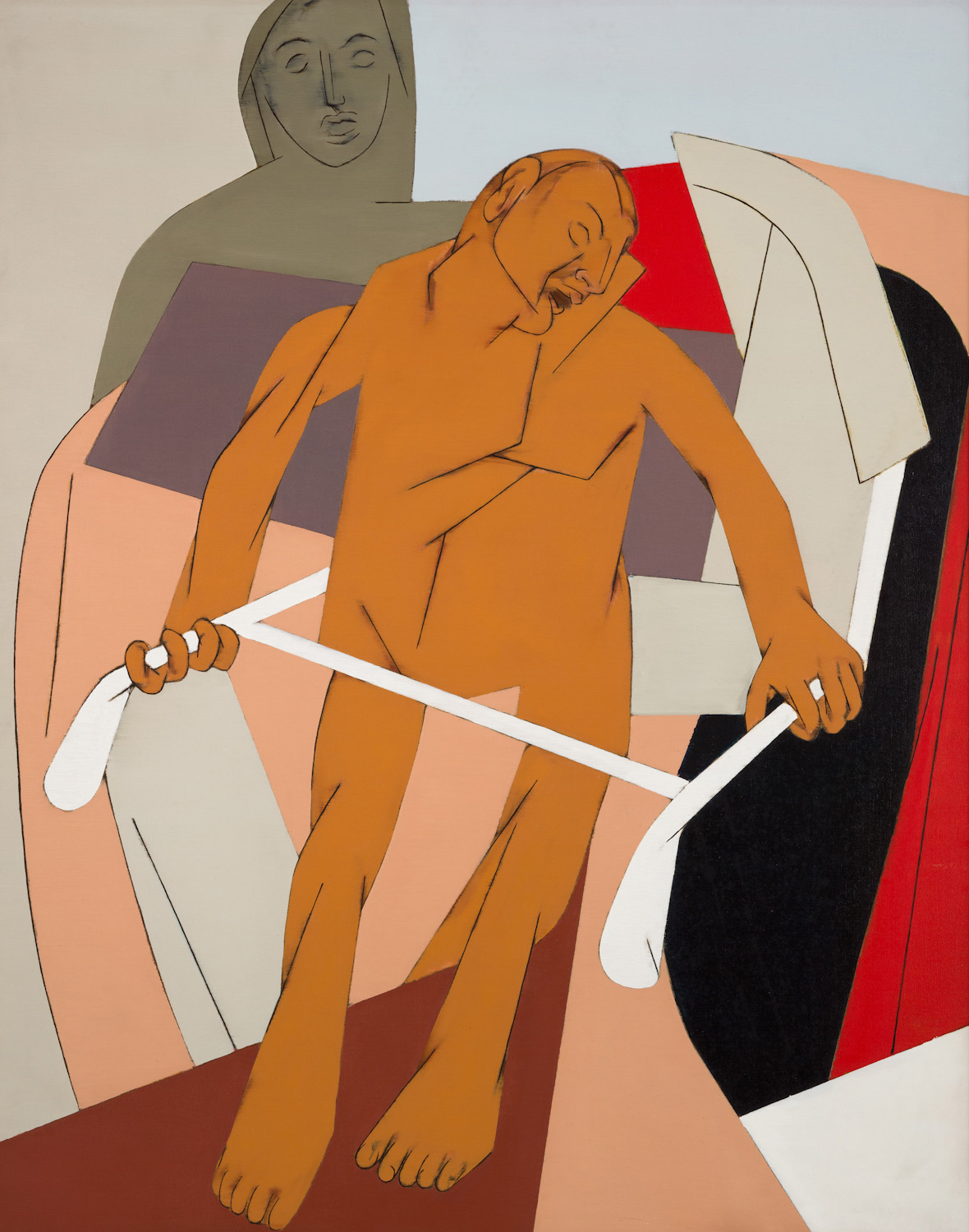
Tyeb Mehta, The Rickshaw Puller, 1982
Contemporary and modern elements as descriptors and deconstructions of the body are also well represented in the exhibition. Tyeb Mehta’s “The Rickshaw Puller” presents its titular subject in pained cubist-esque motion. The body of a working class man, twisted in a grotesque and celebratory fashion. The colors of the painting, loud and menacing oranges and red present a figure melding into the means of its livelihood. “Peasant Couple” by M.E. Husain is is a dizzying meld of contemporary technique and the heavy spiritual traditions of old India. The figures, laden with heavy and overwhelmingly bright oils are monuments in their own sense, the saree of the peasant woman a dream-like representation of traditional garb.
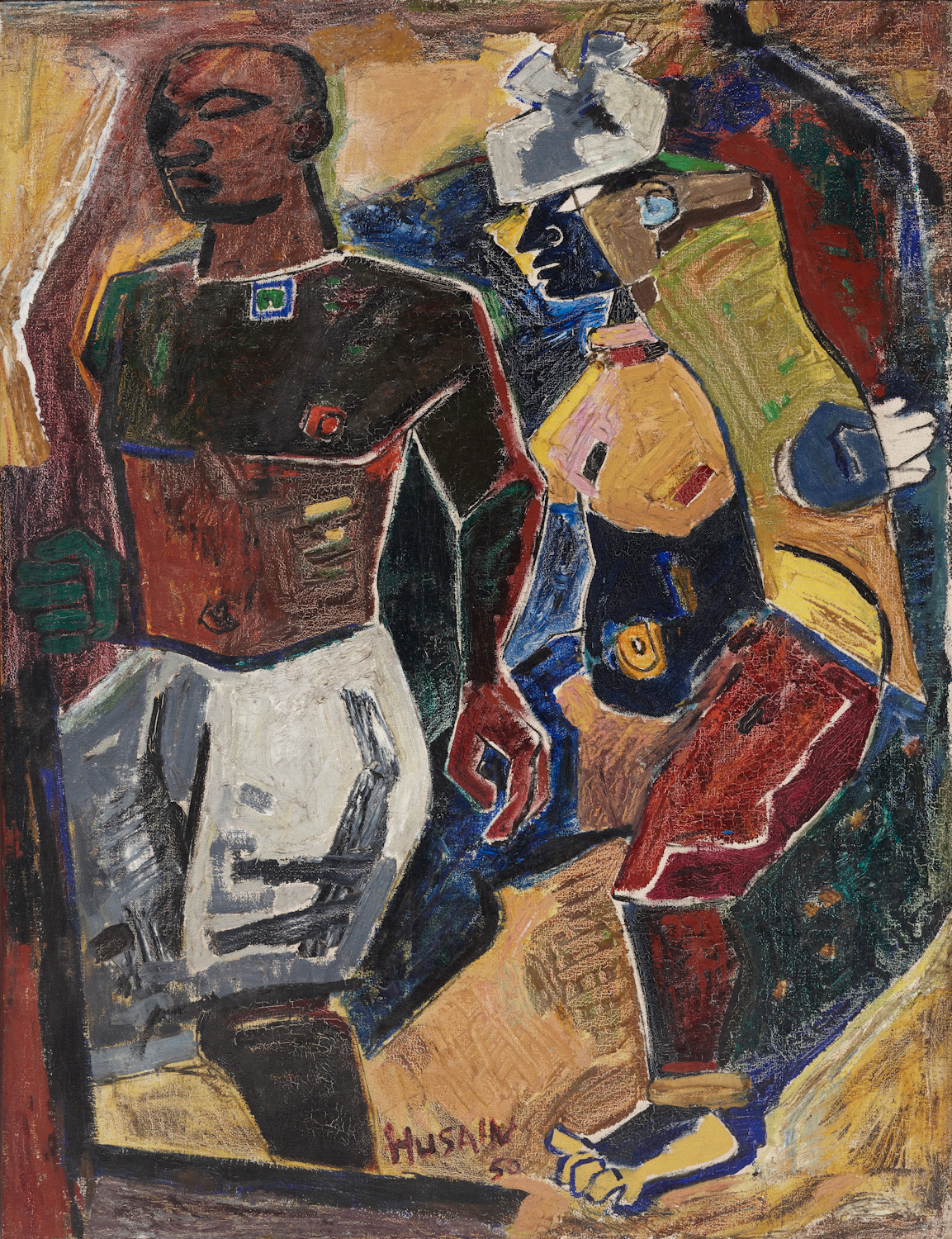
Maqbool Fida Husain, Peasant Couple, 1950
Atul Dodiya’s “The Bombay Buccaneer” presents a tripped out, triumphant portrait of Bollywood glamor, the coolness of an action hero in an imposing foreground. It’s an ironic contemporary appreciation of campy cinderella stories that define the narratives of Indian popular culture. It’s a flattened depiction of a rags-to-riches tale, a hero brandishing a gun with comic stoicism, a purposeful simplification of the reality of contemporary Mumbai.

Atul Dodiya, The Bombay Buccaneer, 1994
The exhibition is a testimony to the contemporary’s power, the power of abstraction and the freedom from traditional schools of thought, a psychic marriage of emotional and cultural context with physical reality. In a country with so rich a tradition as India, it’s especially significant. There are multiple levels by which to view this exhibition, depending on how aware one is of post-colonial history, economics, and constructs of race, urbanity and western influence. At its core, it’s a well curated exhibition with an easily digestible overarching theme, despite the fact that its building blocks are steeped in endless chronology.
MegaCity: India’s Culture of the Streets runs until December 31, 2017. For more information, visit the following link: http://pem.org/exhibitions/189-megacity_indias_culture_of_the_streets
Images courtesy of: The Chester and Davida Herwitz Collection, Peabody Essex Museum, Salem, Massachusetts