Diractors is an ongoing series in which Hassle writer Jack Draper examines films, new and old, whose directors are better known for their work in front of the camera.
There’s a real chilliness in Richard Attenborough’s Magic that isn’t produced from a sense of loss or anger. Everyone is cold and sad, even without the movie becoming an exhausting watch. I don’t even think this is an emotionally filled movie (complementary); rather, the reach for a lost love only adds to the chilliness. A large part of the movie is interested in rekindling romance, but that desperation only adds to the sadness. All that is rewarded to the movie, and yet there’s no snow. Maybe it’s a quality from the ’60s and ’70s horror (specifically pre-Halloween) at which Magic excels: movies that appear to be performance-driven dramas which then slowly drive themselves down into the deeply unsettling (see also Don’t Look Now). Yet Attenborough doesn’t wimp out by giving this loser any sort of redemption.
Said loser is Corky Wither (Anthony Hopkins), a magician who is failing at his first few shows under the management of Ben Greene (Burgess Meredith). Corky returns to the stage with a ventriloquist dummy named Fats; his new act is a hit, and Ben is all the closer to signing a deal for Corky for his own TV show. Through embarrassment and guilt, Corky doesn’t go through with advancing his success, instead retreating to his childhood home. Corky suffers from mental illnesses and an inability to control Fats’ words. He reconnects with high school crush Peggy (Ann-Margret), who is stuck in a hopeless marriage, and woos her with his magic act. In a moment of sincerity, the magic is used for a charming effect, the creepy tone offset by Corky and Peggy’s scenes together. Soon after, Fats, gaining increasing consciousness, begins to overtake Corky, leading his already mentally vulnerable host toward violence among the small cast. Hopkins plays the haunting ending beautifully, even as Corky and Fats dig themselves down too deep.
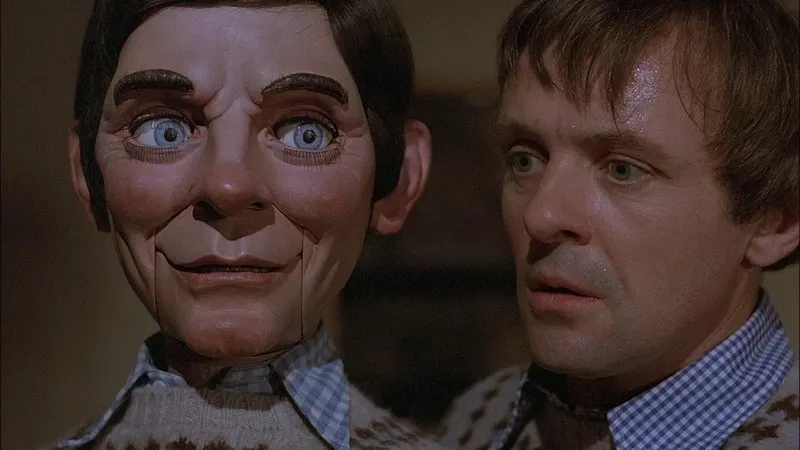
I’m trying to be vague with where the movie goes; while there are no great moments or scares, Magic worth seeing for Hopkins’ performance. Attenborough has a control of the mood that I really responded to, and the film has the advantage of being a product of its time. This isn’t the abhorrent The Monkey or Annabelle (which are very different movies, to be fair) which take advantage of their inanimate characters to say something about the loss of innocence. It’s just the story of a very stupid and scary dummy that takes advantage of a lonely magician. Fats has such an eerie look here; how rosy red his cheeks are and those big ears. I hated him and how he couldn’t be beaten with a baseball bat. The ending he shares with his puppeteer is equally haunting. It’s easy to think of Hitchcock watching the mess the murders get them into.
Richard Attenborough was quite the maverick of the greatest generation. Not even of the silent generation or a boomer like you’d think; Attenborough is someone who is eternally 55 years old at most. It doesn’t help that his most famous acting role since becoming a filmmaker was supporting his peer Steven Spielberg with a little indie movie called Jurassic Park. That a generation of moviegoers knows him primarily as grandpa John Hammond stamps him into that age cinematically, despite any work before it. (See also Max Von Sydow in The Exorcist). But Attenborough was professionally active long before his directorial debut (the 1969 musical Oh What a Lovely War) as an air force pilot during WW2. He began in the theater in 1937 and moved to film in 1942. Scanning his filmography, you can see there’s not much he was ready to reach for out of what he knew. Acting in stately dramas that felt familiar to him like how he performed on the West End or British war pictures as someone who was really. I particularly enjoy him in A Matter of Life and Death and Seance on a Wet Afternoon.
But for his directing, it’s funny to see how much of a switch up Magic is before and after for Attenborough. His earlier films, such as Young Winston and A Bridge Too Far, are “important,” David Lean-esque period dramas. What makes Attenborough look like he is in a comfortable space is how this is a work of adaptation of William Goldman, helping him bring his novel and screenplay to life. Even saying that, Attenborough and Hopkins weren’t the first choice. One time it was Norman Jewison and Jack Nicholson, then Steven Spielberg and Robert De Niro; once Attenborough was tapped he wanted Laurence Oliver. He couldn’t make it happen, but I see where Attenborough was thinking even though you really can’t imagine anyone else but Hopkins playing Corky. I think this could be really lame if it were any other hands and talent, kind like another Hopkins horror picture from this era in Audrey Rose, But Richard Attenborough makes himself out to be a fine director of tension and wish he made another thriller. Also nice that he had Burgess Meredith as Ben Greene and not himself as Meredith is superb here. Eerie Jerry Goldsmith score, too. When’s he bad?
Magic
1978
dir. Richard Attenborough
107 min.
Currently streaming on Kanopy, Tubi, Shudder, the Roku Channel, Night Flight Plus, Amazon Prime, and many other platforms