
The Boston Baltic Film Festival runs from Friday, 2/27 through Sunday, 3/1 at the Emerson Paramount Center, and through 3/23 virtually. Click here for the schedule and ticket info, and follow along with my multi-outlet coverage at the Boston Hassle and There Were No Gods Left.
Renovation

I was a year younger and lived somewhere else the first time I saw Gabrielė Urbonaitė’s Renovation. Now, I’m a year closer to 30 and just moved out of the hotel where I lived for almost two weeks while intense repairs were being made to my new apartment. As miserable as the whole affair was, it may be worth it simply for the way Urbonaitė’s film resonates with me even more. I adored the Lithuanian romantic drama the first time. It finished pretty high on my list of the 10 Best Films of 2025. The second time around, I am convinced it is a masterpiece.
Žygimantė Elena Jakštaitė plays a young woman named Ilona in Vilnius on the eve of breaking into the tricenarian club. The work-from-home Norwegian translator just moved into an apartment with her boyfriend, and major building renovations disrupt her workday. A hot Ukrainian man named Oleg (Roman Lutskyi) on the construction team tempts her during the day while her partner, to whom she isn’t positive about committing, is at work. The scandalous and infatuating romantic pickle teaches her a lot about herself, her desires, and her vision for her future.
Like Ilona, I too work from home. The month-long repair work on my own apartment, before the extra two weeks in a hotel, was a major disruption. (There were no attractive Ukrainians, though.) The metaphors of both a new place and renovation for turning a new page in life work so well it’s a wonder they aren’t overdone tropes. Ilona’s life is familiar and new, safe and scary, dull and exciting all at the same time—and the frustration of the new move to a building in construction pulls this out in a way a more ordinary context wouldn’t. Construction also contradictorily implies both repair and improvement, a nuance perfectly suited to capture her turning point.
Lithuanian director Urbonaitė (an Emerson grad) creates a world which feels as if the characters actually live there. Even Ilona’s oversized-hoodie-and-messy-bun vibe make her relatable. The warm 16mm adds a used texture to the cinematography. The books, dishes in the background, and magnets on the fridge could have stepped out of any of our homes and into Ilona’s. She even has racist neighbors! Their problems are also recognizable to any of us: indecisiveness, aging, insecurities, love, infidelity. You don’t have to be turning 30 soon or experience an apartment trauma of your own to find Renovation relatable.
The intimacy choreography does so much of the storytelling. The first time we see Ilona and her boyfriend Matas (Šarūnas Zenkevičius) have sex, the couple is clearly enjoying themselves. They share earnest laughs as they mix-up and figure out their positioning. The pleasure is equitable too. This tells us a lot about their relationship: they love one another, but, as symbolized by the imperfection of the sex itself, they still have a lot to figure out.
The next time—after Oleg has caught Ilona’s eye—lacks the same passion. Neither of them, and also both of them, are to blame. There will be no climaxing this time. Her mind is elsewhere (i.e. the muscular Ukrainian construction guy), and he is looking for an excuse to get upset with her. Rocky and rough handheld camera work crystallizes the disappointing mood. The bedroom even appears a smidge darker and their faces less transparent. It is as if a shadow has been cast over the sex.
The sexiest scene comes from elsewhere. While Ilona and Oleg never fuck, they do share one fleeting kiss. And it’s the sexiest scene in the film because of the yearning preceding it. (Urbonaitė and cinematographer Vytautas Katkus skipped the foreplay in both sex scenes, opting to drop us in-media-res onto the bed). Her eyeline greets his lips well before their lips meet. They want to devour each other but, not unlike the couple in Wong Kar-wai’s In the Mood for Love, refuse to take their affair that far. Taking place on the roof of the apartment complex, the skyline of Vilnius is much more romantic than the dark room with a small bed.
Though not as splashy as the visuals, the writing is clever. The characters’ day jobs add a great deal to the rich themes. Oleg’s construction work, as already mentioned, presents an alluring image of change. So too does his foreignness. It’s a blue collar job at odds with Ilona’s white collar translation life. Her translation work is about parsing meaning in a confusing world; she makes sense out of what sounds like gibberish to others and then relays the meaning.
Matas also has a niche occupation. He is a tour guide for tourists. When we see him work, he uses English (acting as a translator himself). His job adds a political dimension to Renovation too. The final scene—a sweet moment between Ilona and Matas after one of his tours—uses the history of Lithuania to situate their relationship. He ends the tour at the Bastion of the Vilnius Defensive Wall, a powerful architectural symbol of the city’s resilience. Love is also resilient.
Rolling Papers
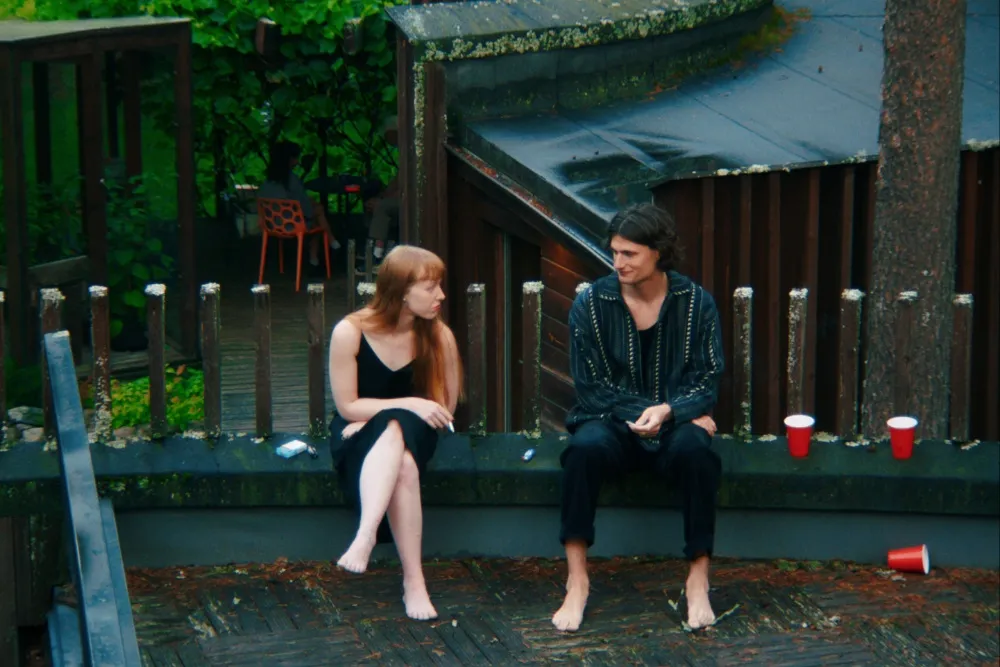
Much like Renovation, the Estonian mumblecore Rolling Papers follows a character at a crossroads. Sebastian (Mihkel Kuusk) has no direction in life. He works (not too hard) at a convenience store—one of cinema’s great symbols of the deadbeat—and becomes friends with Silo (Karl Birnbaum), who also lacks ambition. They dream of leaving Estonia for Brazil.
The weather, it seems, is the primary instigator for their dreams of escape (and not the aggressive empire to the east or any real social issue). Brazil is not just warmer though. It’s also much bigger… and it’s almost big enough for the ambitious dreams that neither of them actually have. They waste their time together smoking weed and listening to Soundcloud aesthetic stoner music, reminiscent of the humor in director Meel Paliale’s first film Tree of Eternal Love (which played at the 2023 Boston Baltic Film Festival).
I found Rolling Papers more compelling not as a comedy but as an indie romance. Sebastian strikes up chemistry with Nora (Maria Helena Seppik) and the film makes a tonal pivot with the couple. The music largely cuts and the comedy cuts back. They are sweet and compelling together, even though things are never perfect between them, and it’s in no small part because of how real they feel together. A meandering scene of them watching an old Hollywood film with Nora’s dad—and then, losing track of time in the streets afterwards like young loves—illustrates their endearing chemistry. Every snap back to Sebastian and Silo comes with a little regret for time lost with Nora.
The film was Estonia’s selection to represent the country at the 2026 Academy Awards for Best International Feature (it was not shortlisted). It also won the Audience Award at the 2024 Just Film Festival (a youth and children’s themed sub-festival of Tallinn Black Nights Film Festival). It’s popular at home, to put it simply. Maybe a small part of this popularity is its charming photography of the Estonian capital. I spent half a month in Estonia just one time and even I recognized several locations, such as the historic Kino Sõprus. To an Estonian, the locations of these capital-wandering lost souls must be a fun game of Where’s Waldo.
The camera work by Markus Mikk is beautiful at nighttime. Colors pop like in a great music video. With Sebastian and Nora, it’s as if the city is theirs and theirs alone at night. The two-shots of them, and the minimal intrusion of others, let their romance unfold within a cute bubble of its own. The frequent and often puzzling zooms, on the other hand, do little for Rolling Papers. They are almost as unmotivated as Sebastian and Silo’s dreams of South America.
Rolling Papers
2024
dir. Meel Paliale
97 min.
Renovation
2025
dir. Gabrielė Urbonaitė
90 min.