Five years after setting the world on its ear, the COVID-19 pandemic still seems to be a bit of a taboo subject on screen. As Hollywood lurched back into production, there appeared to be an unspoken mandate not to include masks or references to the disease, perhaps in an effort to will us back to “normal.” While films have tackled the subject to varying degrees, most have either couched it in genre-inflected metaphor (Asteroid City, 28 Years Later) or framed lockdown as a you-have-to-laugh foible. With the exception of the memory-holed COVIDsploitation thriller Songbird, few films have yet been made about the pandemic— and fewer still have truly dug into the bad weirdness which came with it, the lingering effects of which might just be the longest COVID of all.
It’s fitting, in retrospect, that the first filmmaker to fully explore the dark headspace of the COVID era would be Ari Aster, cinema’s reigning poet laureate of the panic attack. Aster’s first two films, the twin masterpieces Hereditary and Midsommar, amplify the anxieties of familial guilt and codependence into operatic horror movies, while Beau Is Afraid is a sprawling, hysterical nightmare comedy of bottomless mommy issues. His latest, Eddington, falls between those two poles, alternating between broad social satire and harrowing acts of violence (both physical and emotional). To say it will not be for all tastes is an understatement, but it’s also safe to say there isn’t very much like it.
Eddington brings us back to the dark days of May, 2020. Lockdown is in full effect, mask mandates are just beginning to roll out, and unease is rampant even in the sleepy desert town of Eddington, New Mexico. Joaquin Phoenix plays Sheriff Joe Cross, who, despite his plainspoken swagger, is clearly at loose ends: his wife Lou (Emma Stone, continuing her truly wild post-Oscar streak) is increasingly distant, his mother-in-law (Deirdre O’Connell) is falling further down a rabbit hole of online conspiracy theories, and his asthma makes it difficult to wear a mask. What’s more, he’s got a combative relationship with charismatic Mayor Ted Garcia (Pedro Pascal), who plans to bring a massive data center to Eddington (and who seems to have a troubling past with Lou). Frustrated after a humiliating encounter with Garcia over the mask mandate, Joe impulsively announces (via Facebook video) his own run for mayor. But as tensions rise and the nationwide protests come to Eddington, Joe finds himself less and less able to keep a grip on himself.
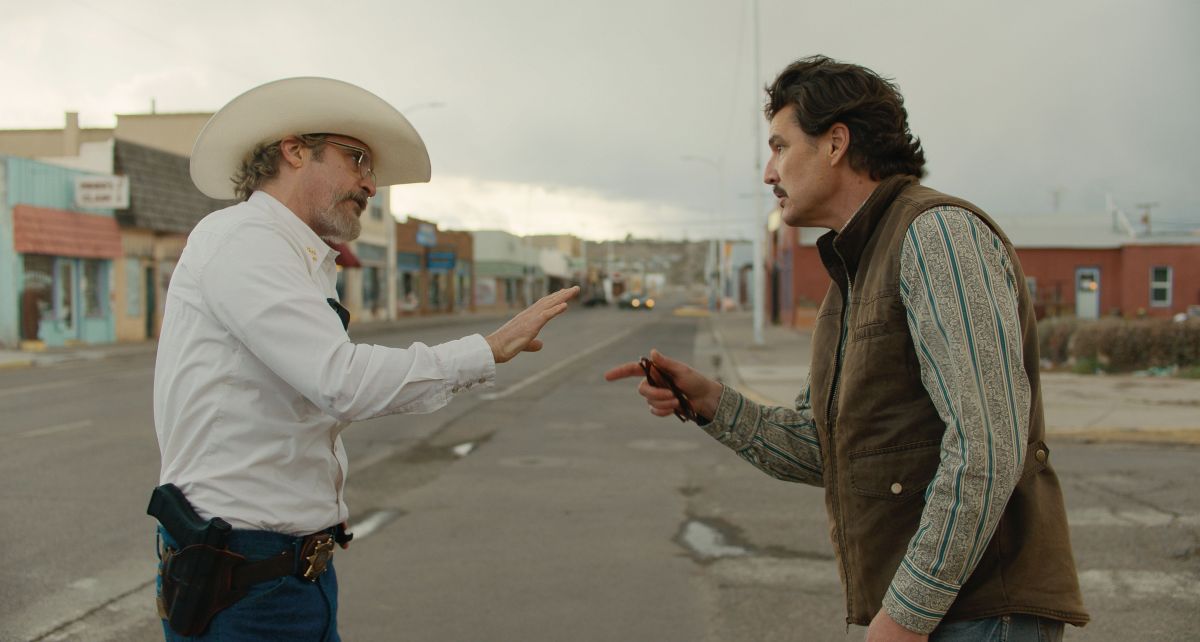
In the early outing, Eddington presents itself as a sort of aw-shucks sendup of COVID-era norms. Aster’s camera plays up the absurd visual of social distancing, masked shoppers nervously eyeing each other from six feet away in the grocery store; in due time, we also get obligatory jokes about elbow-taps, nasal swabs, and privileged white kids staging Black Lives Matter protest (despite the fact that Eddington’s seemingly only Black resident, played by Micheal Ward, is one of the police officers sent to disperse them). Joe is positioned as a sort of Hank Hill figure, the plainspoken everyman pointing out the ridiculousness of the situation (“There’s no COVID in Eddington!” he protests after being told to mask up in his car). Mayor Garcia, meanwhile, is a smug signaller of virtue, toeing the we’re-all-in-this-together party line and pausing for applause. During the film’s (slightly meandering) first act, progressive viewers might find themselves a bit queasy, as if they’ve been tricked into watching a big screen adaptation of their most embarrassing uncle’s Facebook feed.
But Aster is playing a far slipperier game, and Eddington ends a far different movie than it begins. As in Hereditary, the plot hinges on a shocking and unexpected act of violence, and while the moment is not quite as brutal as that film’s infamous swerve (though there were more than a few gasps in the packed preview screening at the Brattle), the pivot is even more dramatic. Suddenly, the realities of living in 2020 are a lot less silly, and the film transmogrifies into something much more sinister. There are still laughs to be had in the film’s back half, but they are of a far bleaker nature. In an instant, Aster reminds us that, despite his recent forays into absurdist comedy, he’s still the guy who made fucking Midsommar.
Like the COVID-19 pandemic itself, there is so much going on in Eddington that I imagine it will take some time to fully unpack. Aster reportedly began the writing process at the height of lockdown, and one can sense layers upon layers of ideas piled upon each other from subsequent drafts (Stone’s arc, which finds her sublimating her trauma and depression by falling under the sway of a charismatic QAnon preacher played by Austin Butler, is so quintessentially Aster that I half suspect it was originally the A-story). To be sure, some of the material works better than others; the BLM gags in particular feel a bit hokey and ill-advised (though the white, mulleted deputy who decks himself out in layers of body armor to disperse a couple of dozen teenagers is a wonderfully wry image). At its best, though, Eddington captures the madness of that maddest of years, that terrifying mix of dopey cabin fever and the very real sense that the world actually might be coming to an end. It also firmly announces the arrival of Katy Perry’s “Firework” as a pop cultural punchline, and honestly thank god for that.

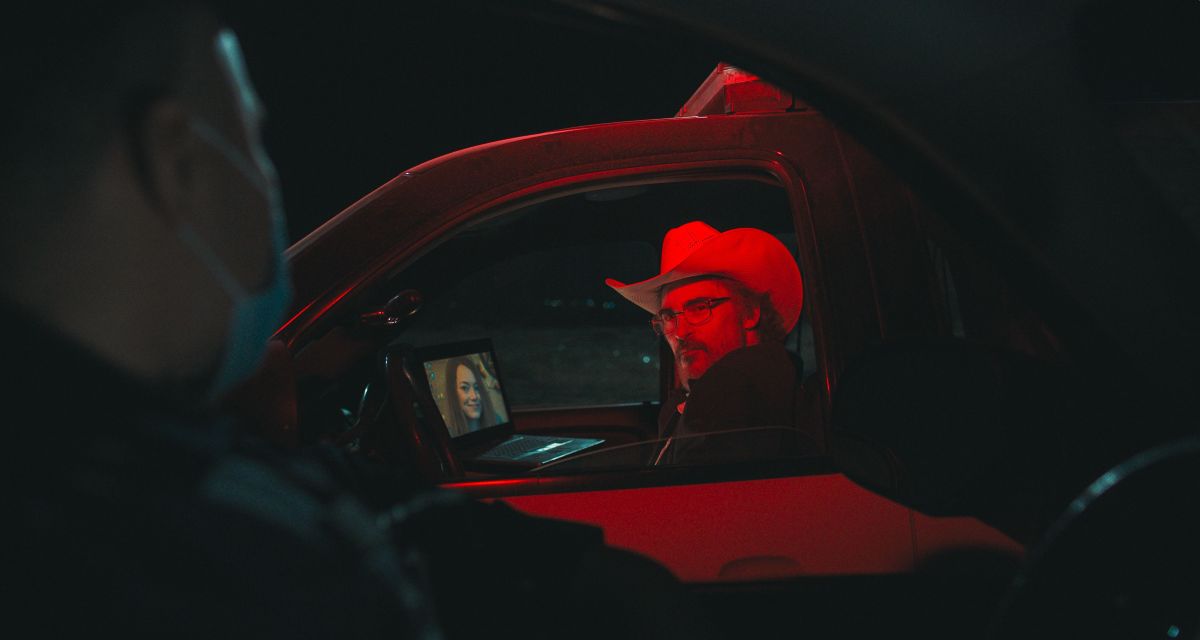
The key to Eddington probably lies in Phoenix’s deceptively nuanced performance. Joe Cross is a guy you’ve probably seen before, if not in person, then at least typing bombastically into social media. He certainly looks the part, with his well-worn Stetson and his appealingly graying beard. But Phoenix plays the sheriff as something like Joe Arpaio inhabited by the spirit of Woody Allen, a ball of neuroses barely contained by his jangling spurs. He mumbles his way through confrontation; even when he stands up for his beliefs, you almost expect him to blow away. His mayoral run, announced so confidently on social media, shrivels almost immediately upon entrance into the real world (his campaign vehicle is also his patrol car; in one of the film’s funniest running gags, he has to drive this gaudy, tinsel-strewn SUV to actual crime scenes). He is, in other words, like a lot of real-world COVID cowboys: handy with a sound bite from the remove of social media, but lacking substance in the flesh.
Fittingly for a film about a polarized America, Eddington is shaping up to be one of the most genuinely polarizing films in recent memory; as the lights went up I could overhear lots of raves and lots of pans, and very little in between. Indeed, the film seems to be made to shortcircuit the brains of the “representation = endorsement” crowd (I truly pity the moderators of Letterboxd in the days and weeks to come). Eddington is, as the kids say, a lot, alternately brilliant and frustrating, funny and horrifying, messy yet immaculately constructed. This is, perhaps, as it should be. The COVID-19 era— which, to be clear, continues to this day both literally and spiritually— is defined by incoherence, by free-floating anger and cries for help wrapped in the irony of memes (it is no coincidence that the film’s climax involves a literal dumpster fire). Just as the first film to directly dramatize the Vietnam War was Francis Ford Coppola’s hallucinatory Apocalypse Now, it seems only fitting that the first film to truly confront the COVID-19 pandemic (as well as, astoundingly, maybe the first COVID film in which someone actually gets COVID) should be something so wild and personal and more than a little crazy. We’re living in Ari Aster’s world; may god have mercy on our souls.
Eddington
2025
dir. Ari Aster
145 min.
Opens Friday, 7/18 @ Coolidge Corner Theatre, Somerville Theatre, and theaters everywhere

Thanks for your take on the film and Aster’s body of work. I do think you overrate Midsommar. Hereditary was the rare contemporary horror film driven by keen intellect, and a powerhouse performance by Colette that seemed to up the ante on the ensemble’s performances. I couldn’t sense the same working intelligence in Midsommar and it didn’t have a performance on the level of Colette’s. Beau is Afraid was a bloated disaster, wasting a rare film appearance by Patti Lupone on a tepid story. I haven’t seen Eddington yet, but I live a few blocks from the Coolidge so I might as well see it while its still there