
Young viewers who grew up in the age of “elevated horror” will likely have difficulty grasping just how fresh 28 Days Later felt when it arrived in 2002. It was a particularly fallow period for the genre, which, in the wake of Scream, was dominated by glibly ironic studio offerings starring model-pretty refugees from Dawson’s Creek. There were decent imports, mostly from Canada and Japan, but you had to know your way around a video store to find them; there were high class affairs like American Psycho and The Sixth Sense, whose publicists worked overtime to convince you that they weren’t horror films at all; and, of course, there was The Blair Witch Project, but everyone at the time seemed to agree that was an unrepeatable fluke (a suspicion borne out by the disastrous Book of Shadows: Blair Witch 2). To the casual moviegoer, horror was itself a zombie genre, more Spirit Halloween than John Carpenter’s Halloween.
This was the context in which 28 Days Later tore its way into multiplexes like one of its berserk, convention-defying zombies. It wasn’t just its nervy, handheld, mini-DV aesthetic, which didn’t look like anything else at the time; it was the very idea that we might get a fresh, earnest horror movie which was also, crucially, really fucking good. While it has not yet actually been 28 years since that original film, the new three-quel 28 Years Later comes at a much different moment for the genre, when critically acclaimed horror is now the rule rather than the exception. Thankfully, original director Danny Boyle and screenwriter Alex Garland have crafted something which feels very nearly as fresh now as its predecessor did in 2002. 28 Years Later has done the impossible: it’s made me excited for a new zombie film.
Canonically, the action does indeed pick up 28 years after the original outbreak. England has reverted to a sort of feudal state, with individual islands and villages establishing their own rules to ward off the infected. Young Spike (Alfie Williams) lives on a particularly remote island, which has effectively blocked itself off from the man-eating hordes and grown into a close-knit, very English community (they’ve even got their own motto, woven into a tapestry which hangs over raucous singalongs in the town pub: “Fail we may, but go we must”). Spike lives with his father, Jamie (Aaron Taylor-Johnson), a stoic sort raising his son to be tough enough to survive this hostile world, and his mum, Isla (Jody Comer). Isla is sick— not with the Rage, but something which nevertheless causes mood swings and bouts of confusion— but with no medicine on the island there’s not much she can do but remain confined to her bedroom. When Spike learns of a (possibly mad) doctor living somewhere in the wilds of the mainland, however, he drags his mother out of bed and into the zombie-infested wood in a desperate quest for treatment. Fail he may, but go he must.
Failure would be just as likely if one were to attempt to recapture the magic of 28 Days Later in 2025. As original as it was at the turn of the millennium, the tone and structure of that film has been internalized as a dominant mode of 21st century horror thanks to the TV success of The Walking Dead and the waves of dreary survivalist fantasy which have popped up in its wake. Thankfully, 28 Years Later is a very different beast. There is a puckish wit and madcap energy which (re-)animates the proceedings, at times recalling the berserk “splatstick” comedies of the young Sam Raimi and Peter Jackson. The tone is set in an opening flashback, in which a family of screaming children are terrorized to the strains of the Teletubbies theme. In the two hours that follow, Boyle places his camera everywhere from inside a corpse being devoured to the heaving, bloated back of a decaying zombie (in addition to the series’ signature sprinting ghouls, this entry introduces “fat ones,” who mostly slug around on their bellies eating worms; I’m not sure the scientific logic behind this, but it’s a wonderfully grotesque visual). Kill shots are emphasized with freeze frames on exploding heads, as if we are playing some wickedly transgressive video game. This is all in addition to a newfound pop-art editing style, weaving in clips of WWI stock footage and old Robin Hood movies, and an immersive, experimental score by Scottish hip hop outfit Young Fathers. After two decades mired in po-faced prepper-porn, it’s a welcome reminder of the gnarly fun that can be had with this particular subgenre. Against all odds, Boyle has once again breathed new life into the zombie movie (so to speak).
It’s also breathed some new life into him. When they made 28 Days Later, Danny Boyle was the edgy enfant terrible behind the indie film smash Trainspotting, and Alex Garland was the postmodern novelist whose The Beach Boyle had adapted two years earlier. Boyle has since pivoted to pop-humanism following his Oscar win for Slumdog Millionaire, and Garland has made a name for himself as the director of such satirical social horrors as Civil War and Men. Here, the pair once again brings out the best in each other: Garland’s script gives Boyle license to be punchier and nastier than he’s been in ages, and the director’s knack for character softens the sledgehammer-subtle excess for which Garland is often criticized. This is both filmmakers working, if not necessarily at their peak, then at least in a space which maximizes their respective gifts, and I hope their collaboration extends beyond this film’s two planned sequels.
Garland’s script is filled with his trademark barbs and commentary on the state of our own world (this is very much a post-COVID film), but perhaps his drollest note is the revelation that this zombie apocalypse is, even after all this time, confined to the British Isles. International authorities, it seems, quickly and effectively quarantined the region (must be nice), allowing the rest of the world to carry on as normal as the UK continues its spiral into chaos. This leads to some amusing scenes of culture clash when Spike crosses paths with a wayward Swedish marine, who tells a story about a friend who’s an Amazon driver before remembering, “Right, you don’t know what ‘online’ is.” But it also provides a bit of meta-commentary on the “legacy-quel” phenomenon. To the adults born in the Before Times, history literally froze in the early 2000s, trapping them in Y2K-era amber (when Isla flashes back to her childhood, her pastoral London village is accompanied by the screech of a dial-up modem). Plenty of reboots pretend it’s still the good old days; Garland and Boyle find a cheeky way to make it canon.
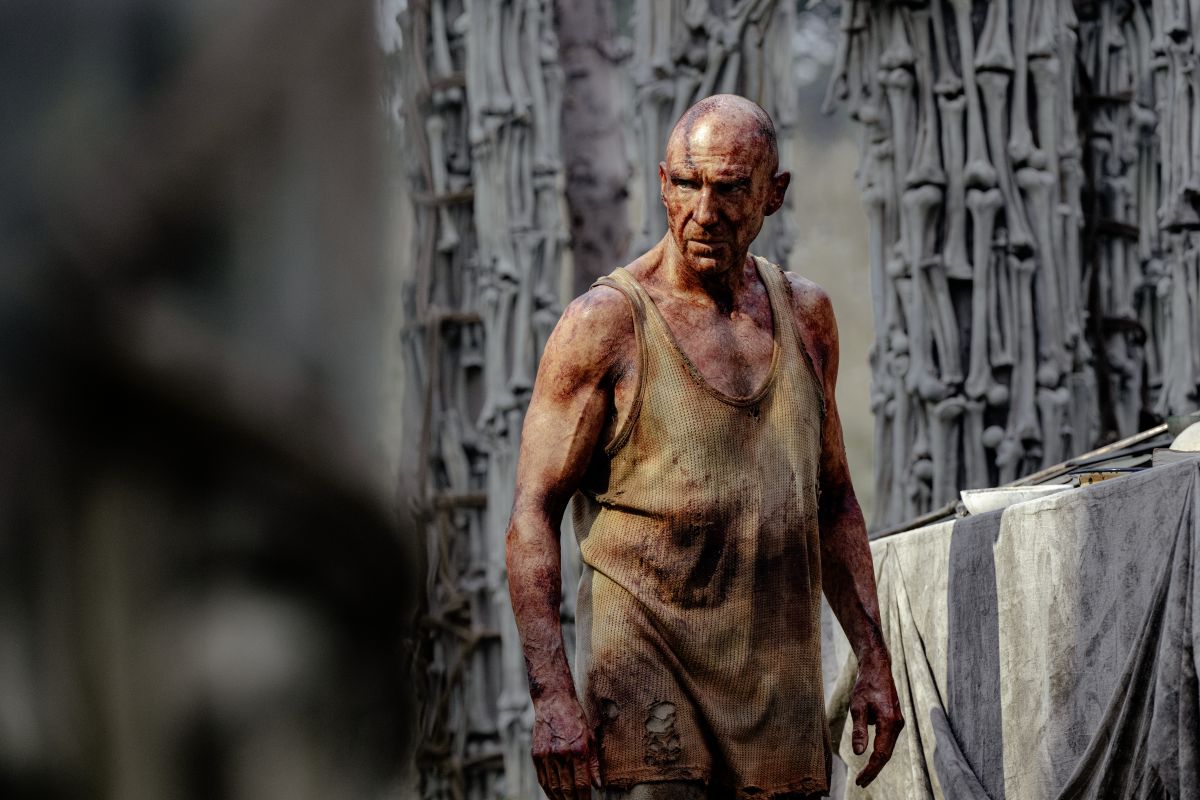
I realize I’ve made it several paragraphs into this review without touching on the best and most distinctive element of 28 Years Later. The medic at the end of Spike’s journey, is one Dr. Kelson, played by the great Ralph Fiennes (clearly enjoying his post-Conclave victory lap). Fiennes embodies the role with his trademark gentility, despite the fact that Dr. Kelson is, at first glance, a Colonel Kurtz-style madman perpetually drenched in a blood-red dye (iodine, he explains, to ward off the virus). Dr. Kelson lives in a massive temple of his own design, built from the carefully cleaned bones of several decades worth of dead. He’s the sort of character you instantly want to see more of (which I imagine we will; the film’s sequel, already shot by Nia DaCosta from another Garland script, is subtitled The Bone Temple).

Dr. Kelson is a perfect embodiment of 28 Years Later’s gonzo sensibility, but also, in his peculiar reverence for the dead, its heart. Perhaps incongruously for a zombie flick, 28 Years Later is a remarkably thoughtful meditation on the acceptance of death. Its characters live in a world even more brutal than our own, yet its characters— the ones who make it, anyway— must make peace with their own mortality, and that of those around them. The film ends, more or less, on a strikingly lyrical ceremony which makes peace with death in a way Hollywood blockbusters are rarely permitted. 28 Years Later has (by my count) more exploding heads than We Live in Time, yet I found its take on grief and perseverance far more honest and moving. It has a more memorable childbirth scene, too.
As Hollywood chums its way through its current phase of endlessly renewable intellectual property, it has become grimly inevitable than any half-remembered film from years past will be hauled out of the closet for an overly reverential reboot. 28 Years Later represents the best-case scenario of this cycle: a case where the minds behind the original work return not to recycle the same beats, but to find new and exciting things to do with the world they’ve created. Though a sequel in name and continuity, 28 Years Later feels like a blast of originality when we need it most. Like those pesky monkeys which started this whole mess, its sense of perverse abandon is infectious.
28 Years Later
2025
dir. Danny Boyle
115 min.
Opens Friday, 6/20 @ Coolidge Corner Theatre, Kendall Square Cinema, Capitol Theatre, Apple Cinemas Cambridge, and theaters everywhere