
Like all of his films, Zack Snyder’s digital-embracing two-part space opera on Netflix, Rebel Moon – Part One: A Child of Fire and Rebel Moon – Part Two: The Scargiver, is only as good as the strong aesthetics of the film allow it to be. If you love the way Snyder thinks as a creator of images, Rebel Moon won’t disappoint; if you can’t stand the images of Zack Snyder’s Justice League or 300, you’re not likely to find a new personal response with his two newest films. He is a visual stylist and these are arguably his most personal images yet.
And a big part of Snyder as a great director of images is his incredible ability in selecting his fellow creative team. His long-time collaboration with cinematographer Larry Fong — from 2006’s 300 to 2016’s Batman v Superman: Dawn of Justice — might be the most public of these collaborations. He has also enjoyed a fruitful collaboration with editor William Harry Hoy. But his latest creative partnership is with VFX Supervisor Marcus Taormina, who has supervised his three Netflix films — which feature arguably the the most quasi-experimental and bold visuals of his filmography, a burden that the visual effects department bears much of the brunt for.
Taormina’s been in the industry since the late 2000s and has worked his way up from a visual effects data wrangler on 2009’s Dragonball Evolution all the way to the VFX supervisor on one of Hollywood’s most original image-makers’ magnum-opus. The effects in the Rebel Moon films are sometimes daringly simple; at other times, they flash with violence. In our interview, Taormina discusses adapting to Snyder’s experimental custom lenses, dives into the technical aspects of how they created the interactions between the wheat and the spacecraft engines, and more.
Enjoy this glimpse into the creation of Rebel Moon.
The following interview has been condensed and edited for clarity.
BOSTON HASSLE: What is a visual effects supervisor and how did you get into the line of work?
MARCUS TAORMINA: I have a computer science background. I went to school originally for computer science, [though] I didn’t want to sit in code. [It wasn’t] for me. But I was like, “Okay, what do I really enjoy doing?” And making movies and grabbing a film camera or digital camera was something I just loved.
I loved photography, so I transitioned into media studies. From there, I ended up moving to Los Angeles. I found an opportunity to get into film and [when] I got my opportunity to get onto a feature film, it was in post-production and it just happened to be in visual effects.
I looked at what visual effects were and I knew some of [it already.] [Between teaching myself and classes], I knew green screen, how to pull a key, how to do compositing, animation. I explored all of that. I really enjoyed it… Of course, I also have a computer background– manipulating a computer to get what you want. And so, that’s where I got into this.
My job as a supervisor, the best way to describe it is I’m the conduit for the director for all the visual effects that they need to execute. I’ll talk to them about the intentions of the project. We’ll just talk about a shot for a second. “Well, how do you want to shoot this?” And then someone might go, “I want to do it all digital,” and I’ll say, “Great! But what about, what if we did some of it practical or this or that?” It’s just about talking about the way that we’re going to film things [and] educating them on maybe what won’t look good, what will look good. In post-production, I’m taking those pieces that we shot or that we didn’t shoot and either animating them or starting to put the layers of discipline on from visual effects. I liaise basically with the director and then I liaise with all the facilities that do the work.
BH: Is there just maybe one image or two images in Rebel Moon that you’re really proud of having worked on?
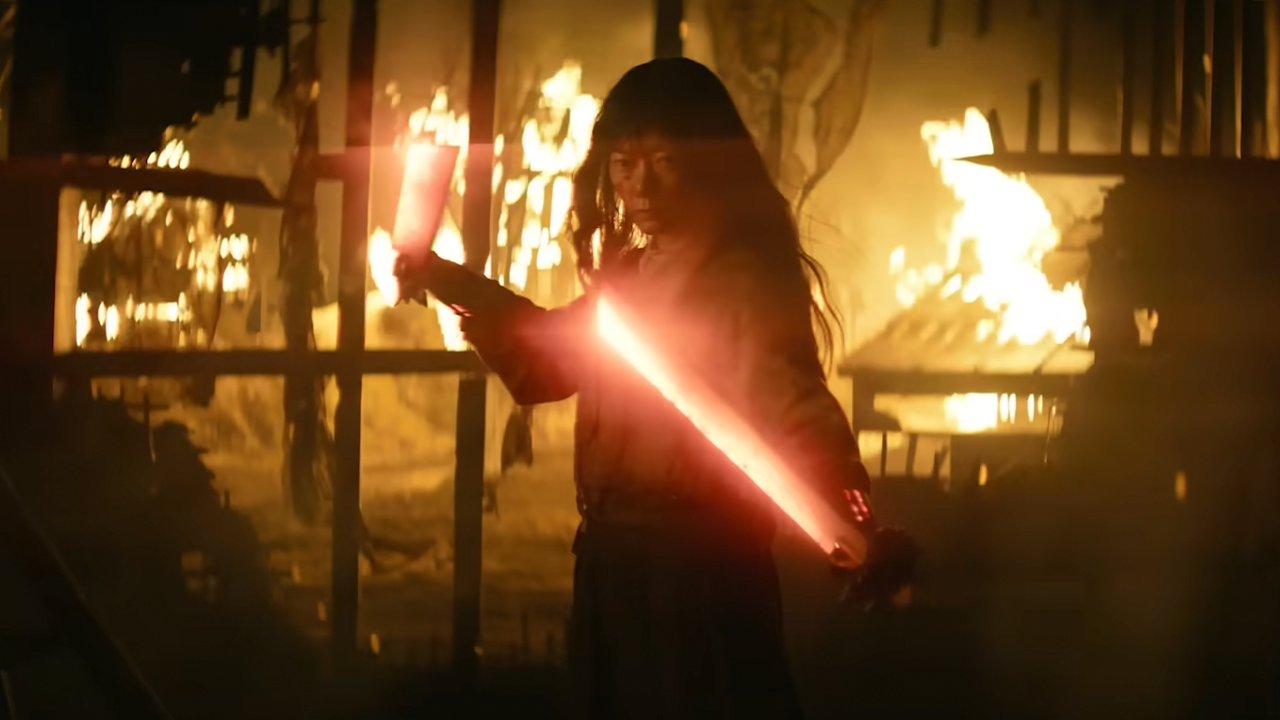
MT: Yeah, as far as [Part Two] goes, a series of images is like actually the final battle that lasted 38 minutes. There’s just so many cool shots there and that’s what we wanted to do. We obviously are trying to support what the story is, what the action is, but also just to make really unique, cool looking shots.
There’s one shot in particular behind Jimmy low on the ground, when he’s first revealed after we go to his face and he’s just all silhouetted [with] heavy dust and atmospheric effects, and there’s the mech in the background. That’s one of my favorite shots just because it feels so iconic. And it’s interesting because it’s one of my favorite shots [but it’s] also just all covered in dust, and one of the aesthetics of Rebel Moon is grimy, dusty fun. I don’t really necessarily navigate towards very clean and crisp digital shots. It’s just not our thing. And so I really like that one because it encapsulates everything that’s there [with] the dust, the grime. Of course, Jimmy is everyone’s fan favorite.
BH: Rebel Moon is a worn out universe in many ways, and I think that the visual effects are a large part of that. Speaking of the look of the film, Zack Snyder uses some pretty experimental lenses with Rebel Moon. How did that affect the visual effects and the work that you were doing?
MT: That’s great that you caught that. For [Army of the Dead], obviously it was very shallow as a f/0.95, which is insane. For Rebel Moon, he was like, “I’m going to do it again. I’m going to make custom lenses.” And I’m thinking, “Oh my God.”
[So, I’d ask], what are we doing [this time]? And he’s like, “anamorphic.” And I’m like, “Oh my God.” But… I love it too. I love the challenge. I also love the aesthetic of the lenses. It’s a creative choice, right? It’s his creative choice. Not everyone’s in love with the shallow depth of field, but it’s the choice [that] was made.
They’re one of a kind lenses. They’ve never been shot except in our movie. I don’t know if they’ll ever be shot [on] afterwards. I knew from [Army of the Dead] that I had to basically create a digital lens package. We did so much heavy lifting of those lenses and solved things after the fact. I wanted to do it up front.
With the help of a couple other supervisors and technicians, we created a bokeh [or blur] board and mapped these lenses. I did all sorts of optical flaring and tests on them to basically replicate what we got when we shot with them. And then…we created a completely controllable digital lens package for visual effects for either full CG shots to make them match one to one — so I could say I want to match the 35mm lens and we could literally like swap it and it would pop and it would match all the kerneling, all the unique distortion on them. Creating that was obviously very difficult, but also helped us in the long run. And then just matching: these lenses are so unique that three years in, I’m still seeing anomalies that have to double-check. [Sometimes things don’t look like how] imagery usually resolves, but then I look and it’s on the plate [too]. We’re not going to change it. It’s weird. It’s cool. Some people might think that because of the shallow depth of focus that we don’t have to use great detail. Like we’re always going to render all of our effects and the highest quality possible for the deliverable.
When we apply these optic passes digitally, it will shadow them out. You’ll lose detail. But what’s important is with the camera, dialogue, and the look that it’s consistent across the board. That was the biggest intent: to match when we were actually shooting. When we jump to the CG, [we don’t want] your brain thinking something’s wrong.

BH: I was astonished by a lot of the interaction between the ship engines, which I presume are mostly CG, and the wheat, which I understand was actually planted for the film. How were these effects accomplished?
MT: I appreciate that you did your research. So, we shot the movies at the same time. For [Part One], you get a lot of the landing. We had a helicopter come through and the rotor wash ended up being the thruster wash. We erased the helicopter and kept the thruster wash.
I’ll talk about the rotor wash for a second.
BH: Yes, please.
MT: Down the line, for [Part Two], once the wheat was harvested, there’s all the chaff and we knew we needed to also have a version of that. So even in [Part One], we knew we had to have it for [Part Two]. We knew we couldn’t do those helicopter passes, so we tried to make the effects match in a digital world, but then, when possible, we would shoot any reference we could. We had one helicopter day and we used that across all of them. Or, you know, we’d shoot with like a Ritter fan.
I also shot a bunch of elements of wheat chaff rolling. As far as the 10 acres of wheat that we shot, what’s cool is it was the supporting effects too, which I appreciate you saying. It’s the stuff that doesn’t get in the reels. But that was actually pretty tricky. When I laid out where we were going to shoot with the wheat, it was like eight separate locations and we had to make all those eight separate locations feel as one. I wanted to make sure they felt the same.
So, what we did was we tied into any sort of GPS data and then whatever was in camera and tried to be consistent where we put, you know, the craggly snow capped mountains, where we added atmospherics, where we felt like we could get away with just the Southern California rolling hills.
We had to do some extensions of the wheat, but the majority of it was in camera and we tried to be very selective with the heights of the camera, how we would see across the horizon. A lot of it was handheld in the wheat. And then just making sure we did a lot of 3-D mapping. We did a ton of drone orbitals so we could see the expanse of the wheat because the wheat was real, the majority of it, and it took a long time to grow and we’d have to figure out [the stages of that growth]. And as part of this, we also had to roll our digital Veldt, which was handled by two facilities. We had to have multiple tiers of wheat: the green wheat, the foot high wheat, the tall wheat, and then our post harvest wheat. There were multiple tiers of that that we had to bring into our digital world.
Rebel Moon – Part Two: The Scargiver is now streaming on Netflix