
Just before its Boston spring premiere at the Harvard Film Archive, I caught up with director Carson Lund to discuss his new film Eephus, the game of baseball, and the inevitability of death and decay. Enjoy!
BOSTON HASSLE: As soon as I found out it was a Western MA baseball movie, I was like, great. I’m there.
CARSON LUND: It’s more Southern Mass. It was written as a New Hampshire baseball movie. We had to shoot it in Mass for a number of reasons. And that’s just where we found the field.
BH: How did this process go? I was looking at Omnes Films and wanted to know more about that. Is it a production company?
CL: We’re a very loose collective.
BH: You guys did Ham on Rye?
CL: Yeah. That was sort of where, I don’t want to say that’s where it started, but basically in college I had a group of friends and we made a short film called Omnes, which then just grew into that group of friends making projects together. Short films, whatever came across. We would do some music videos too. But around the time we made Ham on Rye, we decided to call it Omnes Films just as a way to give it some identity. We wanted to continue making features and we knew we had similar sensibilities and we liked working together. So we’re like, more heads are better than none.
BH: Yeah. Let’s do this together.
CL: So it’s not incorporated as an actual entity. It’s just a name and logo.
BH: I like that. I’m just really interested to see how these very small, independent productions really come together. Do you just have the script for a long time waiting for financing?
CL: Right when we finished the script, we started looking for money. It was a continuous process. I think we started writing it during the pandemic, but the ideas for it had been bubbling up before that. I’d been having conversations about it with my two co-writers, Michael Basta and Nate Fisher. Once COVID hit and we had a lot of free time, we started working on it mostly on Zoom sessions and eventually in person. We wrote it for probably a year, maybe a little over a year. There were no deadlines. We could really go deep and keep coming up with ideas. It must’ve been like early in the year when we finished, and I wanted to shoot it in the fall.
BH: So you had to make sure everything started moving.
CL: Then it ended up being that we didn’t shoot that fall. We shot the next fall. So we ended up having a lot of time for pre-production. I was being too eager trying to get it, but I think you have to have that sort of urgency. Of course you have to act like it may not happen this year, but it’ll happen the next year.
BH: You have to act like it’s going to all fall apart like the next day if you don’t start right now, to really just keep the momentum there. That’s what Eephus feels like too, where it’s just like, “We have to keep playing. This is the last time we’re ever going to get to be here. We have to keep going deep into the night,” which I loved. How did you develop the characters? Do you have a lot of people in mind? Cause I feel like it’s a very eclectic group. Like there’s the guy from Uncut Gems.
CL: Keith William Richards. He’s amazing. I actually did have him in mind early on. I thought, this guy needs to be in something other than a crime film where he’s playing the heavy, intimidating people. I saw something there. He’s just such a vivid personality. His eyes are so intense. He was someone I had in mind, along with a few other people that I knew from New York independent films, like Theo Bouloukos and Keith Poulsen. I wanted to see if I could get them on board. Then there were some more unknown actors that I’ve worked with here in Boston that I wanted to bring back into the fold. So mostly we cast from the Boston casting pool.
I’d say like five or six of them I’d worked with previously. And then the rest were people we found through casting websites. A couple of people were just friends from home that I thought would be great in a movie, and then friends who now live in LA as well. My co-writer [Nate] is in the film, there’s another guy named Tim Taylor, who’s a friend of mine, an actor who was in Ham on Rye. He lives in LA. We had to bring everyone together from different areas.
BH: Boston has a great filmgoing scene, as you know. How long did you write for the Harvard Film Archive?
CL: I still do. Periodically, you know– I just did the Melville notes. Just here and there they’ll ask me to do a whole retrospective, which is nice. I just dive into a filmmaker for a little while.
BH: A couple of years ago they did Ozu for like six months and I got to see a few of his movies. It’s nice to have them spread out because it’s a lot to take in. I saw Tokyo Story and I needed to sit with that for a bit.
CL: Interesting. Sometimes I like the deluge. I like to hit myself with ten in a row, and I might not even grasp all of them, but the whole vision is imprinting itself.
BH: Sometimes I do that when the Brattle has a little series, sometimes it’ll be like a week long. They did that with Kurosawa a couple of years ago and I was like, okay, so we have to see five Kurosawa movies this week, which is not a real problem. But by the end I was like, okay, that’s a lot.
BH: What are some of your favorite baseball movies at this point? Were there any that you really drew inspiration from for Eephus?
CL: Not really. We kind of operated from a starting point of “There aren’t any really great baseball movies,” or just none of them kind of hit that sweet spot that we want to get. We were like, let’s start from scratch. Let’s pretend that there’s a blank slate and just go in and make it exactly how we want to make it. I didn’t think it would behoove us to be like referencing those, those movies at all.
BH: You’re not trying to make Bull Durham.
CL: I like Bull Durham. I like The Sandlot. I like a lot of these movies, but they’re kind of lightweight. And I feel that mostly they’re using the game as just a vehicle for something else. I also like Bingo Long Traveling All-Stars, which actually is really great. It’s just a get the band back together on the road kind of movie. Baseball is very central in that. And it’s got amazing location work. I didn’t really want to think too much about those films because I knew that the baseball films that do exist are very much three act structure, Hollywood narrative, and that’s never been the kind of film I want to make. Let’s just take the subject that I know so well and make my kind of movie.
BH: Something that really stood out to me about the movie is when characters leave the game, they’re gone. I really loved that. Near the end, we realized that Keith wasn’t even going to show up again. Was there a process for you when you decided, here’s when this person leaves, this person leaves that came naturally as part of the story?
CL: I really like that feeling of the bottom falling out from under you when you’re watching a film, and you’re suddenly stranded and need to find new meaning or find something else to take meaning from. I like the perversity of that. But we always knew this was a film about a day’s crescendo, a gradual descent into darkness. Just pitch black. And that means that we’re gonna lose people, we’re gonna lose baseballs, we’re gonna lose light. It’s gonna get colder.
That was always the intention. It’s like a march towards death. Hopefully not one that’s too funereal or too dark. We knew, naturally, some players are just going to get sick of this. And maybe the audience will be attached to those players. But ultimately, that’s okay. Because yeah, losing that player, they will feel the same way that the other characters do. This film was never considered as some sort of aspirational narrative. Built into the very structure of it is that things are decaying.
BH: The game means different things to different people. There are guys who are really devoted to this and other ones where they’re just just like, this is what I do on Tuesdays. And now it’s ending.
CL: Yeah, exactly.
BH: It’s not even loyalty, but just different levels of devotion to baseball and this league.
CL: Exactly, I wanted to show that full spectrum. It’s very ironic, because the character, Ed, who does have to leave for the christening, he wants to stay.
BH: Have you ever thrown the eephus pitch?
CL: No. Not intentionally. The thing about the eephus is the word derives from “efes” in Hebrew, EFES, which means, like, “nothing,” or “a void.” So it’s kind of a pitch that doesn’t require skill. The only skill involved would be the deception of making it look like you’re throwing a normal pitch, but then it’s really just a lob. There’s no special grip. I mean, Bill “Spaceman” Lee might tell you otherwise. But by definition, that’s what the pitch is. It’s just like a tossed off lob. There’s no special movement or anything. It’s just because it’s different from the other pitches it’s going to catch you.
BH: How did Bill Lee get involved? Because when he showed up, I was shocked.
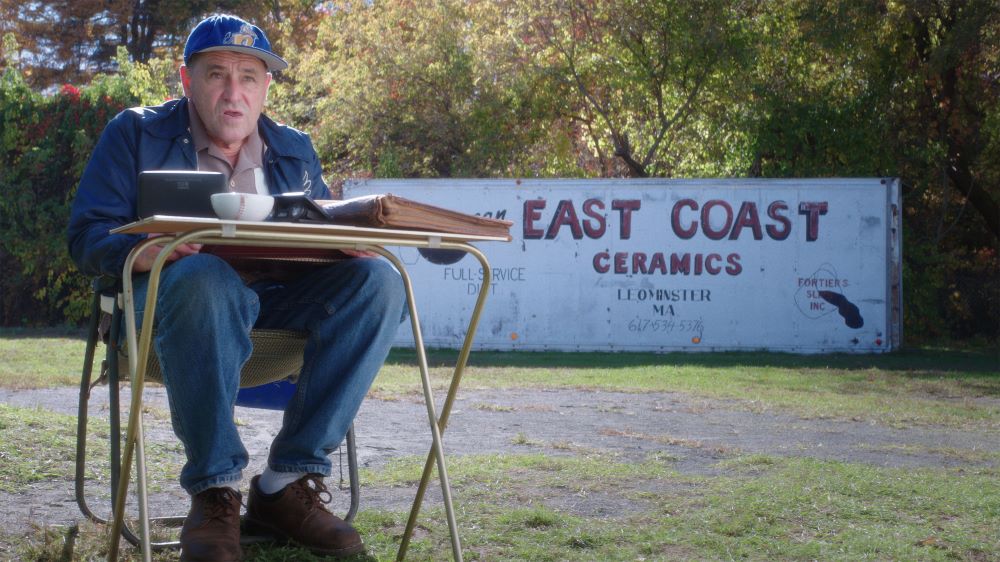
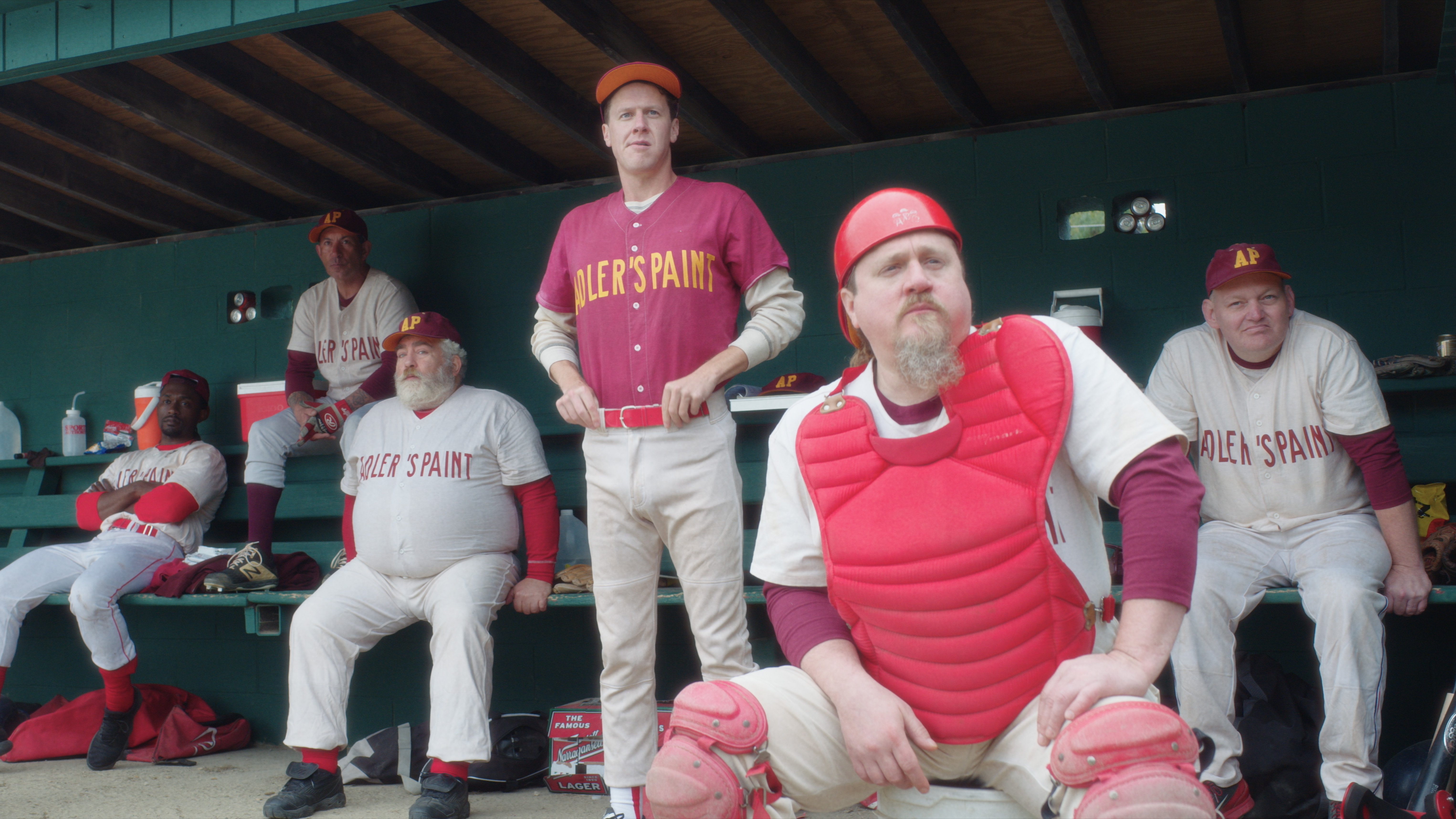
CL: I knew early on that I wanted someone of his stature. Someone who felt like a mythical creature of baseball past. I just knew that was going to be something I needed to figure out. But the problem is, a lot of those kinds of people are celebrities, like major celebrities– it’s hard to get connected to them. I knew that Bill was very personable, and known as this kind of folksy figure, [and that] you can just contact him, because I’d seen him in so many different baseball documentaries. He’s always talking like Savannah Bananas. He’s out. He always finds the camera. He’s kind of a local legend here. I tried many ways to get to him until I finally just resorted to calling his landline. I called his home phone in upstate Vermont. He lives on a farm. And he answered me right away. He said he was happy to participate. Having him on board from the beginning, even without knowing the exact nature of his participation, really helped us find supporters and partners. Everyone sort of perks up when they hear that name, at least here in New England. At the time, he was being considered for the character Ed, which I think we dodged a bullet with that. While Bill is probably the most natural performer in the film, he doesn’t like to read scripts. So he just goes off script and says his own words. And that’s awesome. But I had to just create a little window for him to do that.
BH: He’s in a pocket there. I’ve been following the Eephus Instagram account when they’re posting all the cards of the players. Do those cards exist?
CL: They’re digital for now. They’re so cool. They will hopefully be physical when you buy the Blu-Ray. We want to make them into little packs. I love that plastic wrapper. We gotta figure out how to do it. I think we would work with Vinegar Syndrome. They do all the good stuff. It’s gonna be a great disc. We’re putting together all the extras right now. But I definitely want to make those cards.
BH: That’s what I loved about this– it was just so clear from minute one that this is a gigantic labor of love in a way that like movies sometimes don’t get to be anymore because they have to be so automated for these giant movies. And when someone can actually just get on the field and make these things, it’s so special. I’m really excited to see it with an audience.
CL: I haven’t watched every time it’s shown in the theater. Usually I go out at this point. I actually might watch tonight, just because this is such a special theater for me. So I might sit and watch. They do such an excellent job technically at the HFA. It plays very well with a big crowd. The laughs I find are contagious. And also, we designed the sound mix so that these voices would kind of be all across the room. There’s times if the room is big enough when one corner of the audience will laugh and the other side won’t hear it.
BH: Hometown return.
CL: Yeah, I grew up in Nashua, New Hampshire. Just north of the border. I came to Boston my whole life. And then I went to school here. So yeah, this is home to me.
Eephus
2024
dir. Carson Lund
99 min.
EEPHUS opens in Boston at the Somerville Theatre and Coolidge Corner Theatre on March 14!
In-person screenings followed by Q&As featuring director Carson Lund:
Saturday, March 15
Dedham Community Theatre – 12:00 PM
Learn More
Somerville Theatre – 7:30 PM
Learn More
Sunday, March 16
Coolidge Corner Theatre – 3 PM & 7:15 PM
Learn More