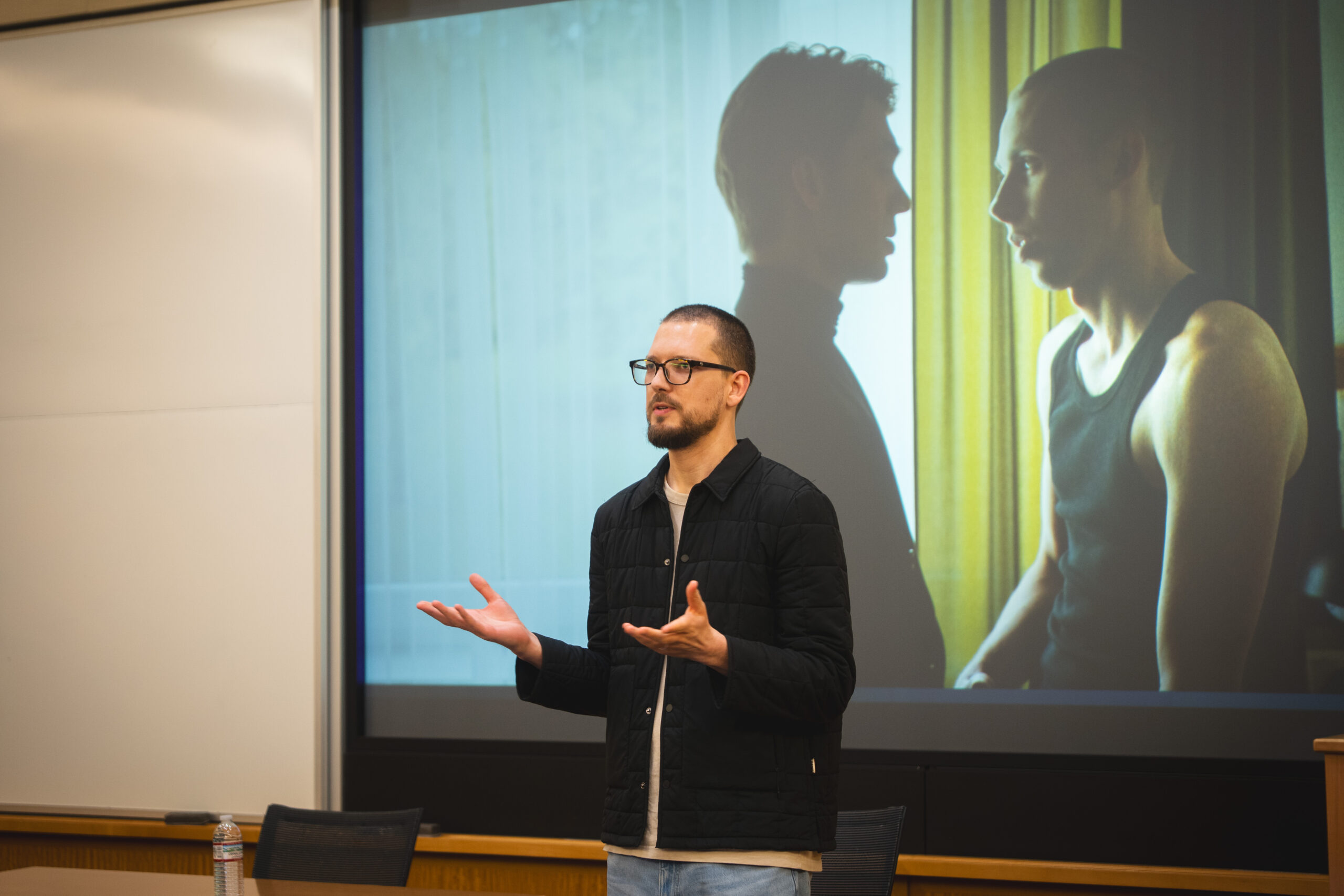
Romas Zabarauskas is the best known queer filmmaker in Lithuania. His debut short film, Porno melodrama, was shown in 2011 at Berlinale and he has been public about his sexuality since then. He followed his debut up with We Will Riot (2013) and then a series of feature films with queer characters at the center: You Can’t Escape Lithuania (2016), The Lawyer (2020), The Writer (2023), and his newest film, The Activist (2025), which just screened at the Davis Center for Russian and Eurasian Studies at Harvard University.
The Activist follows the aftermath of an assassination of a fictional Lithuanian LGBTQ rights activist named Deividas (Elvinas Juodkazis). His boyfriend, Andrius (Robertas Petraitis), a closeted man who didn’t fully understand his partner’s political activism, finds himself enmeshed in the world of a messy queer non-profit named Rainbow Kaunas as they investigate Deividas’s death since the cops won’t. Things get messy for Andrius as he learns more about the broken humans working at Rainbow Kaunas.
In my favorite moment of the film, a trans man, Jonas (played by a real man who happens to be trans, Simas Kuliesius), helps his friend Andrius, a cis-man, learn to navigate masculinity more effectively. It’s an earnest and significant beat in the film that isn’t quite like anything I’ve ever seen before. In a world where trans people are continuously demonized, The Activist paints a more human picture.
I interviewed Romas Zabarauskas prior to his screening over a cup of coffee at Andala Coffee in Cambridge. For over an hour, we discussed queerness in Lithuania, trans masculinity in his film, the film’s visuals, inspiration for Rainbow Kaunas, a Jonas Mekas series he is working on, amongst many more topics.
The interview has been condensed and edited for clarity.
BOSTON HASSLE: How has the reception to The Activist been?
ROMAS ZABARAUSKAS: We released in cinemas in autumn and got almost 12,000 viewers, which is quite good for an art house film.
It is very interesting for me because, obviously, I made the film to be provocative, and it does certainly provoke people across the political spectrum. And in Lithuania, a lot of my friends reported that some people always leave the cinema after the second sex scene. It’s kind of curious because they don’t leave after the first sex scene, which is queer, but also straight at the same time because it’s a trans man and a woman. But the gay scene is too much. At the same time, now that we have started to screen internationally, there are people offended in a sense that we’re critical about the LGBTQ+ representation in the film as well.
BH: Coming from a more liberal perspective?
RZ: Exactly. They think that I went too far, I suppose. It’s difficult to talk about it without spoiling the plot, but we can say that queer characters are both our heroes and our villains in the film. That was kind of the idea. We’re all human and being human is a very flawed experience anyway, so why not?
I also wanted to address the growing far right and current social and political trends from a perspective where I could understand it and see some responsibility on the liberal side too, which contributes to that growth. I don’t think it’s a reactionary idea, but some people are not taking it well. In fact, at the Trieste Film Festival in Italy, one person who was really quite angry said I should be ashamed that I used queer pain for entertainment. And I mean, I’m honestly excited.
BH: Did they know you are gay?
RZ: I shared that information afterwards. But I don’t think that excuses me because I’m still very privileged and I understand that. But it’s kind of funny to see Western urbanite cinephiles lecturing me, as an Eastern European, on how I should represent the queer community better. And it’s okay, actually. It’s difficult to be provocative today because, in a sense, everything is already done. So I’m actually happy that it stirs this debate.
BH: I don’t know how much the Bostonian audience knows about queerness in Lithuania, let alone queer cinema in Lithuania. What is being queer in Lithuania like, and how do you hope to push things a little with this film?
RZ: Or make it worse. [laughs] I’ll share it through my own perspective. I came out in 2011, during the premiere of my debut short soon after its premiere at Berlinale Panorama. In Lithuania, I became famous for being gay in a sense, to be honest, because there were so few people that were out at that time. I was in my early 20s and, for me, it was just natural to share because the film also is connected to queer characters. I didn’t really anticipate or overthink it. All of a sudden, I was going to TV and giving interviews about what it means to be gay in Lithuania and stuff like that. And it certainly branded me as a public activist, which is not something I really desired. In a sense, The Activist is almost a reflection on that too.
I sourced it from my own experiences being close to the activist world, even if I didn’t necessarily want that.
What’s changed since then is definitely that there are a lot more LGBT people that are out now, and I’m happy that I contributed to that with my own films and my story. Coming out wouldn’t make such a media stir at all [today]. Even myself, I feel more accepted already as a filmmaker. Of course, my career continued to grow also, but also just that there is a little bit less pressure now that there are more people that are open.
In terms of society and equality, step by step [Lithuania] is becoming more open, more accepting, and that part of society that is already more open [and accepting] has become more vocal in their support. These are positive changes.
BH: There was a major legal change in 2025. Correct?
RZ: Yes. [In legal progress], we are still struggling, but yes, last year our constitutional board decided that before our parliament legalizes partnership, which is a process that started 20 years ago, that because the process was already started, same sex couples have a right to have their families acknowledged and their partnership acknowledged in court. That’s a big development.
However, this type of partnership is limited in its effect. And in terms of trans people, we still lack proper legislation and healthcare. It’s a bit of a gray zone; there is some access to healthcare needed and documentation, but still it’s lacking. Overall, the current situation is that we had a little more liberal government before, which promised quite a lot and didn’t deliver. And now it’s swinging to the other side. We have a more socially conservative government, which is shaken by its own problems. The attention is not there now. Russia’s invasion in Ukraine influences the overall mood also because in a sense, we are mobilized to focus on safety and it’s more difficult to talk about emancipation at the moment.
In daily life, me and my fiancé live together, and we’re celebrating 10 years together next month. We feel fine. We’re public about our relationship, and we feel safe, and it’s a safe city. We like Vilnius and we have accepting environments. So again, it’s not black and white.
BH: What about queer cinema? Obviously, Lithuania is a small country, with a relatively speaking small cinema, but what is the state of a queer cinema beyond your films?
RZ: Well, the queer cinema in Lithuania has an outsized representation. It’s kind of ironic. I joke that we don’t have equality, but at least we have films. Maybe that’s why we don’t have equality! [Laughs] But yeah, we have my films, because this is already my fifth feature and most of them center around queer characters, except my debut feature, which still has queer characters. But then we have The Summer of Sangailė, [which won] the Best Directing Award at Sundance for Alantė Kavaitė, and is a queer love story between two girls We have a documentary about this trans sex worker, Julia, which was screened at Venice Days. We have a couple more features that have queer characters or themes and we have shorts.
BH: Like Five and a Half Love Stories in an Apartment in Vilnius, Lithuania?
RZ: Yeah. I guess we have a couple more than like that. But I was thinking more like the energy of Anarchy Girls. It’s more central, a bisexual triangle. It’s a low budget art arthouse movie. To be honest, it is so strange. It truly stands out in the Baltics: Latvia and Estonia don’t compare with queer representation. And even in the region, I think it’s actually quite a lot. It’s quite curious. It’s quite courageous.
BH: Does it feel newer though too?
RZ: No, because I was already doing this in 2011 and Summer was 2015, so it’s been quite consistent. Once those boundaries were broken, everyone just saw “Oh, okay, so queer films can be done and funded and even watched by some people.”
BH: Where does the funding come from for the queer films?
RZ: From the [Lithuanian Film Centre.] The juries in the film center are made out from industry itself. I also served in another jury in the Film Centre. The Activist was funded by the film center. The Writer was an exception because it was actually not eligible because it’s an American co-production, but The Lawyer and The Activist were mainly funded by the Film Centre.
I do have a unique career because I’m also the main producer of my films, but I’ll probably move away from producing eventually. Even with that, I was able to secure the funding.
BH: Switching more specifically to The Activist now, you connect homophobia and transphobia with other forms of bigotry through the new Nazi group. And at the same time, you have two queer characters who are able to “infiltrate” those new Nazis in different ways. One subversively, one not so subversively. I’m wondering if you see their masking of their own identity in the neo-Nazi group as speaking to the way that us queer folks have lived in closets and are able to mask identities that way? Did you see the infiltration through a closeted perspective?
RZ: Yes, I did. [For Andrius], the starting point is that he is closeted and he doesn’t really understand his boyfriend’s values, who’s a famous activist organizing the first Pride in the city of Kaunas. When his boyfriend dies and he sees the indifference from the police and fellow activists, he takes upon infiltrating and finding the truth himself. Throughout the journey, he realizes the values of his boyfriend better. And then the fact that, in infiltrating, he kind of needs to go deeper into the closet and that makes the climax of the film even more pronounced. Without spoiling too much, I would formulate it this way. And with Tekle Baroti’s character [Laima], a lesbian woman who is really a so-called trans-exclusionary radical feminist (TERF), or as other people would say, a gender critical activist, she represents the other side of the perspective, as you noted.
She’s not really hiding her identity. Of course, there are some twists in the film as well. She feels more accepted than she really is in that company maybe, but in reality, it’s a very curious phenomenon which exists and I think it’s very rarely represented. The TERF movement exists, and JK Rowling is just the most notable example. At the same time, there is a significant number of queer women who really have that perspective. I think it’s important to talk about it. There are examples of these extremely weird coalitions made between queer women, or queer people in general, and the far right. Each follows their own interests. So [it is to say], “Hello, this is the modern world.”
BH: With Laima, in particular, do you think her transphobia comes from her rejected love with Jonas?
RZ: Yeah, definitely in a sense.
BH: To me, it seems to have a different origin, I guess, than most TERFs.
RZ: I personally don’t think it’s so different. It’s just a way to dramatize it. I don’t even think it’s that far from reality, because I think it is a very personal way that that philosophy is formulated. For some queer women, it almost seems like trans-masc[uline] identity is a renouncement of being a woman and being a lesbian. It’s uncomfortable to talk about it, but yes, it’s true that many trans men live their lives as lesbian and butch women before coming out as trans.
There is a strain of feminist philosophy which kind of got entangled and radicalized in this way because some people take [Judith] Butler a little bit verbatim and really focus on talking about sex as biological versus gender as performance. Basically, it’s almost as if, in order to promote freedom of expression for everyone despite their gender, this notion starts to clash with trans identity, which does suggest a more innate understanding of gender. It is a complicated question. In my personal opinion, I am in favor of returning to talking a bit more about biology. I know it can sound controversial, but in reality, modern biology talks about sex as a spectrum, so you don’t need to rely on gender and freedom of expression.
Biological science [already] understands sex as a spectrum and [research shows] trans-identity is determined by innate factors as well. For example, there are twin studies that show that if one of the identical twins is trans, then there is a higher chance the other one would be trans too.
So why not talk about [biology]? It doesn’t deny the possibility of breaking gender norms. It’s not about that. And it doesn’t deny non-binary or other identities that are words to express that identity across that spectrum. In my opinion, there is such a focus on talking only about the freedom of [gender] expression. It is almost like opposing it to biological sex—as if biological sex would be limited only to male and female. That’s just inaccurate and confuses people more across the political spectrum, actually. That’s my opinion. I understand it can be controversial also.
BH: Hearing that opinion, if you were able to successfully argue that on a larger scale, it also disarms the TERFs’ main ideological weapon.
RZ: That’s what I think. I’m also very happy that our trans character was played by [Simas Kuliesius], a publicly out trans actor. It was important for me to hear from him whether he found the storyline authentic. And he did.
BH: I think that Jonas has a lovely end.
RZ: Thanks.
BH: Let’s shift to Rainbow Kaunas. Were there any real organizations that you were thinking about?
RZ: You’re going to get me in trouble.
BH: You made the movie. They already know.
RZ: It’s difficult to talk about it without spoiling the film, but it’s not really based on one real story. It’s based on my personal observations throughout my life, but let’s just say… more abstractly. If we would quickly Google search injustices in human rights organizations, it’s not as if there would be none. There would be. And it’s uncomfortable to speak about it from a liberal perspective, because you want to support the cause. But it’s part of reality. It’s actually good to be self-critical on that note.
BH: There wasn’t a real murder, correct?
RZ: Oh, the murder? No, no, there wasn’t a real murder. And [this is] worrying for me, because we started to develop the project in 2019 and today it feels increasingly topical. I’m a fan of melodrama. The Activist is ultimately a melodrama, a film noir, which is also melodrama in a sense. But now so many melodramatic things in real life have become a reality. I’m a little bit uncomfortable that people may think that it’s an insensitive comment about what’s happening now in the US, or even in France. For example, a few weeks ago in Lyon, there was a far right activist killed, presumably by a crowd of far left activists, and I’ll present the film in Lyon in two weeks.
BH: Of course, there is a similarity to Harvey Milk. He was the first person that I thought of. I couldn’t find anything similar in Lithuania. It didn’t seem like there was a big, traumatic incident like this.
RZ: Harvey Milk had some Lithuanian roots, actually. And I received this Harvey Milk Champion Award some time ago from Stuart Milk, his nephew, at a ceremony in Florida. [Zabarauskas was awarded the LGBTQ Champion Award from the Harvey Milk Foundation in 2021]. So certainly, I’m inspired by Harvey Milk’s story, but as you know, my film shares a different story. It’s important to condemn political violence across the political spectrum. I know that for some people, it’s controversial even to say that, but I think it’s true. I’m not saying that violence is equal across the political spectrum, but I still think it’s something worth condemning.
BH: Trying to get yourself out of trouble now?
RZ: [Mild laugh] I like getting in trouble. It’s too late for me to redeem myself.
BH: Returning to the organization, why Kaunas instead of Vilnius or another city?
RZ: That’s another thing. When we started to develop the film, there was no Pride in Kaunas yet. And then, in 2021, they had their first Pride. People thought that there was a parallel, but there isn’t really. I participated myself in the Kaunas Pride and I wholeheartedly supported it. It couldn’t happen in Vilnius because the capital is a lot more liberal now and pride happens without many issues. It also couldn’t happen in smaller cities. This is the second largest city in Lithuania, so it was a logical choice.
BH: Does Šiauliai have one?
RZ: No other city has a pride. Just those two.
BH: You touched on this earlier, but I wanted to go a little deeper: the queer people in the film aren’t all protagonists. They start out that way, and then that gets complicated. We don’t have to get into specifics, but, to pivot back to our discussion of fitting your films within the broader spectrum of queer cinema, this doesn’t seem too typical. Do you think that’s accurate?
RZ: It’s interesting because on one hand, in the original film noirs in the 1950s, you already had queer villains, in North by Northwest or Laura. It was already a tendency. It’s interesting to explore it on a different level. If you look at the broader TV and film [context], Ryan Murphy is exactly that. He is all about queer villains. I guess it’s a strange mix of Ryan Murphy, classical film noir, art house, and Eastern European drama. But certainly, I think it stands out within the European queer art house film.
BH: I was thinking about queer depictions by queer filmmakers, not just the queer depictions by hetero filmmakers.
RZ: Well, Ryan [Murphy] is queer. I think European art house films are very often focused on sending a humanistic message and are uncontroversial and very kind from the victim’s perspective. In general, I don’t really like that. It’s kind of boring.
Those films are clearly meant for an audience that already thinks what they’re trying to say, and that’s frustrating. And what I find even more frustrating is that I feel pressure as an Eastern European filmmaker to make these working class poverty victim narratives and that [these stories] would be more accepted on the festival circuit. That’s annoying because we should celebrate originality and not be afraid of provocative takes and political messiness.
That’s where I come from. It’s interesting that you like this film because I thought you could find it controversial too.
BH: How so?
RZ: Because politically it’s not that far away from The Writer, which [you didn’t like].
BH: I didn’t have a problem with the politics of The Writer per say. It was more, I think, the acting and the line delivery of the politics. How the politics were communicated.
RZ: It’s the COVID of [the production].
BH: Yes, perhaps.
Back to The Activist, I found it really interesting that as Andrius is infiltrating the neo-Nazis, he goes to his friend Jonas for help. I don’t know if there’s another example in film history where a cis man goes to a trans man for help navigating hyper-masculinity. Can you say more about the process of writing those scenes and the character arcs that kind of led to that?
RZ: I truly appreciated that you noticed that. I was so happy because it’s definitely something we intentionally aimed for.
In general, I’m really drawn to the experiences and identity of trans men. I already have a trans male character in The Lawyer, a smaller one, also played by a trans actor. First of all, I think this is because we really lack representation of trans men. It’s a lot less from a personal observation than trans women in the media. It’s almost a way for me to look for a positive representation of masculinity in general. It’s inspiring for me as a man.
BH: What did the actor that played Jonas, Simas Kuliesius, think of it?
RZ: He liked it. In general, he was very happy about the role. I don’t want to overshare about his personal life, but he definitely connected to it very much. I was very happy with that.
Jonas is an interesting guy because he’s probably the most positive character in the film. He really tries to get things right, but even he makes some strange decisions in the film. Even he is not completely honest. It is curious.
BH: Do you think of the visual process as being important as you construct a queer aesthetic for Kaunas?
RZ: Absolutely. Well, I don’t know if it’s a queer aesthetic, but we definitely draw inspiration from film to art. The film is in color, but it has chiaroscuro lighting and urban panoramas—also in general, I’m inspired by mise en scène from 1950s Hollywood. Douglas Sirk is forever an inspiration for me, and All That Heaven Allows is my favorite film. I like where the dialogue is very constructed, almost artificially and a little bit poetic, and there is a lot of movement of the characters within the dialogue, within the set, within the space. In that sense, there is not a lot of space for improvisation.
There is a notion of contrast that we talk about often with the cinematographer because the dialogue is shot in a very simple way. Parts of the dialogue are very simple. You just see the closeups and then it’s contrasted by more creative visuals. That play with simplicity was important for us too. The cinematographer, Narvydas Naujalis, you have surely seen his movies at the Boston Baltic Film Festival. He shot Southern Chronicles.
BH: Oh, okay. And one of the actors was also…
RZ: Yeah, the main actor, Robertas Petraitis, was also in Southern Chronicles.
So definitely. I told our cinematographer before the shoot to go crazy so that we cannot fix it in post-production, and he did. Nowadays you can fix so much in post-production. We needed to push ourselves more so it wouldn’t be possible. It would stay artificial and we really made it.
BH: What’s next for you?
RZ: I can share a little bit. I’m developing a few projects I cannot talk about, but I can share that I started a PhD in film in September at the National Film School of the Lithuanian Academy of Music and Theatre with the goal to write a miniseries about Jonas Mekas. That’s a very ambitious and new direction.
BH: That’s really cool. Congratulations and good luck on your studies.
RZ: Thanks. I’m doing it with the permission of his estate headed by his son, Sebastian Mekas. It’s a fiction series. The idea is, in four years, to write the script, and afterwards to try to realize it, because it’s a very ambitious project. I’m really looking forward to it.
BH: He is safely the most important Lithuanian filmmaker. And there is part of his legacy where he is sometimes thought of as an American filmmaker. The Lithuanian-ness gets lost sometimes in how people talk about him. But he’s definitely still fully Lithuanian, especially in the way that memories of his homeland shaped his diary films.
RZ: I got to meet him while he was still alive. He saw my first two features and he kind of praised the second one in the Q&A, and I have a low quality video of that. That is kind of a little bit of a blessing making me more confident about taking upon this project.
I’m curious to explore also his entrepreneurial side and his hustle, because he’s very much known as a poet, but in reality, he was hustling.
BH: It feels like he wanted to be known as a poet, but he’s known more as a filmmaker. At least, that’s my impression as an outsider.
RZ: No, but I mean, as a poetic filmmaker too. I’m just saying he was hustling all his life, and it’s a spectacular story. Of course, my style is at complete odds. He was saying, “You can’t live on melodrama alone.” And I wonder how a melodrama would look about his life. Why not?
The Activist
2025
dir. Romas Zabarauskas
94 min.