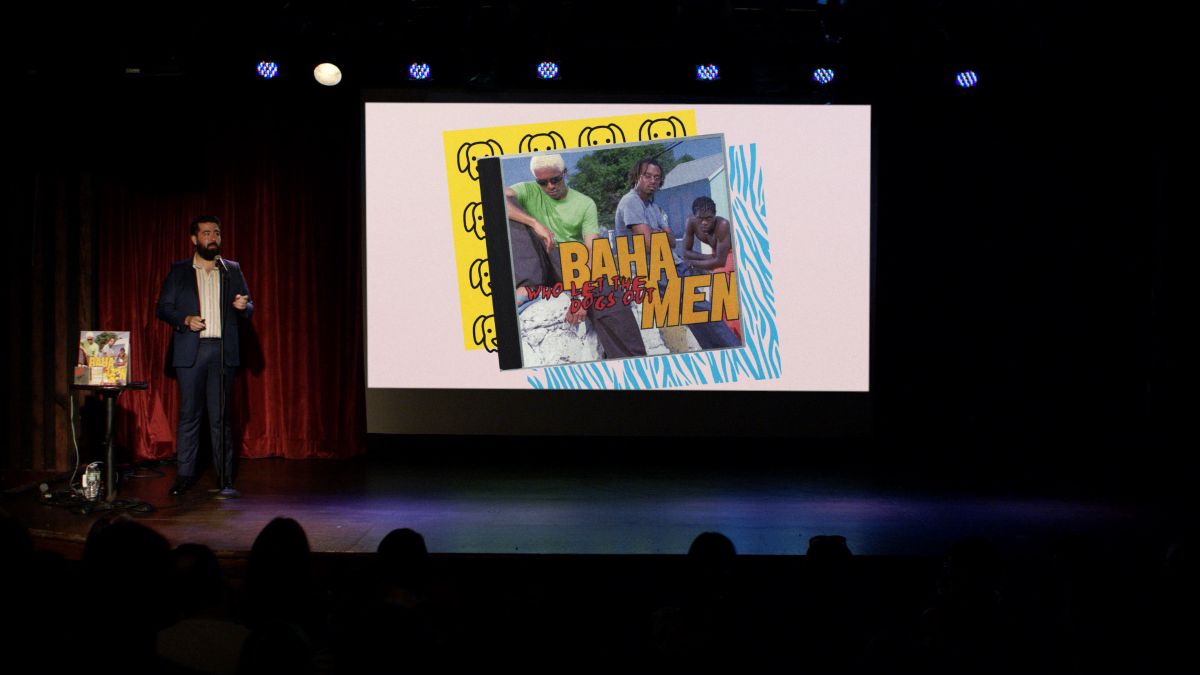
In the summer of the year 2000— and, arguably, for the 25 years since— few questions were asked more frequently, or more loudly, than “Who let the dogs out?” That earworm of a refrain, from the single of the same name by the Baha Men, was inescapable, permeating movie soundtracks, sporting events, and even casual conversation. When a pop song becomes that ubiquitous, one tends to quickly take it for granted, as if it simply emanated from the ether.
Unless, of course, one happens to be Ben Sisto, a mainstay of the New England music and art scene (and longtime friend of the Hassle). In 2008, while browsing Wikipedia, Sisto was struck by an unattributed reference to a “hairdresser Keith” in the section for the song’s origins, and took it upon himself to learn more. That idle click led Sisto to a globe-spanning investigation into the origins of “Who Let the Dogs Out,” interviewing everyone from underground DJs to high-powered lawyers to midwestern high school sports fans— each presenting a different variation of the story, like a Jock Jams Rashomon. To celebrate the 25th anniversary of the Baha Men’s single, Sisto will be bringing the documentary of his findings, aptly titled Who Let the Dogs Out, to the Alamo Drafthouse Boston Seaport, followed by a Q&A moderated by yours truly. In preparation for the event, I spoke to Sisto about the song’s enduring popularity, his background in the copyleft movement, and just who did let those dogs out. (This interview has been lightly edited for clarity and flow).
BOSTON HASSLE: There may be some people reading this who weren’t around the first time around, so I was wondering if you could describe a little bit about “Who Let the Dogs Out,” both the song and the grip it had on our culture in the year 2000.
BEN SISTO: Gladly. “Who Let the Dogs Out” is a song that came out on July 26, 2000. It’s by a group called the Baha Men, who are a multi-generational band coming from the Bahamas. It’s a song they originally didn’t want to record, but their manager insisted that they do it, and it sort of became this global pop phenomenon— some people think because of how annoying it was, some people think because it had really, really good marketing around it. Some other songs [from] around 2000 mark this transition where brand affiliation got real, real big. It was marketed, and placed in all these, like, Nickelodeon videos and Jock Jams tapes. [It was] one of the first songs of the late ’90s-2000s era that was intentionally amplified by corporations, but also had this inherent kind of memetic quality to it. People who don’t know the song, you can still say, “Who let the dogs out?” And then they’ll bark back at you.
BH: In the film, you talk about how you were drawn into this story from a strange, unattributed line in the Wikipedia entry for the song. I’m curious what drove you to the Wikipedia entry for “Who Let the Dogs Out” in the first place?
BS: Back in the 2000s, when I lived in Boston, the copyleft movement was starting— Lawrence Lessig was publishing the foundations of what would become Creative Commons— and I was involved with a scene of people who liked DJ and dance culture, but were also, like, at the Berkman Center at Harvard, which is their [center for] internet law and internet studies. It was kind of in the air to be into, for lack of a better term, the political side of remix culture. I was always very interested in intellectual property law, and the free culture movement also dovetails neatly with the punk scene. I can’t remember exactly how I even ended up on the Wikipedia page— I know I was unemployed at the time, so that’s a good head start! But once I got there and noticed this missing citation, I was like, “Oh, I’ll fix this, because my friends in Wikipedia world will think that’s funny.” Like, I’m not getting any job leads at the moment, but this is something [where] I can be a productive member of society, or whatever. And then it just kind of snowballed. I didn’t set out to do the project!
BH: At what point in your research did you realize that this was going to be a whole thing?
BS: I would say there are two points. The first is when I spoke with Keith Wainwright, who is the person whose name was missing from Wikipedia. He is a legendary stylist who came up alongside Vivienne Westwood in the UK punk scene. We talked for a few minutes on the phone, and he was casually dropping, like, doing hair for Roxy Music. And I was like, “Whoa, whoa, whoa! I did one cold call, and I’m talking to the person who did Brian Eno’s combover! This is wild!” And he was just a really, really nice guy, and he was very passionate about the song. And I thought, “Oh, this is unexpectedly fun. Maybe if I keep asking people who let the dogs out, I’ll keep getting interesting replies.”
The second moment was when I talked to Lita Rosario, who was a lawyer for a record company called Wingspan, and she was like, “Straight up, back off. There’s been a lot of litigation on this song already.” [She] kind of told me that the research I was doing would potentially create another lawsuit, and when she told me that, I was like, well, that means that there’s still artists out there who haven’t gotten their dues, their attributions, maybe some paychecks. And I’m the kind of person where, if someone tells me no, I’m more likely to follow up.
BH: There are so many great characters in the film— it feels like every person involved with the song is this larger than life personality. What was it like getting to know some of these people, or talking to them?
BS: It was really great. First, you are right. It is like characters. In a 61-minute doc you get snippets of it, but they really are bigger than life personalities. Everyone was very much like, “This is who I am, this is my brand, my essence.” Everyone was a little different. One of my favorite people to meet was Mamado, who was the producer from Jacksonville. Mamado gave me a tattoo. She was super welcoming, [but she was] a person that, outside of this project, I would have never, ever met in my life, and I just felt so glad that I did. Also, because everyone’s personalities were so different, it was a real learning lesson for me. I’m a chatterbox, but when I had the mic on and I would ask a question, I would just go silent and let everyone fill in all of the blanks. I learned that, when people have big personalities, they will just fill in the silence. They will reveal more than you expect them to reveal. So it was a nice exercise figuring out how to interview people, which I had no experience doing prior.
BH: Was there anything that interesting that you found in this project that you couldn’t quite fit into the film?
BS: Yeah, there are. There’s things that are in the 99% Invisible episode that didn’t get into the film. Joe Gonzalez of Miami Boom Productions is originally from Michigan, where this Dowojiac high school team was using the chant, and he was like, “Oh yeah, I was there visiting family in X year.” And I made a Google map of all of the places in Michigan, all the regional teams that were using the chant, and it formed a perfect circle around his hometown! When I saw the map I couldn’t believe it, so I called Joe and I was like, “You gotta explain this.” And Joe, like other people in the story, was sort of like, “All I can tell you is that I wrote what I wrote, and I believe that I’m the original author of that.” But Joe, and also Manny Mohr of 20 Fingers, did acknowledge [that] this is the ’90s, this is sampling, everyone’s using the word “dog,” all these phrases are dog-based. And this idea of where things come from, it just kept getting more and more hard to answer.
BH: It’s been a few years since you made the film. I’m curious, has anything else come to light in the time since then? Or is the timeline pretty much settled at this point?
BS: I’d say the timeline is pretty set. There is another claim out there, but I think it’s total bullshit. Mannie Fresh has been out there, on Reels and Instagram Stories, saying that he wrote “Who Let the Dogs Out.” What’s interesting about the Mannie Fresh claim is, I don’t think it’s true, but he does reference a recording studio that Baha Men did record at, so it’s possible that he was around when it happened. But even if the Mannie Fresh claim emerges, it doesn’t derail the story. But I just thought it was interesting that, as recently as a year ago, I was hearing chirps.
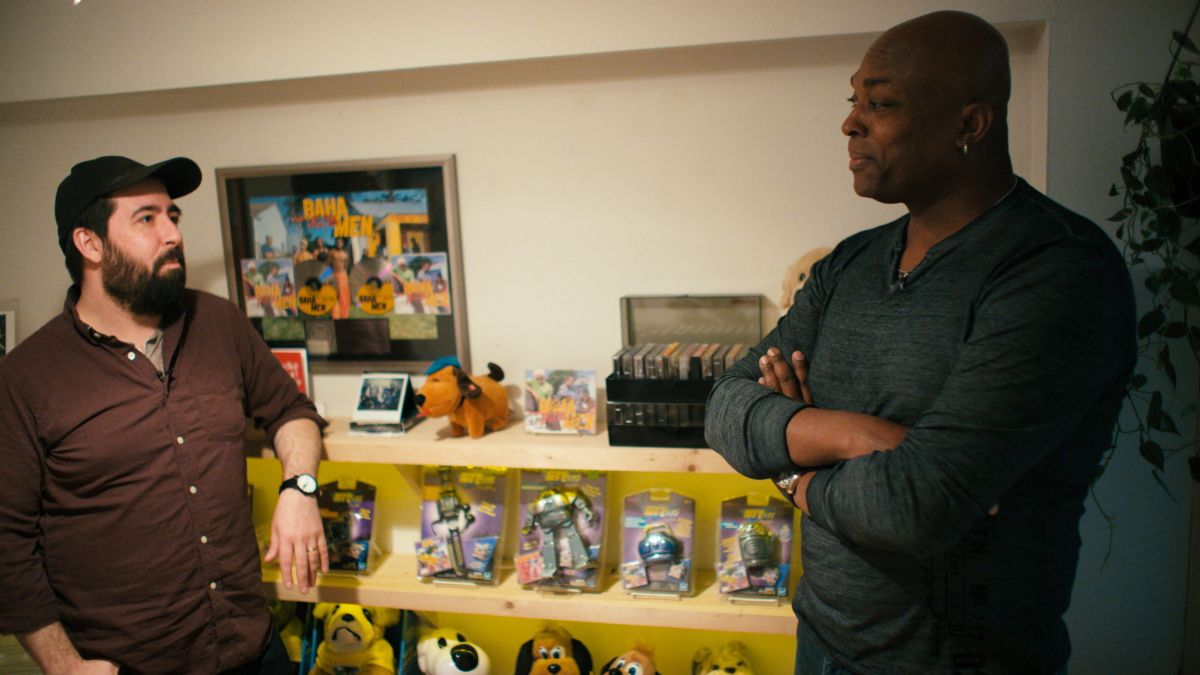
BH: You show in the film, and of course also in your exhibit, so much “Who Let the Dogs Out” ephemera and merchandise. Do you have a particular piece that’s your favorite?
BS: Oh, that’s really tough. There have been a few. One of my favorite things is a “Who Let the Dogs Out”-themed flying disc, which, for copyright purposes, is not a Frisbee. When the song came out, there was a promotional ad on TV that was like, “Call this 800 number, buy the CD, and the first X number of callers get this free flying disc!” And I wanted it so bad, forever. Finally, I was using an image of it doing a reverse image search on Google, and one came up on an international auction. And I was so excited that I got it that I wrote to Steve Greenberg, Baha Men’s manager, and I was like, “Steve, I finally tracked down this fucking Frisbee!” And his response was, “Oh, you should have just asked me. I have so many of those in my basement!”
BH: To close things out, what is it about this song in particular, or chant, or whatever you want to call it, that has made it so enduring across all these varying timelines?
BS: There’s a number of things. The rest of the lyrics of the song, at least the Baha Men version, [aren’t that memorable]. The rap doesn’t really fit in. The other lyrics are kind of borrowed from the Anselm Douglas version. But really, it’s less about the song, it’s just about the hook. People love call and response things. It’s very malleable. There was a Super Bowl ad this past year that was a parody of the song for some kind of outdoor weed killer products. It’s silly, but for all of the people that think it’s annoying and stupid and silly, it’s also become a phrase everybody knows. It can mean whatever you want it to mean. There’s no question mark in the title. It’s just this very choose-your-own-adventure phrase.
Who Let the Dogs Out
2019
dir. Brent Hodge
61 min.
Screens Tuesday, 7/22, 7:00pm @ Alamo Drafthouse Boston Seaport
Ben Sisto will be present for a post-film Q&A, moderated by Boston Hassle’s Oscar Goff!
The Museum of Who Let Who Let the Dogs Out Out on display @ Providence Public Library through 8/15