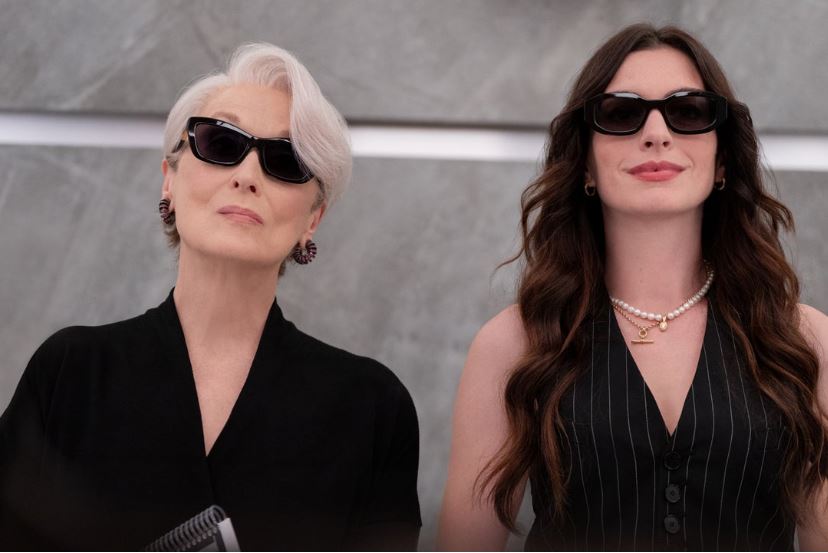
Not too long ago, Northwestern University published an analysis of fashion across centuries to confirm the astute observation that fashion trends tend to come back around in twenty-year cycles. As witness to the return of baggy jeans and cutesy barrettes, this timeline tracks. It’s quite the coincidence that this study comes ahead of the arrival of The Devil Wears Prada 2, exactly two decades after the original’s release year (and that the film’s protagonist, Andy Sachs, is a Northwestern alum). Like many fashion resurgences and sequel announcements, I had not taken this renewed interest to a serious capacity. In my mind, the original film was a perfect cinch to a toxic mentor-mentee relationship while being able to advocate happiness sans boyfriend or job that a million girls would kill for.
And yet, the taste for nostalgia is evergreen. Much can be appreciated in the sequel just for the fact that the talent returns like a successful vintage haul. We have the original cast: Anne Hathaway as the aforementioned Andy, Meryl Streep as Miranda Priestly, Stanley Tucci as Nigel, Emily Blunt as Emily (and a special shout out to Tracie Thoms, who return as Andy’s best friend Lily, who keeps her grounded while also consistently being gifted designer handbags in both movies). We also have the first movie’s director David Frankel, screenwriter Aline Brosh McKenna, and my personal favorite, music supervisor Julia Michels, who somehow maintains the vibe of the early ‘00s extra-spring-in-your-step music in the soundtrack while incorporating Florida swamp princess Doechii into the mix. For all of this to happen — a sequel for a story that didn’t exactly need one, a cast of stars whose careers are even more luminous than they were in 2006, and the fact that TDWP2 is actually entertaining — makes this film the sequel we didn’t ask for, but the one that we needed in this moment of time.
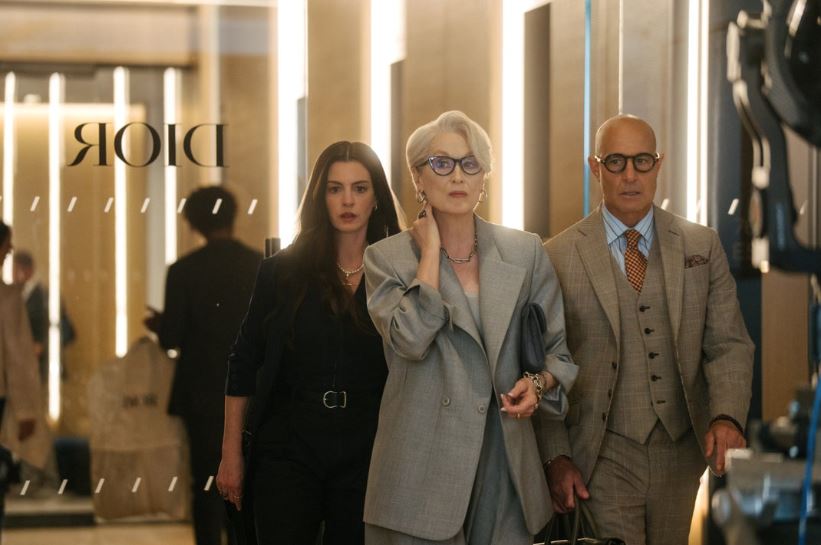
The years pass by in TDWP2 as they do in real life, ostensibly to reflect the things happening in the real world. Andy is now an established journalist, while still maintaining the chicness that she learned from her time at Runway. While accepting an award for a investigative story, Andy learns that her and her reporting colleagues have been fired following a corporate takeover of their newspaper. Journalism, whether a victim of uber-capitalism or intermingled with weird unethical behavior, is in a state of decline, and Andy’s despair is not in solitude. Within the glossy buildings of Manhattan, Runway is in the hot seat after publishing a poorly vetted article. While still at the top of her game, the twenty years have humbled Miranda’s previous attitude; her first assistant Amari (Simone Ashley) spends as much time mitigating Miranda’s offensive remarks (“What did I say wrong? Methadone clinic? New Jersey?” Miranda mews in her recognizable white-gold drawl) as she is adequately competent at her job. The conflict of Miranda vs. the world is drawn back in this story. Runway’s troubles are exacerbated by the lack of subscriptions by way of virality and clicks that even Miranda couldn’t afford to be herself.
Andy and Miranda cross paths again when Runway‘s chairman recruits Andy as the magazine’s Features Editor. While seeming to understand that she needs help, Miranda’s attitude towards Andy hasn’t changed by much. But the devil here does not wear Prada. Instead, it swaggers into the Runway offices in lab-tested athleisure wear and tries to put profits and fashion in the same conversation, much to Miranda’s mortification. While Miranda’s fiery, merciless status had paused for a tender vulnerability in the first film, TDWP2 pushes Miranda to understand and display the fragile state of her job in each and every way: the financial investments in the magazine, the advertisers and brands who bargain collaborations for page spreads and name-drops, and scorned people waiting at the end of a burnt bridge.
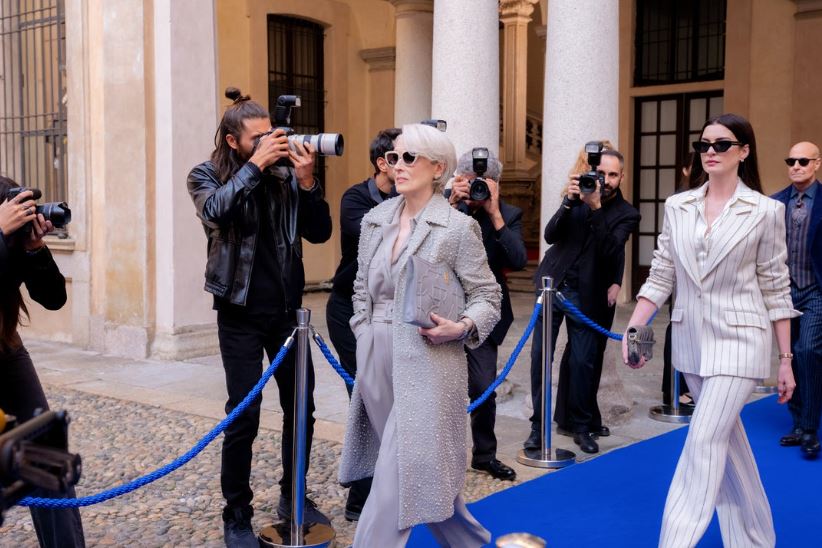
Watching the original film matters in how to register what TDWP2 brings to the table. The 2006 film is an artifact of its time, in both fashion (which I could thankfully say has not made its full cycle-pilgrimage yet) and the status of the world. If Runway has not been bought yet, it’s not surprising that the sequel will show how looming that threat is. But it also is a recognition of how we, along with the environment around us, can grow from our molds. Andy and Emily have departed from their assistant roles (the latter being part of Dior’s retail expansion) and into careers that feel organically true to professional growth. Cerulean blue, the subject of one of the original film’s central scenes that demonstrate how fashion trickles down to the everyday person who may dismiss the field otherwise, makes as many cameos as florals do in the wardrobe and integral Milan fashion show (not groundbreaking, but pretty!). The winks and jokes are there, but instead of recreating the relentless bites from the original, TDWP2 feels like watching people from your high school give into maturity (though make no mistake, Miranda’s meanness is still reliably present).
If there’s one thing empowering about TDWP2, it’s integrity. Andy sticks to her guns by writing meaningful stories that play into the progress of Runway’s livelihood despite Miranda’s skepticism. The change in the magazine’s direction is recognized by elusive artist Sasha Barnes (Lucy Liu — we’re truly in God’s playland), who agrees to conduct her first media interview in over three years with Runway. There’s also a quietness in eternal fame; there are as many celebrity appearances as one could muster, but they are flipped so quickly through the film that it feels like Easter eggs (and confusion/amusement over Knicks star Karl-Anthony Towns just hanging out at Miranda’s summer house). While this sequel is geared toward a new generation who might need a sort of specific language or acknowledgement to connect with them, it feels rewarding to see two seconds of Anok Yai than to hear a canned joke from the influencer of the week (probably the most blatant face-fronting form of cameo would be Ms. Donatella speaking hasty Italian to Emily). Just like its costuming, the movie doesn’t cheapen in its writing or flashiness.
However, it’s still okay to acknowledge that the new generation of moviegoers understands the toxicity of leader glorification, or that choosing a healthy work-life balance can be normalized, or that having the dream to live for and having the means to live may not be congruent to pursue at the same time. TDWP2 adapts and modernizes the characters to make us feel like we’re on their side already. Some of the practical changes, like Andy affording designer brands through consignment shops and the new Runway office lighting gets rid of fluorescent bulbs because we are no longer main-light girlies, are part of the Devil‘s little details. But the presence of TWDP2, a worthy and marvelous “recycle,” has the kind of early-millennial hopecore that had been lost in recent movies and TV shows. For us — the fashion world, the mathematicians at Northwestern, the millennials who wonder about the ecological burden of getting rid of skinny jeans — we can feel like we’re in Mamdani’s city instead of Trump’s America.
The Devil Wears Prada 2
2026
dir. David Frankel
119 min.
Opens Friday, 5/1 @ Coolidge Corner Theatre, Somerville Theatre, Kendall Square Cinemas, Apple Cinemas Cambridge, Alamo Drafthouse Boston Seaport, all local AMCs, and pretty much everywhere else on earth.