To an auteurist, Steven Soderbergh represents a paradox. Each new film— and there are a lot of new films— only muddies the water, making it less and less clear who this guy is. Just over a year ago (and two movies ago) he gave us Presence, a formal exercise of a horror movie shot from the ghost’s point of view, keeping us a perpetual arm’s length from its characters. By contrast, Soderbergh’s new film, The Christophers, is arguably his most human to date, an immensely warm and funny character study about the public and private lives of great (both big-G and little-g) artists. In a career filled with unexpected delights, The Christophers is perhaps the most delightful.
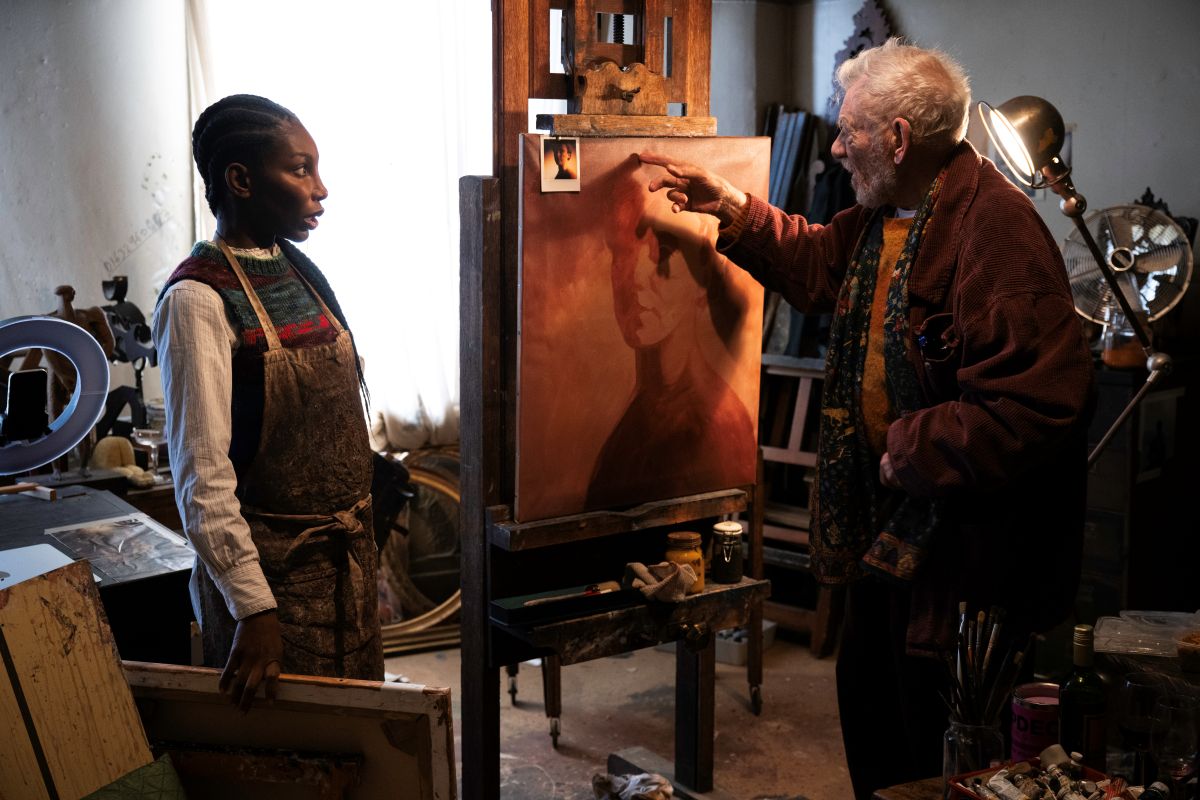
Michaela Coel plays Lori Butler, a struggling artist, sometime critic, and part-time restorationist with an uncanny knack for imitation (or, less charitably, forgery). One day between shifts at her food truck day job, Lori is contacted by old art school friend Sallie (Jessica Gunning) and her brother Barney (James Corden, sadly) with a curious proposal. Their father, you see, is the great Julian Sklar (Sir Ian McKellen), a pop artist of some renown who has fallen on fallow times, frittering away his days in his cluttered artist’s flat and paying the bills by recording Cameo videos. Lori’s mission, should she choose to accept it, is to take a job as Julian’s “assistant” while covertly finishing a stash of incomplete would-be Sklar masterpieces, so that they can be “discovered” following his death and provide his offspring with an extra dash of inheritance (“You’ll be forging through them,” Sallie insists, as if that would be more ethical). Of course, for all his “eccentricity” (read: pain-in-the-assness), Lori slowly realizes she has more in common with the elder Sklar than her ostensible friends, and the two form an uneasy truce.
The heart of The Christophers lies in McKellen, who delivers perhaps the first truly great performance of 2026 (at least until Obsession opens next month). Julian is brilliant, self-obsessed, and lonely— all qualities which lend themselves to monologuing, at which McKellen is, of course, singularly wonderful. The screenplay, from journeyman Ed Solomon (writer of Soderbergh’s overlooked heist picture No Sudden Move, as well as a whole bunch of genre comedies you loved as a kid), provides the actor plenty to sink his teeth into; he barely lets Lori get a word in edgewise during her own job interview, instead peppering her with one-liners and self-mythologizing asides one senses he’s been storing up for decades (“I was bisexual when it still cost something to say so,” he quips, somewhere in the middle of explaining Lori’s daily duties). It’s as much fun as the actor has had in ages, and it’s hard not to smile whenever he’s on screen.
But there is a sadness which runs through The Christophers as well. Julian may still be kicking around, but his accomplishments are invariably referred to in the past tense; when he appears on magazines, the image is of a mustachioed, ‘80s-era McKellen coolly flipping the bird, not the daffy old man currently occupying his cluttered loft. As Lori tells him in retort to one of his many self-aggrandizing diatribes, her younger cousins know him better as the bitchy, Cowellian celebrity judge on a vapid reality show called Artfight than for any of his actual art. Julian is clearly aware of all this, and as much as he plays off his perceived irrelevance with self-deprecation and drunken wit, one senses his studio has become a living memorial to the man he once was (and, perhaps, the man who appears in many of his most famous works).
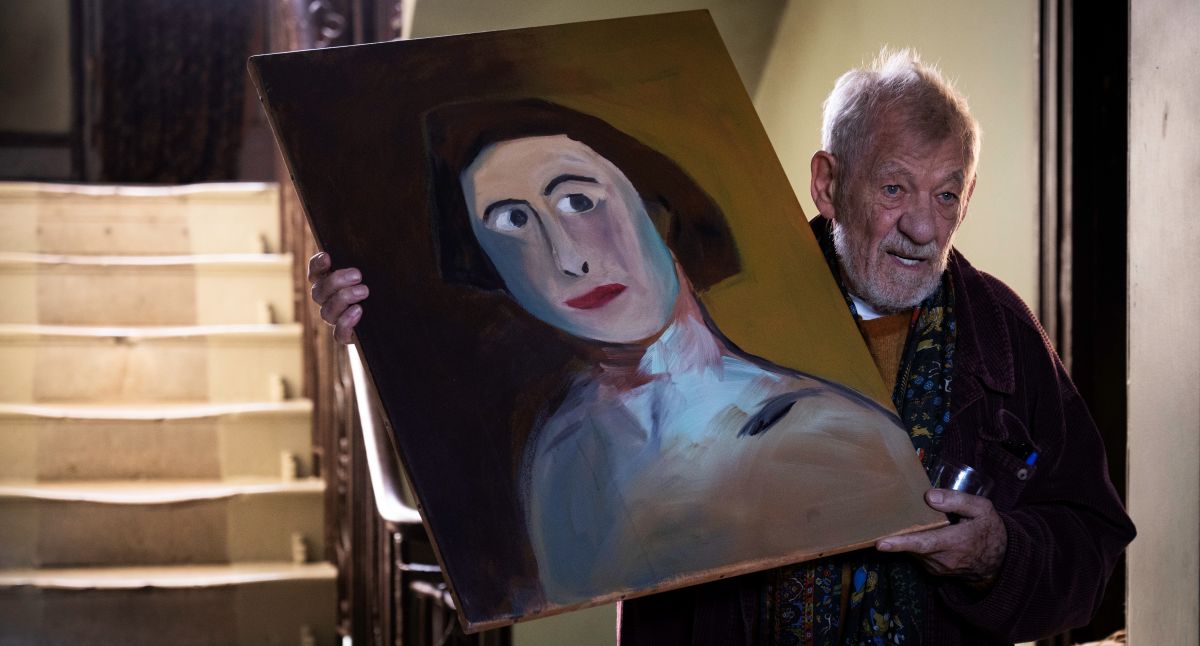
There are moments when The Christophers threatens to topple into anti-cancel-culture crankiness; Julian laughs off Lori’s discomfort with his lack of modesty (“Weinstein ruined the robe for everyone!”), and allusions to the precise cause of the artist’s public downfall are perhaps frustratingly unexplored. But Soderbergh and Solomon are more interested in the nature of art itself— specifically, how one loses and regains their creative mojo. When the beans of the plot are inevitably spilled, Julian asks Lori how she could possibly know how he would have finished the portraits. Lori responds as a critic, reading intent into his every brushstroke and extrapolating where momentum would have led him had he not hung up his smock. This analysis, in turn, invigorates Julian into picking up his long-dormant brush for the first time in perhaps decades. We don’t see what he creates (the film makes a point of hiding any of his completed work until its final scenes). The point is that he creates, and that only through this creation can he truly understand himself.
Given all this, it seems fair to ask: what does The Christophers tell us about its own creator? This is again, perhaps, a losing game, given the director’s who-am-I-this-time approach to filmmaking and genre. Still, it seems significant that both Soderbergh and Jim Jarmusch, another agelessly cool indie-film icon prone to genre-hopping, have made films this year about aging. Like Jarmusch’s Father Mother Sister Brother, The Christophers brings us into its elder character’s cluttered realm through the eyes of a younger observer. As an X-Boomer cusper nearing his mid-60s, one imagines Soderbergh can see himself in both characters: the cool, detached young turk viewing their elders with a mix of affection and skepticism, and the onetime enfant terrible grappling with a world that threatens to keep spinning without them. Taken in this light, it’s a rare bit of self-examination from an occasionally impersonal auteur, a peek behind the mask of hipness at something approaching genuine anxiety.
However, when analyzing an artist’s work one must also take into account their public statements, and unfortunately Soderbergh has made a few recently. In interviews earlier this month with Amy Taubin for Filmmaker Magazine and with Sam Adams for Slate, Soderbergh made enthusiastic comments about using “a lot of AI” in the completion of both his upcoming John Lennon documentary and his Spanish-American war epic. This is, on the one hand, not particularly surprising for one of our great cinematic dabblers; when I saw him speak at the Coolidge a couple of years back at the opening of Godfrey Reggio’s Once Within a Time, he asked if the plagiarism of AI was any different from how he’d ripped off Brian De Palma while making Sex, Lies, and Videotape (I wanted to shout out, “Yes, but you’re a person!”). But it’s still disappointing— and worse, it colors one’s interpretation of The Christophers. It’s probably safe to say that when Soderbergh and Solomon crafted their tale of the transitory nature of artistic ownership they did not intend it as a pro-AI parable, but by timing his decidedly tone-deaf comments to the film’s release the director set it up to potentially uncharitable readings.
But discourse cycles pass like clouds, and it’s probably unfair to hold Soderbergh’s statements against one of the most purely pleasurable films of his career. The Christophers is a lovely, soulful hangout comedy, with a crowning performance by one of earth’s greatest living actors. In short, it’s a film that could only be made by a living, human artist— or, perhaps, a particularly skilled forger.
The Christophers
2026
dir. Steven Soderbergh
100 min.
Opens Friday, 4/17 @ Coolidge Corner Theatre, Kendall Square Cinema, West Newton Cinema, and AMC Boston Common and Assembly Row