
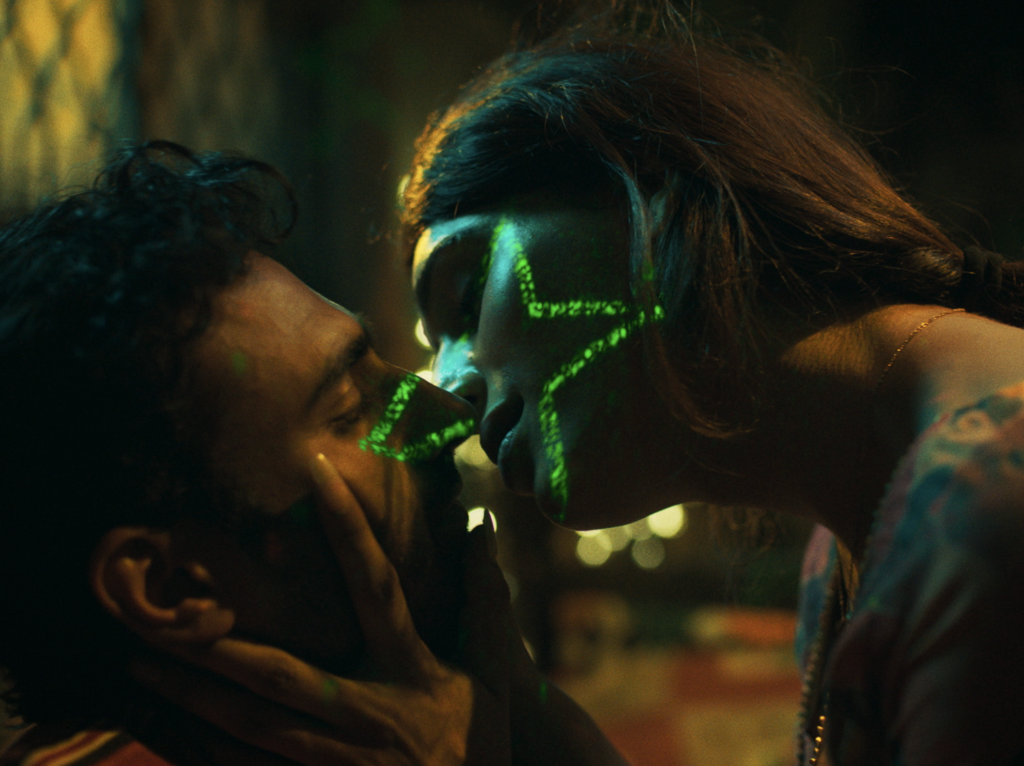
Saim Sadiq’s Joyland is probably one of the most difficult films I’ve seen this year. Not because of any shortcomings or provocations, but because it is an experiential deliverance of anger and sadness without solution. Set in Lahore, the camera falls upon a family comprised of one elderly patriarch, Abba (Salmaan Peerzada), his two sons Haider (Ali Junejo) and Saleem (Sameer Sohail), their wives, and Saleem’s three daughters. After years of unemployment, Haider finally scores a job as a background dancer for Biba (Alina Khan), a transgender performer at an erotic theater. We are given the impression that Haider is the protagonist of the story, as he harmlessly receives the back end of Abba’s beratement towards his masculinity. Despite his lostness, Haider’s innate gentleness makes him likable, especially when he pursues a relationship with Biba.
If the film was poised as the great love story between Haider and Biba, the means to the end would have held different focuses. But one of Joyland‘s greatest fixations is Mumtaz (Rasti Farooq), Haider’s wife. When Haider becomes employed (and initially lies about his responsibilities at the theater to avoid the wrath of judgment), Mumtaz is forced to quit her job (which she loves) to help her sister-in-law take care of the home (one that she did not grow up in) and the children (none of which are hers). Though physical intimacy is implied as sparse and their lapse in connection is seemingly widened by Haider’s nights at the theater, Mumtaz holds a quiet patience for her husband. She slaughters a goat when he’s unable to do so in front of his father. Even when they are aware of the unfair trade-off (though not to the extent of his affair), Mumtaz encourages him to show off his dance moves in the late hours after his return. The imbalance between Haider’s self-discovery and Mumtaz’s oppression sets the pain of Joyland on fire, but for me, they are also able to co-exist without nullifying the other.
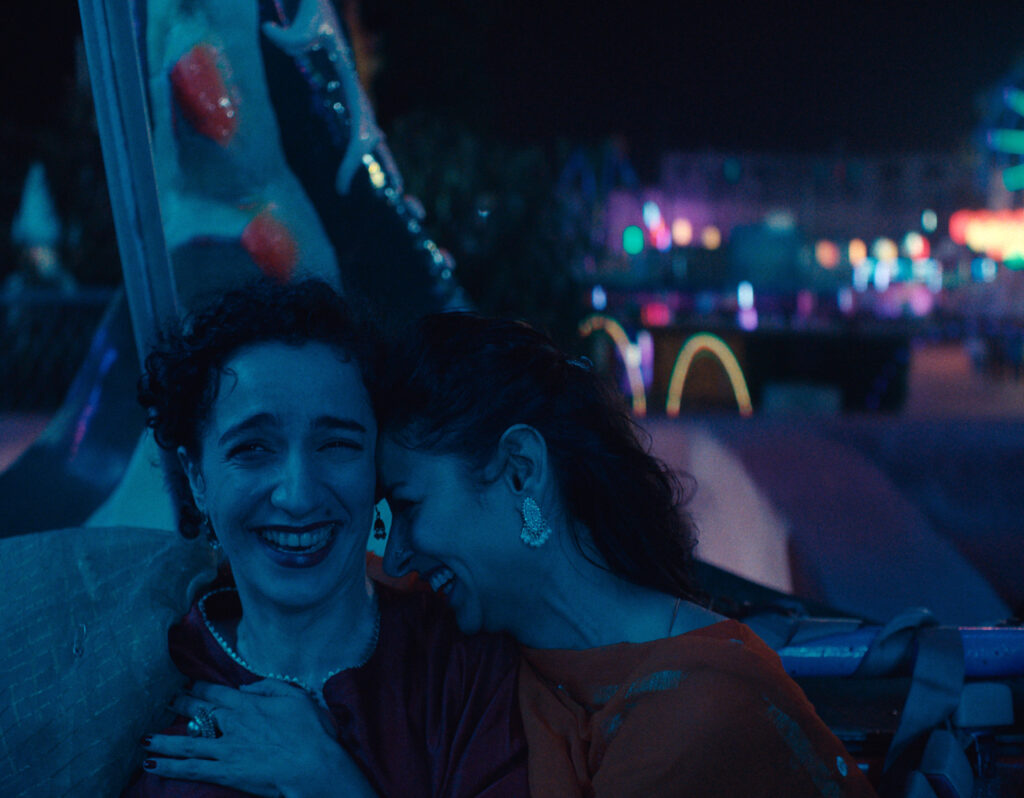
The film’s power is driven by character performances. Even in a busy household or public transit, Sadiq is able to deliberately choose silence in a scene to emit the feeling of isolation in spite of physical presence. Significance is encapsulated through portraited shots framed from the sternum up, and it is an achievement to have a lot of characters get a moment to shine. While I found Mumtaz to be the heart of the movie through collateral damage, a mistake-laden Haider does hold some genuine sorrow about the existing state of the patriarchy. Even Nucchi, who initially seems like the one-note dutiful sister-in-law, has an explosive tirade at the end, sharing precisely what the audience is thinking. And of course, Biba, as a transwoman, carefully chooses her moments of vulnerability and guardedness (“Tell me a joke,” she asks twice in a movie — one, flirtatiously, to Haider alone in a room and again, aggressively, to another background dancer that was taunting Haider with transphobic comments). Khan’s performance is a reckoning force that brings us to our knees when she is at the center and carries the interest of the story wherever she goes, alone or with others. It’s the rest of Lahore that needs to catch up.
Ultimately, power dynamics and desire are dictated by toxic masculinity, which has a casual ebb and flow throughout the film until it becomes glaringly present in confrontations or points of tension. It’s the unnamed enemy that suffocates freedom of identity and empowers nasty blows, and like much of societal repression, it’s not a dragon that can be slayed at the end. No one is inherently at fault, but when they play the game of blame in a house of cards, it’s what makes the toughest parts of the film watchable. I’d be remiss to not mention the other parts that make up the whole of Joyland, especially the bits that remind us why people try. Moments of humorous reprieve are offered at times where they are most needed and least expected (Haider’s scenes where he displays an ineptitude in dancing, even down to the stage performance, is one of my all-time favorite gags). With the tonal switch of the last few scenes, “funny” might be one of the last adjectives I’d use. However, when I think about Joyland long after watching it, the aftermath’s complexity can honestly be narrowed to the one trite but true: human.
Joyland
2022
dir. Saim Sadiq
127 min.
Opens Friday, 5/26 @ Coolidge Corner Theatre