

The story infrastructure of Neo Sora’s HAPPYEND appears as an elaborate timepiece of a high school movie set in Tokyo. At the surface level, its expansive themes about political-party dominance, wealth, and the helpful/helplessness of surveillance within Japan’s increasingly diverse population might presume a tornado of a watching experience. And true, it touches upon the genres of futuristic technology and xenophobia with skyline shots that resemble Blade Runner. But underneath the sophistication of discourse and inevitable dissatisfaction with the world, HAPPYEND reminds us that time is only made of living, breathing seconds getting through the day.
I knew that this was going to be my movie from the very first scene where we are introduced to the central friend group. Under the high-school sponsored Music Research club (though one will soon assume that these kids were trying to make their hang-outs CV-official), they attempt to sneak into a club to see a certain DJ. Two of the boys succeed in getting inside, but the police storm in during the set and break up the audience. One of the boys, Yuta (Hayato Kurihara), remains on the dancefloor, melting into the music just as long as the DJ will play. The other boy, Kou (Yukito Hidaka), stays with him as well. The rest of their friends – Ming (Shina Peng), Tomu (Arazi), and Fumi (Kilala Inori) – assist in their escape from policy custody, and all five laugh away into the late youth of the night.
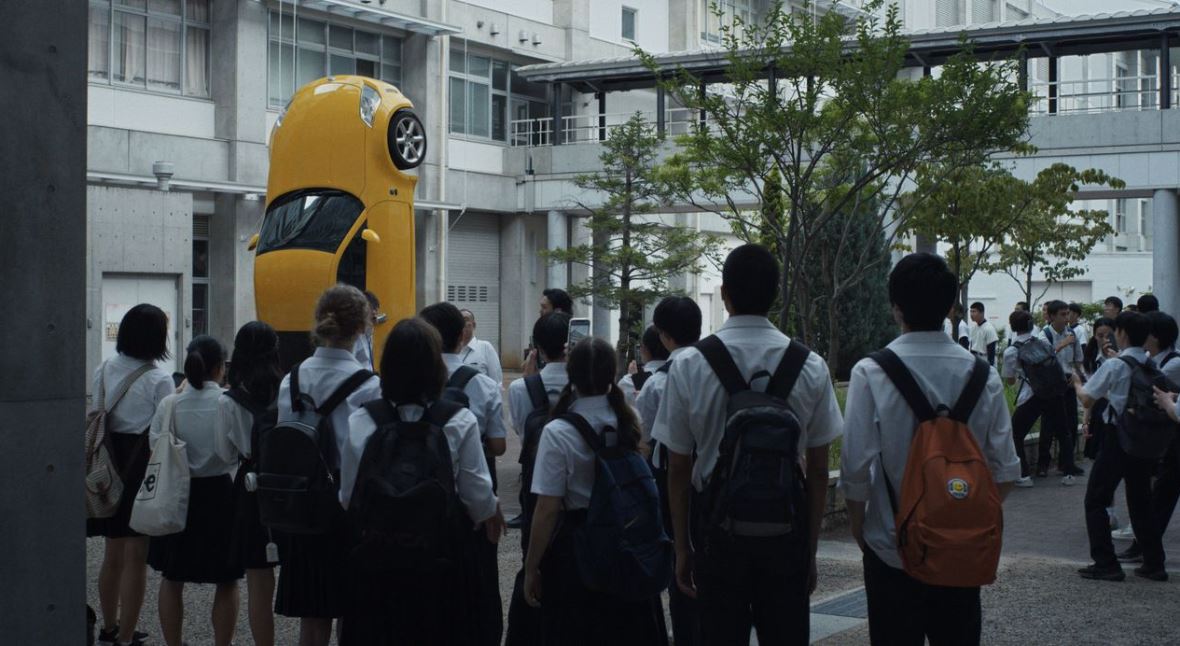
We will eventually see how the friend group is fragmented by their unrealized dreams and uncertain futures as they approach the end of their high school year. Yuta is without a care for consequence, giving off an assumed privileged attitude or a life that hasn’t been tended to by his parents. Kou, who is ethnically Korean, keeps his head down to help support his single mother running a restaurant. Their differences erupt when Kou vandalizes the principal’s luxury car on a dare, invoking the installation of a school-wide camera system that monitors the students and deducts points for mischief, uniform code breaking, and other harmless misdemeanors that could only be useful for authoritative judgment.
It’s within the school’s new surveillance system, postured as the school’s call for student safety, that the thematic frayed ends are uncovered. In the outer atmosphere of the country’s national government, xenophobic voices are loud and proud, and it trickles down to the gears of this school’s particular ecosystem, in which non-Japanese students are excluded from military service conversations and wealth means protection. Though not an outspoken person, Kou feels drawn to Ata (Yuta Hayashi), a boldly spoken classmate who isn’t afraid to call out the wrongs of the police state and the principal’s monetary benefits in his role. Soon, Kou’s entanglement with resistance becomes antagonistic to Yuta’s directionlessness.
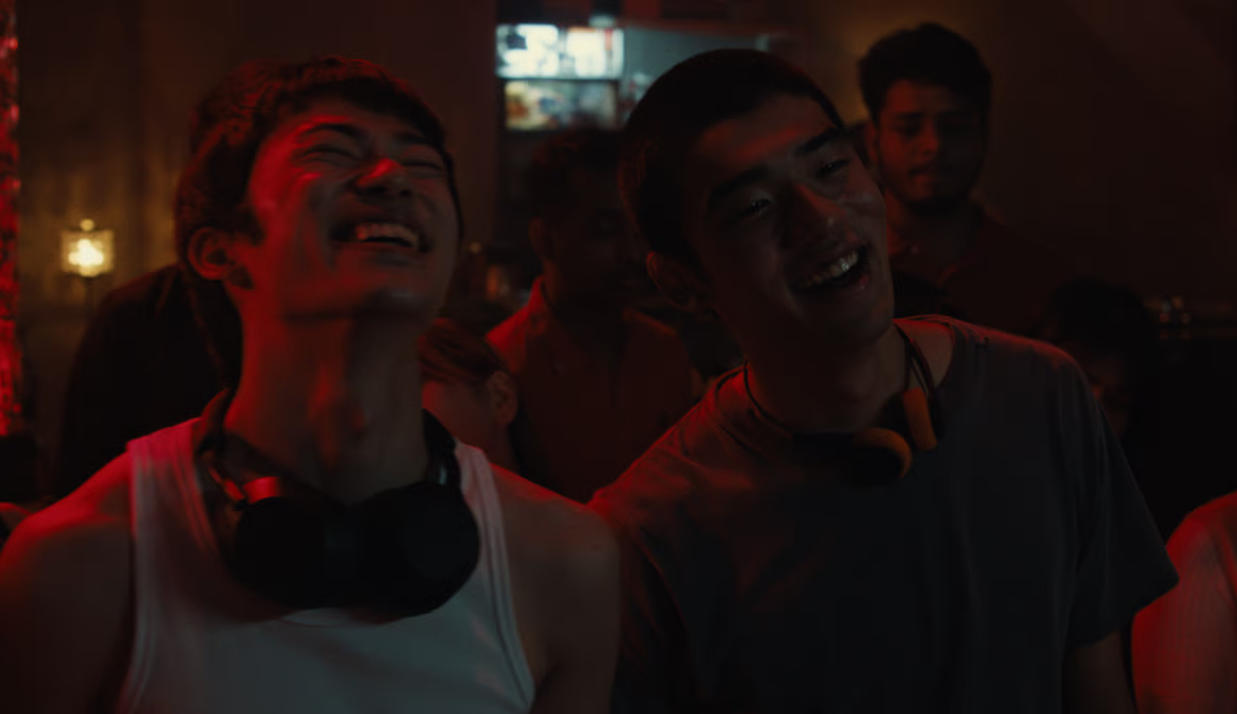
Despite all of the revolving players and broad conversational strokes that make up the taglines for HAPPYEND, its strongest selling point is the fact that it’s a good movie about teenagers, and how the interstitial moments are monumental to the adolescence-turned-adult stage. I think about how camaraderie feels tightly held during the sit-down protest at the principal’s office, where Kou delivers handmade kimbap to his participating classmates, who were otherwise drooling over the principal’s offer of omakase (and a slight devil-wink for surrender). I think of Yuta’s gradual deflation of hope, only to feel like there is a different light at the end of the tunnel, particularly of his middle-aged manager spinning some beats at an audio store. I think of Ming and Fumi quietly professing their love for each other in quiet spaces, amidst the threat of the friend group break-up, to chase after the tenderness of a crush feeling more than just a feeling.
It is HAPPYEND’s contrasting focuses that become advantageously singular as a high school movie. Within the larger frame of the adult doom-and-gloom world (which unfortunately will always exist for young people to come into), nostalgia unfolding in real time is an experience that prevails above all. The film treats their subjects with the maturity that comes with their emotions; an argument between Yuta and Kou is displayed as two long shadows in a room, feeling as epic as a bro-showdown should look like. Private moments are sometimes playfully framed as if we are watching the limited perspective of a surveillance camera. The consideration in making this film look beyond its supposed genres is quite meaningful. Teenagers aren’t stupid, that spooky sci-fi thought bubble isn’t that far away from us, and politics do have a heart beating within.
There is a bit of irony in HAPPYEND, as the characters don’t exactly have a conclusive ending that denotes guaranteed happiness. But one could argue that to even have a promised ending at a young age would be a sadder demise. The world runs on fear and profit, and there is little to persuade the incoming generations that we have handed over a better place. But the flashes of joy that can and will occur can enchant even the most exhausted person in a thunderstorm.
HAPPYEND
2024
dir. Neo Sora
113 min.
Screens Friday, 10/3 through Wednesday, 10/8 @ Brattle Theatre – click here for showtimes and ticket info