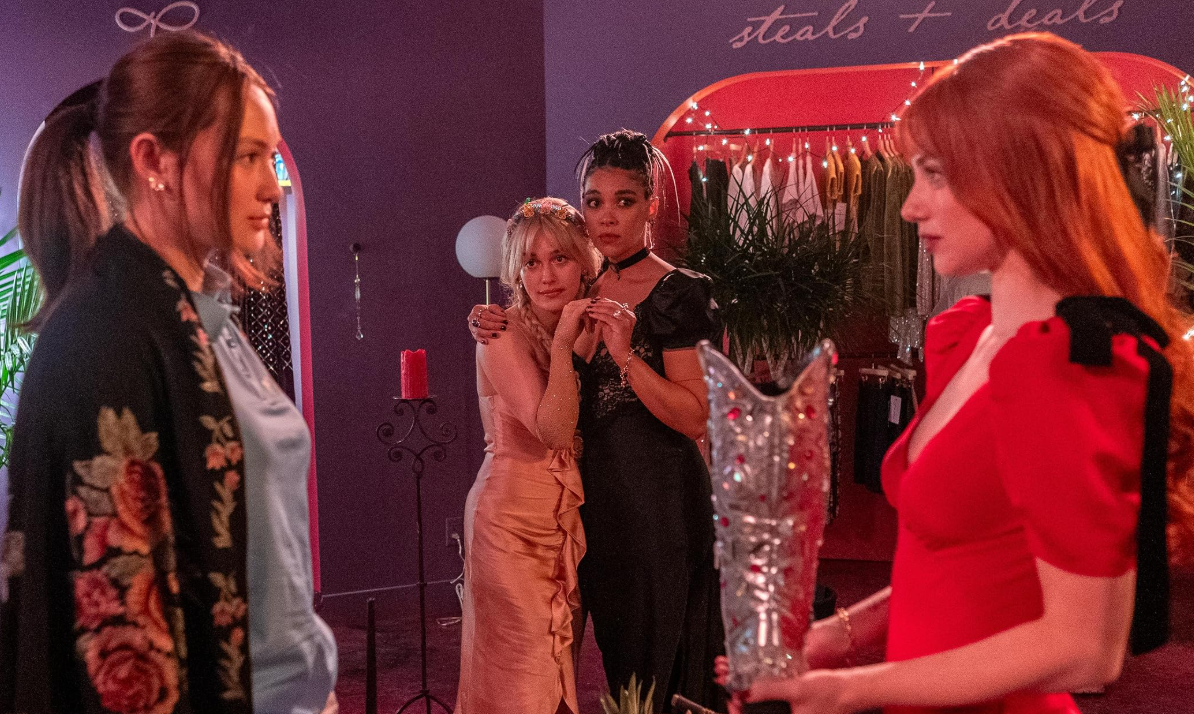
Without dispute, the scripture of Meredith Alloway’s Forbidden Fruits is for the girlies. Adapted from Lily Houghton’s title-telling stage play, Of the woman came the beginning of sin, and through her we all die, the film attempts to reverse-Uno the feeling of shame that comes with the existence of being a woman. Eve, so to speak, is represented by mall employees costumed in surface-level witchery and Biblical references. It doesn’t have the transgressional impact that it seeks, but if we were looking for a recent census check on what weird girls are like since The Craft, this coven might be a good indication.
Hobbyless boredom is a dangerous mood upon itself, and the Fruits are damned with idle hands. Comprised of Apple (Lili Reinhart), Cherry (Victoria Pedretti), and Fig (Alexandra Shipp), the pop-girl collective work together at Free Eden, a pricey influencer-tinged lifestyle store. The film opens up with the aftermath of the Fruits dumping an ex-member; the initial details are cryptic, but the promise of not allowing another member in so easily is clear. That is, until they meet Sister Salt employee Pumpkin (Lola Tung) five minutes later. For what it’s worth, the opportunity of another girl with a fruit name is undeniable to pass up.
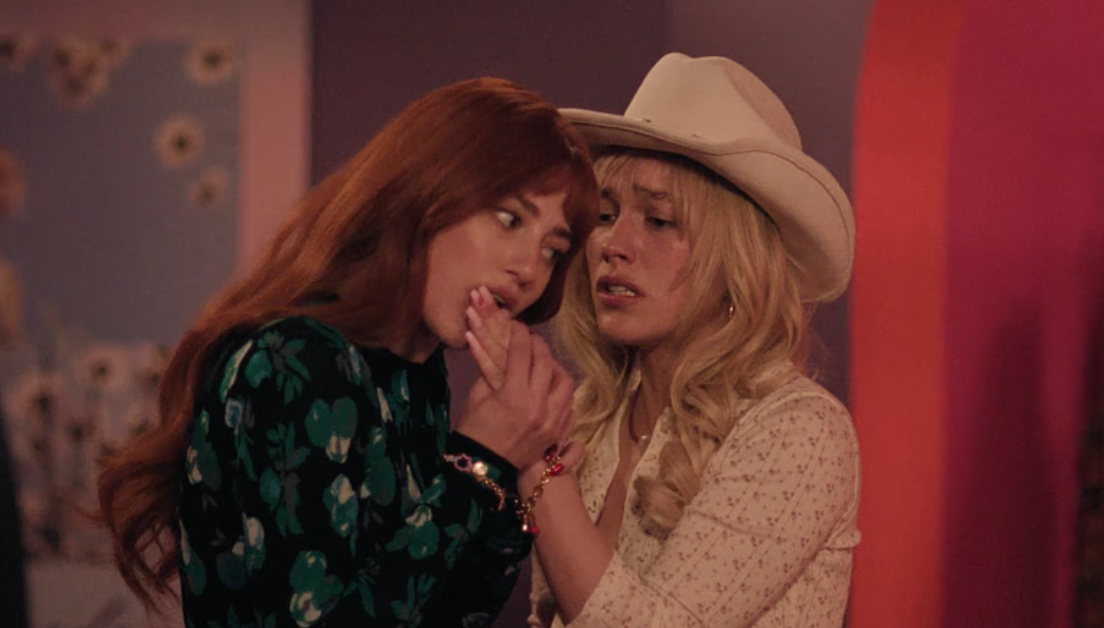
Of course, Pumpkin’s first hangout with the Fruits isn’t quite normal; it’s an initiation ritual that takes place in the after-hours of Free Eden. She participates in a near-laughable experience of circular chanting and sipping some bad-juju juice. However, if the Fruits are aware about humiliation, they don’t acknowledge it. In fact, it seems like an apt reflection on women today: crystals and astrology are not as niche as they once were (albeit perhaps not fully understood), and having girl-friends can be identified on Maslow’s hierarchy. Pumpkin has many chances to ditch, either at the ritual or when she’s asked to have a one-on-one consultation with Marilyn Monroe’s spirit. Instead, she sticks around to watch how this girlhood will go down, even if she smells the smoke nearby.
Divining where Forbidden Fruits goes right and wrong is a little difficult, since explaining an asset or flaw needs the prerequisite context from the movie or with the societal status at large. There is an essay waiting to be written from both the film’s biggest fan and the film’s biggest hater. It goes without saying that this movie isn’t for everyone, and it still might not be right for the usual audience. I suppose the specific tone of deadpan mean-girl humor within a world befitting for a horror film could be traced back to Jennifer’s Body or Heathers, but because it exists in a strange liminal space where extremities of girl-boss feminism and a rather convoluted reality of trauma and murders occur, the film introduces you to so much and leaves you with more to ponder about.
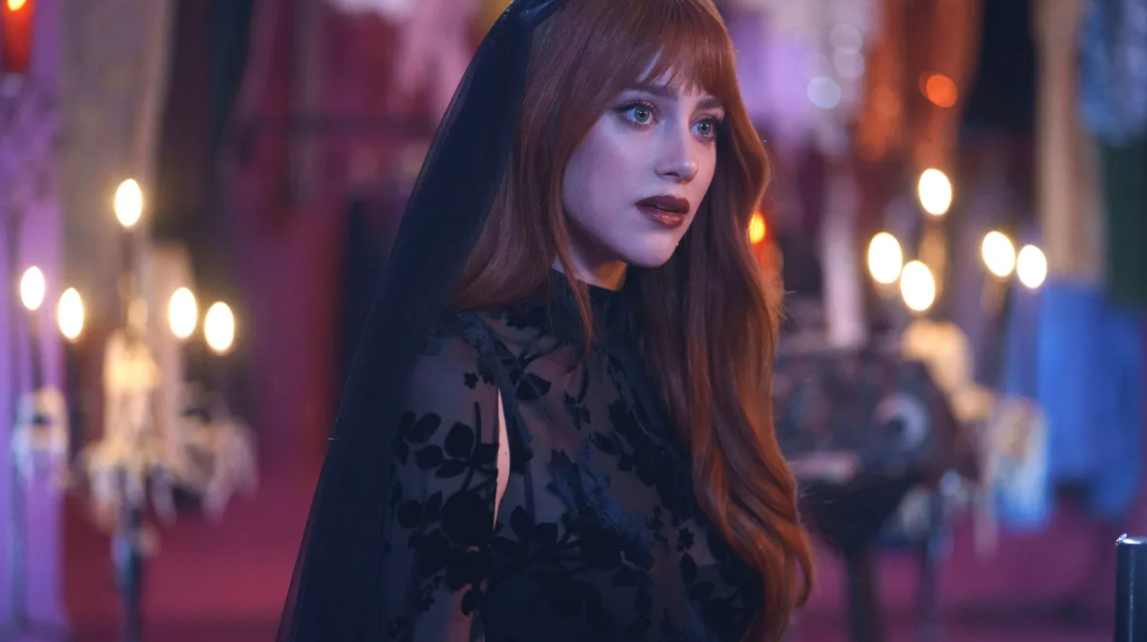
Nonetheless, I can’t deny that the film has got something. Its ambience and structure are unapologetically alluring. The production’s contrast between today’s aesthetics and verbiage and yesterday’s discourse can feel displacing, but still refreshing amongst the predictable dredges and commonplace scenery. Life weaves in and out between the vendor stands and the food court, but much like the current mall experience, the air feels deadened by something rotting. Either in your first or third time watching this, the film has an irresistible pull to make you feel like you’re a part of something weird.
More importantly, the gravitation leads toward the cast. All of the actresses have their star power coming into this film, but it’s clear that Reinhart has done her homework. The importance of line delivery is paramount to the film’s enjoyability, and Reinhart hones viciousness and vulnerability to make Apple less of a Medusa villain and more of the scorned woman Eve was. I was hedging between whether the movie would have succeeded with a lesser known cast, but Reinhart’s clear command of this character amplifies the intention of the talented cast around her, creating an aura of authenticity in girl friendship.
Truthfully, it is the power of friendship that can make or break the movie for me. Controversially, what makes Women Talking a little more of a comfort rewatch than, say, Girlhood is the fact that the women are working with each other, while in Girlhood, the experience deflates in the third act when the main character’s friends disappear from the plot. Forbidden Fruits confronts the performative nature of girl friendship that seems to be plastered as a sort of social enhancement, so it makes sense that the comfort level isn’t intended to be as heartwarming as The Craft. But instead of sticking to history, wouldn’t it be nice if we don’t burn the witches this time around?
Forbidden Fruits
2025
dir. Meredith Alloway
103 min.
Opens Friday, 3/27 @ Alamo Drafthouse Boston Seaport and AMC Boston Common, Causeway, and South Bay