

I recently saw a take online (I’m not going to link to it, because tracking down a specific bad Twitter take is like looking for a needle in a racist haystack) deriding some of our biggest-name directors for spending the last decade-plus making period pieces. The implication, it seems, is that, by retreating to a “comfortable” past, these filmmakers are avoiding tackling contemporary issues. This notion of “safety” is, of course, ridiculous on its face to anyone who’s actually seen these movies (The Irishman is as despairing and discomfiting as any film in Martin Scorsese’s career), but the idea that stories set in the past are incapable of commenting on the troubles of today is simply a case of semiotic illiteracy. Drawing parallels between past and present is one of the oldest and most potent techniques in storytelling; the thought of someone watching Inglourous Basterds or The Master and not finding any echoes of modern woes is frankly baffling. The contemporary vogue for disregarding the past is more than a little unnerving to those who can remember its mistakes.
That Georgia Oakley’s Blue Jean takes place in the notoriously reactionary world of Margaret Thatcher’s England makes its clear echoes of today all the more troubling. Rosy McEwen plays Jean, a physical ed teacher in a high school in 1988 Newcastle. Jean has a loving girlfriend, Liv (Kerrie Hayes), and a support group in the lesbian clubs of England’s punk underground, but she is forced to keep mum on her personal life on the job; her fellow teachers unquestioningly parrot rhetoric from members of Parliament that the “pretend family relationships” of homosexuality is an inherently corrupting influence on impressionable youth. Despite her attempts to check her identity at the door, Jean can’t help but notice an introverted student, Lois (Lucy Halliday), weathering taunts from her classmates accusing her of being gay– suspicions Jean inadvertently confirms when she spots her sneaking into her go-to club. Jean is torn: she clearly wants to help this girl, but doing so would jeopardize her livelihood and make her a pariah. Inevitably, the situation becomes complicated, and soon Jean is forced to make some seemingly impossible decisions.
Jean is an indelible protagonist in more ways than one. McEwen embodies her character with the twitchy intensity of an alien stuck on a foreign planet. Even in the comfort of the club or her friends’ commune house, Jean often seems to want to crawl out of her skin, fiddling with a cigarette and scanning the horizon; at work, it’s as if she’s succeeded, with every bit of her personality except “teacher” meticulously removed. In either world, Jean is a woman of few words, which makes McEwen’s performance all the more remarkable: though Jean is extraordinarily guarded, McEwen is so expressive– in her fidgety body language, in her micro-reactions to her coworkers’ casual bigotry, in her thousand-yard stare through red-rimmed eyes– that we rarely wonder what she’s thinking.
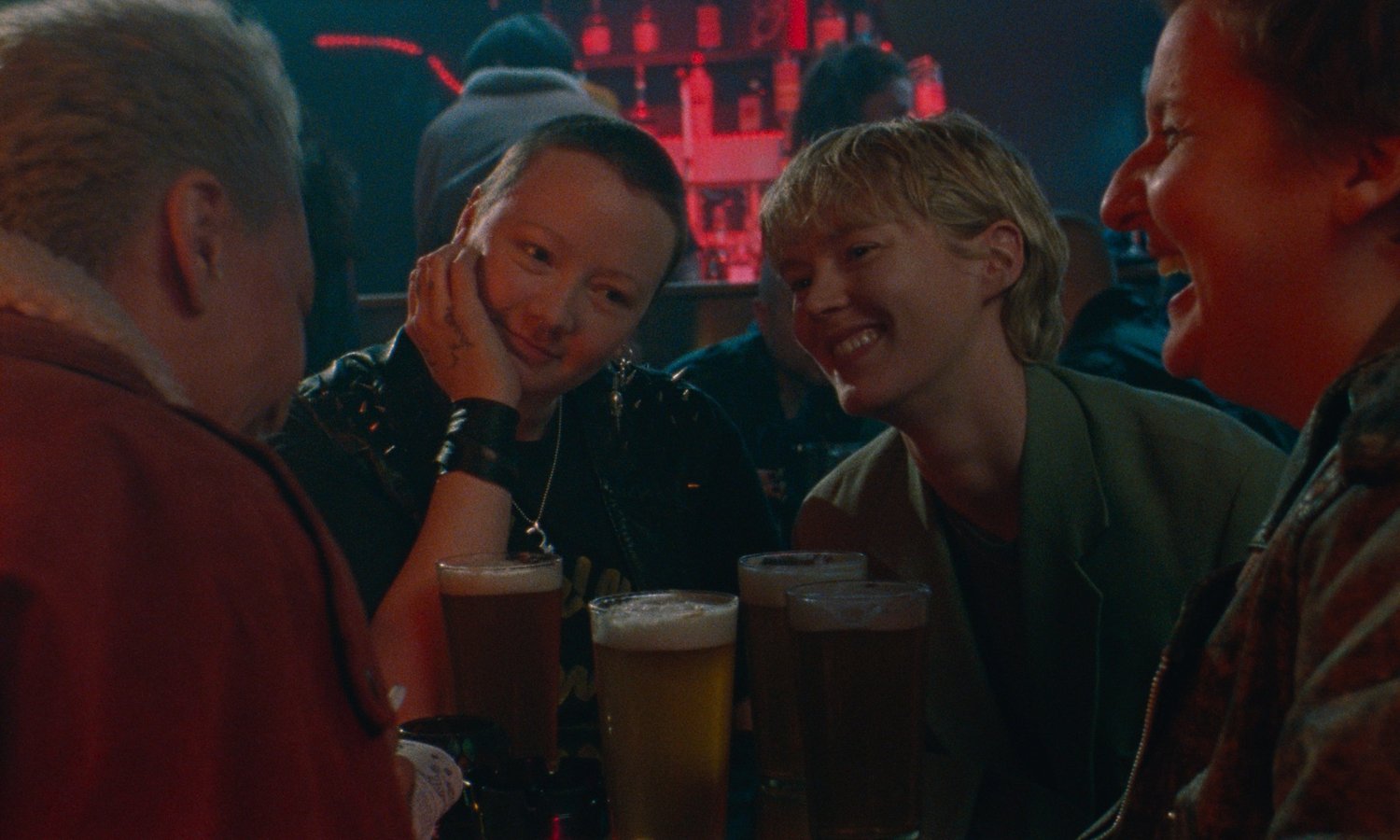
Except, of course, when we do. Jean is a far cry from the noble queer heroines of a Ryan Murphy production; on the contrary, she makes a number of decisions throughout the course of the film which are, at first glance, shocking in their callousness. Jean has no interest in being a martyr, and she’s not going to risk what little she has for the sake of principle. Each of these actions clearly cuts her like a psychic dagger, but it’s clear she has little choice: she is, after all, living in a time and place where a person of her persuasion has little room for error. She has specific reasons to keep herself afloat, which are revealed by film’s end, but realistically she doesn’t need them: when all of society is mobilized against you specifically, survival is enough of a goal.
It’s around this point that the film’s contemporary parallels should come into focus. Blue Jean is set in a very specific time and place, and the sound bites from Thatcher and other politicians and pundits are authentic artifacts, but the rhetoric on display is strikingly similar to the current right-wing panic equating LGBT+ people, specifically in education, with vaguely defined notions of “grooming” and other unseemly forms of corrupted innocence. It’s all from the same playbook, of course: political elites cynically position themselves as “underdogs” against a conveniently otherable bogeyman, and their constituents follow suit in ginned-up outrage. Blue Jean is a stark visualization of how bad things got for certain people among the Thatcherites, and undoubtedly how bad things are for people today– and if current trends persist, they’re liable to get a whole lot worse.
Blue Jean is not always an easy film to watch, and there will surely be those who can’t hang with some of Jean’s choices. But while British kitchen-sink drama is not a genre known for its sunny uplift, Blue Jean offers a surprising amount of hope. For all the hopelessness in Jean’s life, she does have a vibrant and supportive community, and while she can’t afford to embrace it as guilelessly as Liv (whose buzzed head and ratty Slits t-shirt offer little public doubt as to her identity), it’s clear that she loves it and depends on it. And while Lois can’t find the mentor in Jean that she yearns for, Jean’s very existence provides a glimmer of hope through the Newcastle drab. The cycles of oppression can be heartbreaking to linger on, but the thing about history is that there are always survivors, and as long as we keep their stories alive the persecuted will continue to find a way forward. Thank god for period pieces.
Blue Jean
2022
dir. Georgia Oakley
97 min.
Opens Friday, 6/16 @ Coolidge Corner Theatre