As the wheels of time clunk inexorably into 2026, the last thing anyone needs is another cinematic universe, let alone one based on a fondly remembered cinematic property. Stranger Things, with its tepidly received series finale, seems to have finally exhausted America’s seemingly endless reserve of nostalgic ‘80s goodwill, and that countdown timer at the end of the Avengers: Doomsday teasers feels more like a threat than an invitation. At risk of reckless optimism, it really does feel like something is shifting in the tastes of mainstream moviegoers; we’re beginning to realize how malnourished we’ve become from consuming the same regurgitated stories ad infinitum, and that being expected to do homework for our popcorn entertainment is a drag.
All of this is true, and yet, somehow, the recently reanimated 28 ____s Later franchise has quietly become one of the most exciting things in blockbusters right now. Last year’s 28 Years Later was an unexpected delight; rather than rehash the guerilla minimalism of 2002’s zombie* classic 28 Days Later, director Danny Boyle and screenwriter Alex Garland (both returning after sitting out 2007’s just-OK 28 Weeks Later) went for broke with a flurry of fresh ideas, bringing a demented gonzo energy to what could have been a rote legacy-quel. The result was more Fury Road than Force Awakens, a giddy, ultraviolent joyride through a post-apocalyptic sandbox.
It’s barely been 28 weeks since the release of 28 Years Later, but its follow-up is already charging its way into theaters. Technically a spin-off rather than a true sequel (Nia DaCosta is subbing in for Boyle, though Garland is still at the keyboard), 28 Years Later: The Bone Temple takes all of the previous film’s wildest elements and makes a full meal out of them. The result, while far from what most would consider “elevated horror,” is another blast of gleefully bonkers zombie mayhem, and miles ahead of the typical “January horror dump” fare.
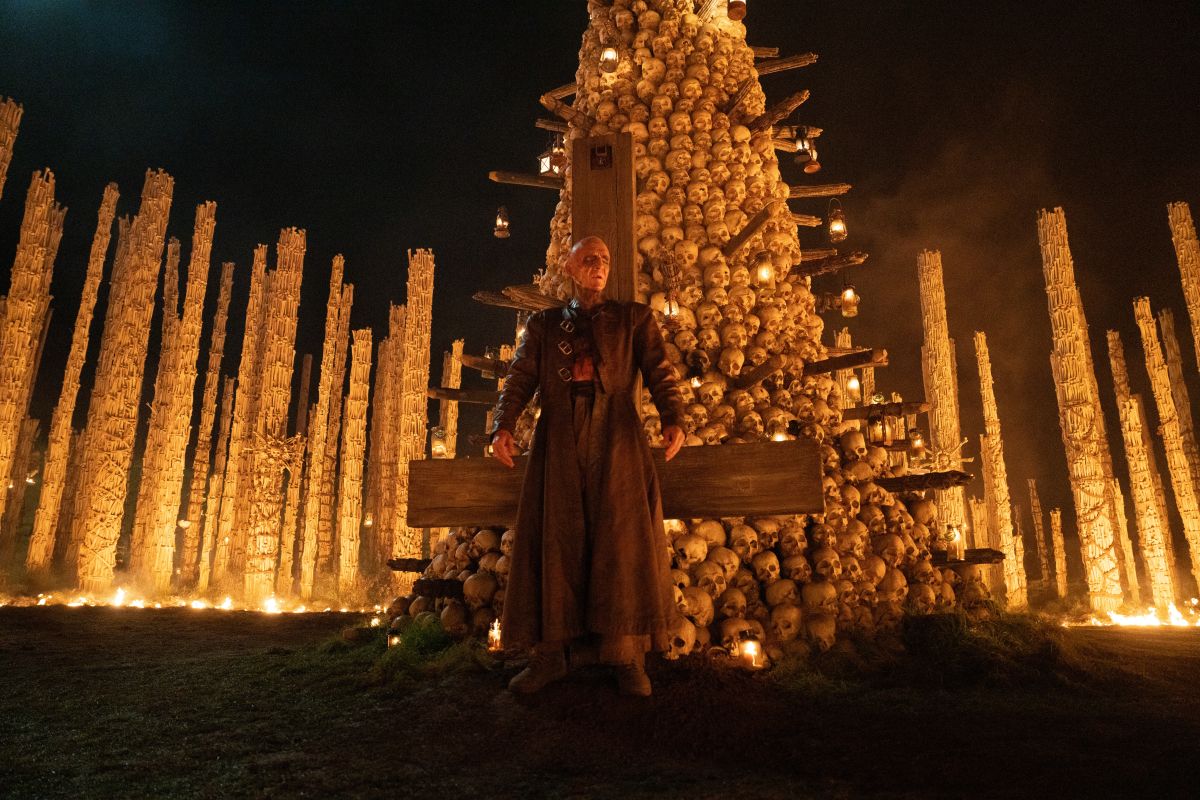
As one might expect from the film’s subtitle, Ralph Fiennes is back on hand as the compassionate (if lightly mad) Dr. Ian Kelson, the iodine-dyed physician carrying on his research in a sprawling field ossuary made out of towers of bones of the dead. Dr. Kelson has taken a special interest in the “alpha zombie” he calls Samson (Chi Lewis-Parry), a hulking barbarian who shows signs of sentience when Kelson doses him with a morphine blowgun. Imagine if Bub from Day of the Dead had been Jason Momoa in life (and was also perpetually nude), and you’ll get a sense of the queasy comic tension.
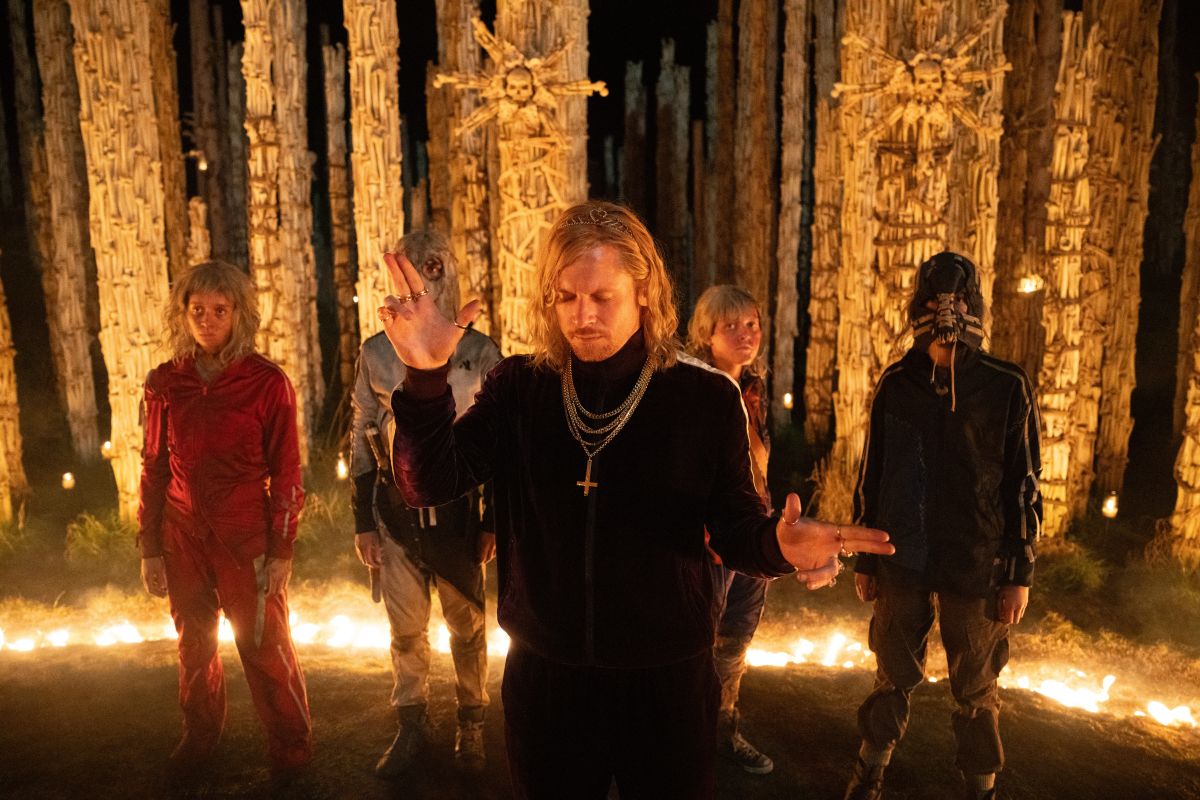
Also prowling the countryside are the Jimmies, the tracksuited and wigged gang of Satanic parkour sociopaths who popped up in the last scene of Years to rescue young protagonist Spike (Alfie Williams). Spike is back too, uneasily tagging along with the Jimmies, but the focus this time is on the gang’s charismatic leader, the self-dubbed Sir Lord Jimmy Crystal (Sinners’ Jack O’Connell). Needless to say, these two stories eventually intersect— with poor Spike stuck in the middle.
28 Years Later was notable not only for its visceral excess, but also for its surprisingly poignant passages of grief and death acceptance. This element is toned down for the spinoff, but not entirely absent. Dr. Kelson remains, in spite of everything, a profoundly lovely soul, and the film’s quieter passages, in which we see how the doctor spends his daily existence, are almost perversely cozy. In his underground bunker, Dr. Kelson makes tea, consults his surviving research tomes, and even listens to an eclectic assortment of LPs on his hand-cranked Victrola (it’s a pity society has collapsed, as that original double-10” vinyl pressing of Kid A would surely fetch him a mint on Discogs). When he doses Samson, he speaks to him gently, as if he were a particularly frightened patient; it’s clear he relishes the opportunity to converse with anyonel, even if his partner is a hulking, tranquilized rage-zombie. It’s remarkable that, in this truly gnarly bloodbath of a film, the most memorable zombie moments involve a man and a zombie gazing at the stars together.
But make no mistake: this is a truly gnarly bloodbath of a film. While DaCosta eschews some of Boyle’s more eccentric stylistic choices from the last film (such as the ironically deployed bits of stock footage), she doubles down on the in-your-face wildness that made it such an electric delight. In an early zombie-rush scene, DaCosta disorients us by mounting the camera directly on Samson’s chest; she then cuts to a second angle as he rips some poor hiker’s spine out by the skull. Indeed, this is perhaps the goriest studio film since the “torture porn” boom of the ‘00s, but most of it is not at the hands of the zombies at all. Rather, the true monsters are the grinning, droog-like Jimmies, who are so ghoulishly entertaining that one can’t help but grin even as they flay their poor victims alive. DaCosta is American, but she’s clearly a student of Britain’s notorious tradition of “video nasties.”
On the subject of culture clash, the film’s most peculiar element is likely to sail clean over the heads of many American audiences. The aesthetic of the Jimmies— their names, their jewelry, their truly upsetting wigs— is modeled after the infamous BBC presenter and world-historic sex criminal Jimmy Savile. It’s a curious choice, and one that I suspect serves two purposes. The first is to reinforce the notion that the world, as far as England is concerned, has ceased to turn in 2002, a decade before the extent of Savile’s crimes were widely known (there were rumors, of course, but likely nothing that would have filtered down to an 8-year-old Jimmy Crystal). We never learn why the Jimmies adopted Savile’s look, but it’s likely the same sort of cargo-cult sensibility that leads Crystal to recount Teletubbies episodes as if they were folklore. These are simply things they remember from the old world, and now that no one else is using them they are free to take their power for their own.
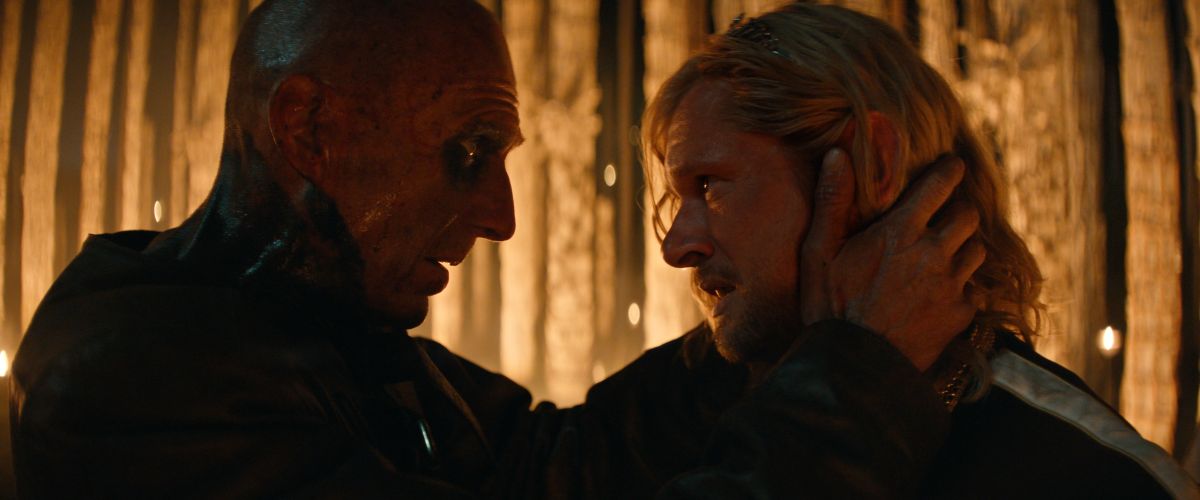
The other reason, of course, is that seeing a gang full of leering psychos committing acts of brutality dressed like a 1970s TV clown looks rad as hell on a movie screen, at once disturbing and undeniably amusing. O’Connell is just as wildly entertaining here as he is in Sinners, devouring the scenery with his rotten teeth and commanding the screen for every second he’s upon it. When Crystal finally crosses paths with Kelson, we rub our hands together at the thought of these two unforgettable characters playing off each other, and the result does not disappoint (there is a scene near the climax of the film which I would not dream of spoiling, but suffice to say Fiennes briefly matches O’Connell in terms of onscreen insanity, and appears to be having the most fun he’s ever had in his entire life doing it). DaCosta knows that if you have a great visual and the chops to sell it, everything else will fall into place.
Is The Bone Temple art? That’s debatable; it lacks either the formal innovation of Days or the unexpected emotional pull of Years, and we know from its “spinoff” designation that it is intended in part to push the pieces toward Boyle’s next outing in a couple years’ time. But in an age of storytelling by algorithm and cynical, cyclical sequels, the thought of a franchise installment with actual ideas— let alone two installments, let alone in under six months— is something close to miraculous. The Bone Temple is everything a zombie sequel should be: raucous, funny, surprisingly smart, and bloody enough to make you avert your eyes into your popcorn. Howzat.
* – Purists may bicker that the ghouls in the 28 films are not technically “zombies,” but rather living humans infected with “rage virus.” To this I say: zombies are not a scientific reality, but rather a convention of movie monster, and thus are to be defined by their onscreen presence rather than the mechanics of their transformation. If they stagger like zombies and munch like zombies, they’re zombies.
28 Years Later: The Bone Temple
2026
dir. Nia DaCosta
109 min.
Opens Friday, 1/16 @ Kendall Square Cinema, Capitol Theatre, Apple Cinemas Cambridge, Alamo Drafthouse Boston Seaport, and all local AMCs