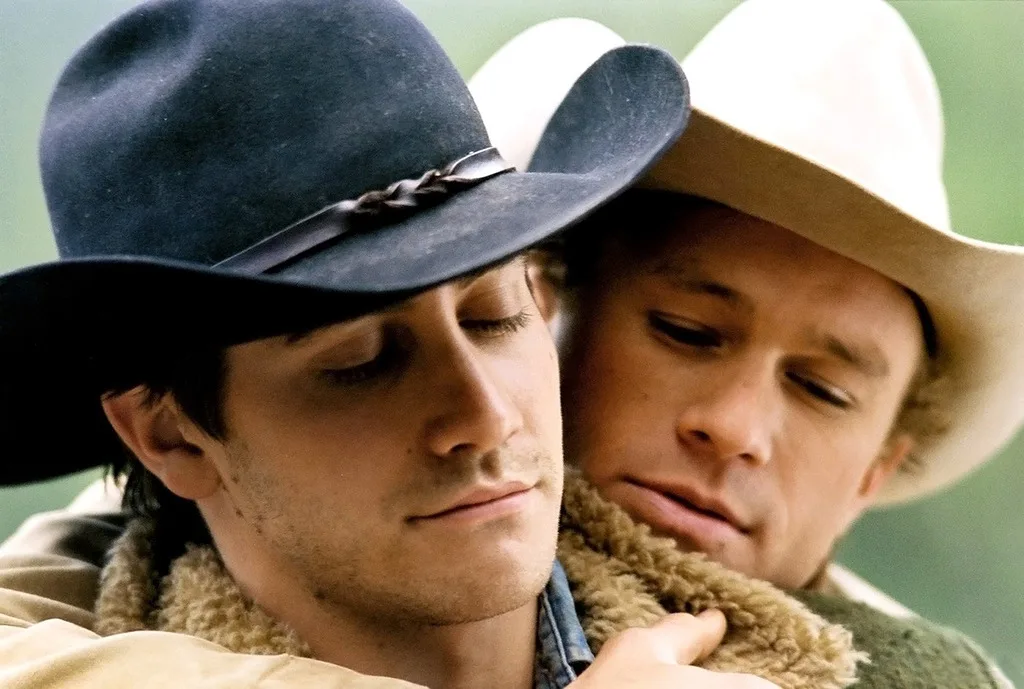
There exists a tension between distaste for Brokeback Mountain as one of many stories that depict queerness as tragedy (made by straight creators) and the fact that it is a magnificent feat of filmmaking. Based on the exquisite short story by Annie Proulx published in The New Yorker in 1997, Brokeback Mountain has spectacular acting, thematics, and cinematography; it opened doors for many more LGBTQ+ media; and it didn’t win Best Picture only because a large number of Academy members were cowards.
The movie’s legacy is unavoidably impacted by Heath Ledger’s tragic passing only three years later. Thus, Ledger’s own revered legacy was cemented just before my time. Before he was posthumously awarded Best Supporting Actor for his disturbed, chaotic, self-possessed villain performance in The Dark Knight, he changed the world with an understated yet utterly devastating turn, one that is all about restraint and self-repression yet evident in its constant underlying tumult. The de facto main character of Brokeback Mountain is Ledger’s Ennis Del Mar, a ranch hand who perfunctorily marries his teenage sweetheart and has a family, but is fundamentally trapped by this life, internalized homophobia, and a traumatic event from his past.
A significant presence in the narrative is the real physical danger queer people face, but this is competently interwoven with the things that prevent Ennis from being with the love of his life, played by the other half of this truly historic acting duo. As a lifelong Swiftie, I’m biased against Jake Gyllenhaal, though I accept that he is a talented individual, and I don’t actually know him as a person. As the cheekily named Jack Twist, Gyllenhaal perfectly embodies the fearless, lively spirit needed to match Ennis’s bleakness. Jack’s nuclear, hetronormative home life seems less like a prison and more like being on autopilot, and he comes to points of self-revelation about his masculinity and sexuality that Ennis never reaches.
Ennis and Jack first meet in 1963, when they are hired together to spend the summer isolated up on Brokeback Mountain, protecting a flock of sheep from predators. The simply yet boldly styled title is revealed against the backdrop of the vast landscape just before the sun rises, instilling an early sense of heavy melancholy and anticipation of something life-changing. Ennis and Jack’s near-silent first encounter is also loaded with foreshadowing, and brilliant in its cinematography, with furtive glances in a rearview mirror and the “train shot” that has inspired whole essays. Shortly thereafter, we are launched into glorious, sweeping shots of the mountains, the flock, the skies. It is lonely, but it is freeing, allowing them to fall and fall hard.
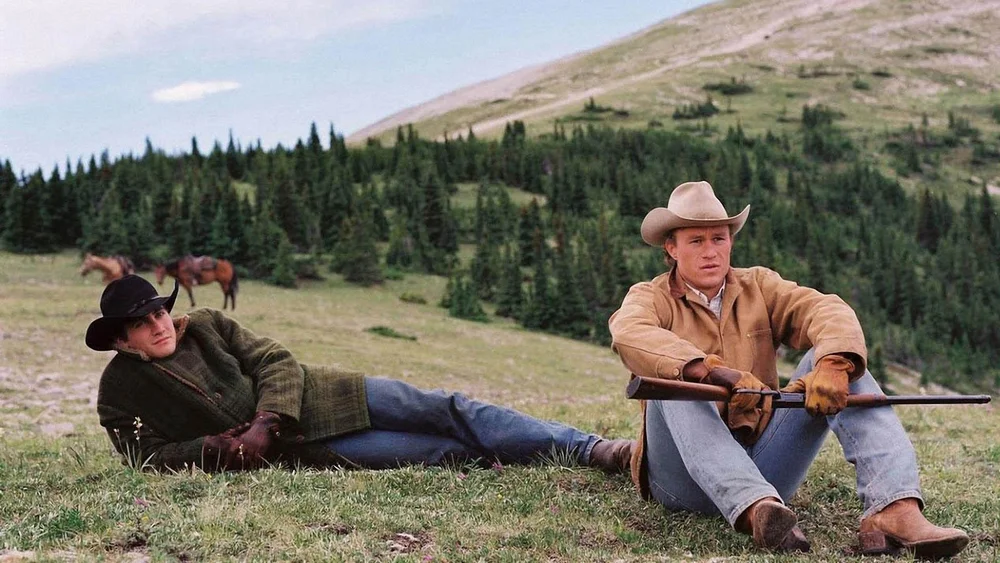
After this time together, Ennis and Jack spend the next two decades semi-frequently meeting up to continue their romantic-sexual relationship. Alongside the boys, Michelle Williams pulled an Oscar nomination for her complex performance as Ennis’s wife Alma, who is, to an extent, prejudiced against Ennis and Jack because of their sexuality, but she’s also just angry and sad about the situation. Anne Hathaway is just happy to be there, doing her job well, playing Jack’s snappy wife Lureen.
Going on “fishing trips” over the years, Ennis and Jack find themselves in more places like Brokeback Mountain that are visually gorgeous, pleasingly rustic, and isolating while being a safe haven. However, Brokeback Mountain illustrates that these excursions aren’t a surefire way to preserve the relationship, nor are they entirely secure. During the initial summer, Ennis and Jack’s boss (Randy Quaid) happens to be in the mountains and sees them embracing from a distance. Alma creates her own paper trail to confirm what is happening while her husband is away. The last time Ennis sees Jack, Jack confesses that their fleeting moments in the symbolic space of Brokeback Mountain ultimately are not enough.
It’s somewhat ironic that this landmark piece of queer cinema, still held up as one of the all-time greats, then commits the cardinal sin of Bury Your Gays. After a lifetime of clandestine weekends, kids growing up, and finally some bitter truths, Ennis has a postcard returned to him because the recipient is deceased. It should be insultingly anticlimactic, but we are seeing it from Ennis’s perspective, the cold moment that stops him dead in his tracks. What actually happened to Jack is left ambiguous, but also from Ennis’s perspective, he imagines that it couldn’t have been an accident but a hate crime like the one he witnessed as a child.
It’s not as though this is a TV writers’ room nonchalantly killing off their one supporting queer character. So, just over 20 years later, how does Jack’s death meaningfully serve Brokeback Mountain? At this point, after repeatedly suggesting to Ennis that they leave their wives and get their own place, Jack was tentatively planning on doing the same with another man he’d met (played by David Harbour). His death reflects the realities of being queer in this place and time (still the reality for many in the world today), but when the movie’s message lies in denying oneself happiness for so long because of internalized social constructions, it’s also a bitter reminder that any day could be your last.
“I swear, Jack…” Ennis says in the final moments. Jack’s ghost will haunt him, but as a reminder to live his life differently? To remain alone, devoted solely to Jack’s memory? This famously inconclusive moment came across to me as Ennis still instinctively reaching for Jack after a weighty moment: His eldest daughter (Kate Mara) has just come by to tell him that she is getting married. I think he just wishes Jack were there to help him process it, with the understanding of another father. It’s like saying, “I swear, this life is complicated,” but he is doing his best to be present.
Brokeback Mountain is intricately woven with quiet conflicts and powerful nuance in its two main characters’ sense of selves. It’s a tragic story, but an amazingly well-told one, also delving into how these circumstances affect the two families and being a quintessential masterclass in show-don’t-tell. The heavily mocked sex scenes and cliched conclusion aside, it’s an epic of internal struggle and lost love that has stood the test of time.
Brokeback Mountain
2005
dir. Ang Lee
134 min.
Screens Tuesday, 6/23, 7:00 @ Kendall Square Cinema