There was a time where I thought being on the Internet all the time was deep-frying my perception of reality, but it turns out that real life is pretty goofed as it is. You wonder if the news are a joke, or if the workplace AI training sessions feel like a acceptable warp of shortcutting tasks. At a mandatory meeting, my company used a completely made up spokesperson to navigate the training video. I do not wish to know what prompts they used to make up this person. I wish I could unread about erotic country music or the very unerotic things happening in this country.
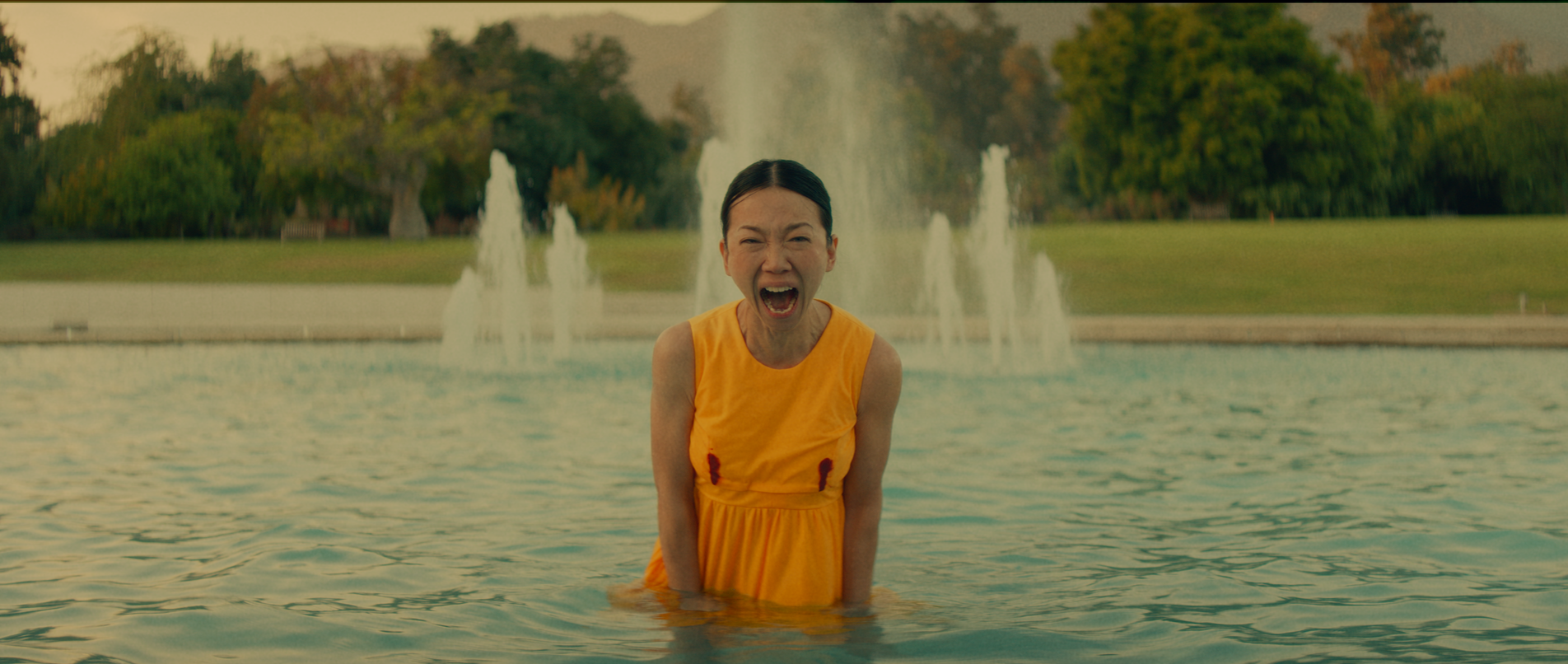
In watching Milk Baby, I find it uncanny how dysfunctionally fucked this world is, yet somewhat closer to the truth than we realize. The short film, which puts the stages of pregnancy in an assembly line through the experience of Kei (Mia Ando), almost feels like it was a deprogrammed advertisement from some big-tech company looking to make motherhood easy, despite sacrificing the bottom line (the women who go through the pregnancies). I hate to say that this movie would have been wholly unbelievable a decade ago.
Short films tend to be limited by budget, but I was impressed with how Milk Baby looks and feels like The Handmaid’s Tale, Severance, and The Good Place had to share the same film set one day. Yet the set design was eerie enough that it couldn’t have been a place that one just finds and starts filming. Or was it?
After Milk Baby was recently screened at the Rhode Island International Film Festival’s “Moments of the Uncanny” Short Films program, I sent questions over to director/writer Kristen Gerweck Diaz to see how this film of stunning details and bad vibes came to be, what the heck maternity homes are, and what we can look forward to in Diaz’s career.
The conversation has been edited for flow.
BOSTON HASSLE: I want to start the questions with a silly admission – I thought the concept of a maternity home was a futuristic idea, but they currently exist in this country. Can you provide some background on maternity homes and how you decided to base the film on one?
KRISTEN GERWECK DIAZ: From 1945 to 1973, there was a significant rise in premarital pregnancies, accompanied by a surge in adoptions. Maternity homes played a pivotal role in facilitating these adoptions, often under intense pressure for mothers to relinquish their babies. It is estimated that up to four million babies were surrendered for adoption during this period, with two million in the 1960s alone. Maternity homes were marketed as supportive environments that would facilitate happy adoptions. In reality, many women found themselves in centers of abuse. Mothers were often forced to part with their babies, and not all separations resulted in happy adoptions. The babies who were deemed undesirable were sometimes killed. At many of these homes, selling babies was just a business.
If pregnant women in a future dystopian world needed to be trafficked, maternity institutions like those of the past could serve as the perfect guise: luring vulnerable women with no resources into maternity homes with promises of care and/or the possibility of finding adoptive parents for their unborn children. Women in desperate situations are often trafficked with promises of help and support, only to find themselves prisoners once they are lured behind closed doors and into the control of their captors.
BH: The production set looks amazing. Where was it filmed, and was there anything that had to be constructed for the film’s intended design?
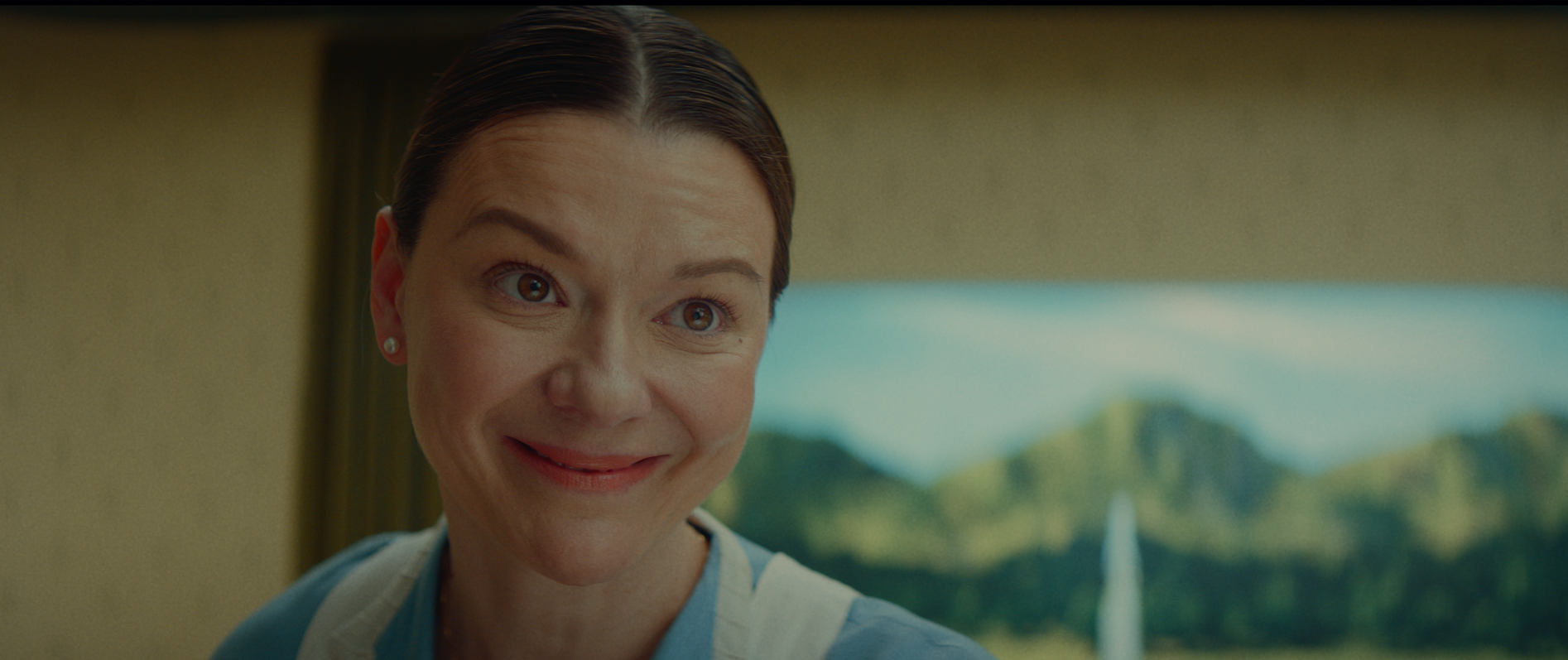
KGD: The film was shot in Los Angeles and the Pasadena area. Aside from the exterior shots, the entire world was built from scratch, down to the custom-made costumes. Creating a stylized near-future world that exists only in your imagination is no easy feat. Fortunately, I had an incredibly gifted producer who moved mountains to bring my wild vision to life, Lou Wang-Holborn. I call her my superwoman! Not only did Lou move mountains, but she also deeply understood my vision for Milk Baby. As a director, I look for a producer not only who can execute, but also who is creatively on the same wavelength and truly understands my vision. From day one, I knew my “baby” was in good hands.
I also want to highlight our talented production designer, Hanrui Wang, who made my vision a reality. She is a powerhouse — an exceptional collaborator who not only executes with precision but also has the creative depth to realize this unique aesthetic. Additionally, our costume designer, Amanda Wing Yee Lee, was instrumental in bringing my concept of the milking dresses to life. The maternity dress she created for Kei is a work of art. Not only is Amanda a talented artist, but she also thinks deeply about story and psychology when designing costumes, which is what makes her work so powerful.
In terms of the visual design of a film, I always start with the underlying themes. Milk Baby is a story where beautiful lies obscure a terrifying reality – a near-future world that has dangerously regressed into a bio-capitalistic nightmare for its prisoners. Horror doesn’t always have to be dark and ugly; I believe that contrast is often more truthful to reality and, consequently, more unsettling. This idea influenced the film’s aesthetic — bright, poppy colors, floral motifs, ornate maternity costumes. A seemingly idyllic world that’s coated in sugar.
BH: It’s hard to describe what the film is. It’s like a brightly colored nightmare, or an Amazon ad for a federally-approved dystopian service. What was the original blueprint of the film, and how were you able to expound on different topics like motherhood and commodification while keeping it under fifteen minutes?
KGD: A film should never attempt to cover more story or characters than it can effectively serve. When writing a short film, I concentrate on one major reveal, watershed moment, or defining climax that serves up a gut punch to the audience. Building toward one central plot twist allows me to distill complex concepts into a smaller but impactful story. Milk Baby is a story driven by large ideas and concepts, but with only 15 minutes, I knew I had to leave some things unsaid and focus on building toward that one crucial reveal that conveys the core messages. While I do have a larger story in mind for a feature, for the short, I knew I had to strike the right balance of concept and story. I think one of the most significant challenges in short filmmaking is finding that “sweet spot” – what you can fully explore and service without sacrificing your big ideas.
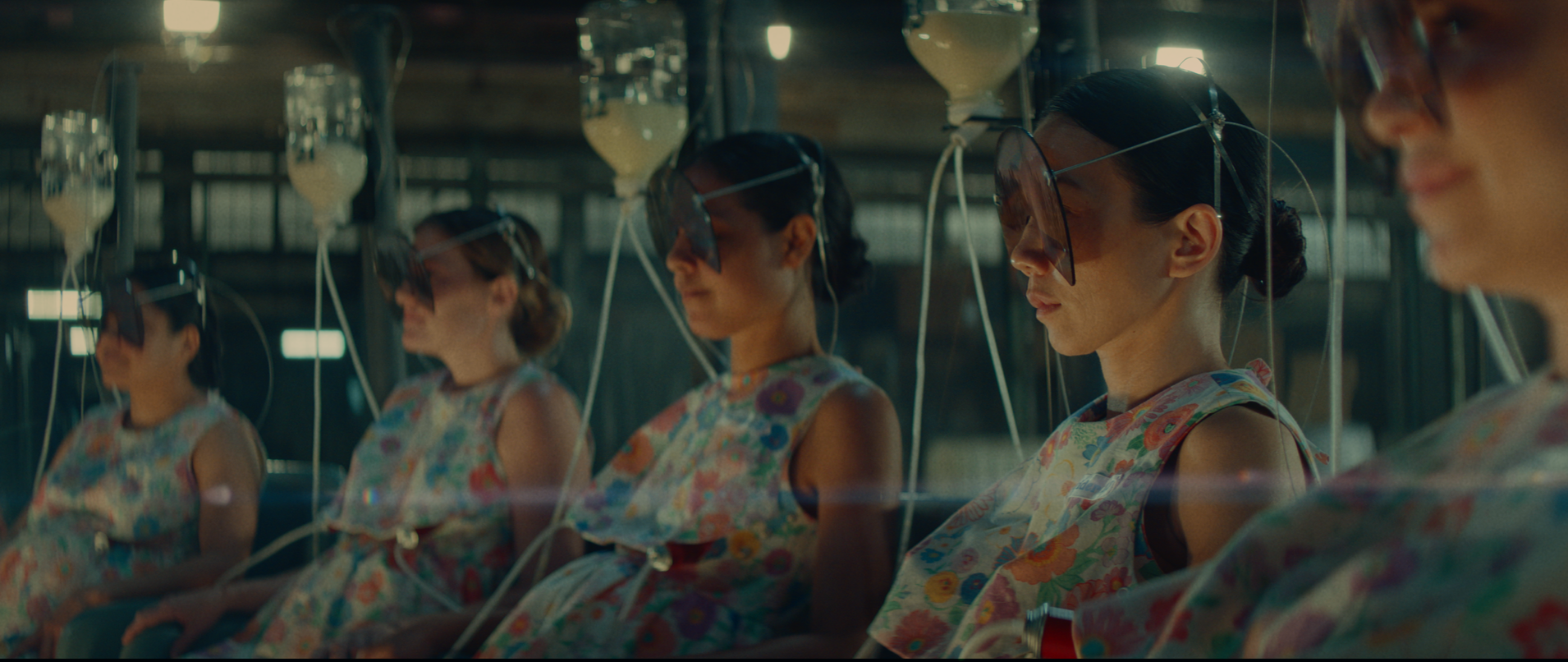
BH: I think of the lactation merry-go-round as both a stunning and devastating scene for the film that’ll stick with me for a while. How did that one come about?
KGD: Shockingly, I didn’t make up that idea. I sourced that design idea from a dairy farm. After giving birth, dairy cows have their calves taken away from them, and then they are sent daily to be milked side by side on these milking wheels. I’m not sure if it’s about space efficiency or if the motion is designed to facilitate milking, but that image has haunted me ever since I saw it. These cows are milked until they dry up, only to go through the entire cycle of pregnancy and giving birth again. It’s a horrifying and heartbreaking reality that’s difficult to fathom.
BH: Your past work has included short films, including a prior collaboration with [actress] Mia Ando and [DP] Joe Keng on The Wind Phone, though I’m sure there were more that I may have missed. Was it easy to collaborate with them again, especially for another short film format?
KGD: It was a dream to work with both Jon Keng and Mia Ando again. I have such a strong creative connection with both of these collaborators.
The lead character, Kei, doesn’t have much dialogue, as she is a woman gradually losing her voice in this terrifying power struggle. I needed an actress who could convey everything without saying a word, and Mia is an actress with that kind of power. She also has this effortless elegance reminiscent of Mia Farrow that is very magnetic. Mia also walks the line of strength alongside vulnerability so well, which adds incredible depth and dimension to her work. Since the very inception of this project, I always felt Mia was the one to play Kei.
Jon Keng, Milk Baby’s incredible director of photography, was the only choice I had in mind for this film. We had such a powerful collaboration on The Wind Phone, and I couldn’t wait to work together again. From our very first meeting, I knew he would be a lifelong creative partner. Not only do we share similar sensibilities, but we also see the world in a similar way. We even discovered that we both accomplish our best creative work in our dream states!
As a collaborator, I love how deeply Jon and I can discuss story and shots. He always puts so much thought into serving the story above all else, [which is] something that is incredibly important to me as a writer and director. Listen, Jon will never deliver anything that doesn’t look stunning, but what makes him truly special to me is his ability to understand and trust in my visions, even when they are as wild as Milk Baby. Over the years, we’ve developed a close friendship, and I’m always so grateful for every day we spend on set. We’re determined to create many more projects together, including shooting a feature of Milk Baby. While I am happily married to actor Joshua Diaz, we often joke that Jon is my “set husband.”

BH: It feels limiting to ask if there was an intended statement at the end, but is there anything in particular that you hope people take away from watching Milk Baby?
KGD: As a filmmaker, I like to give audiences some space for their own interpretations and reflections. Everyone has a unique life experience, and I believe people should decide for themselves how a story connects to their reality. Milk Baby is a film that will strike a chord with mothers, but there are also universal messages that will resonate with anyone. In a world where the line between truth and fiction is increasingly blurred, we must always question the reality presented to us. What are we being told, what are we consuming, what are we consenting to, what are we normalizing, and what are the potential real-world implications?
BH: Can you share any projects lined up for you in the future, or any projects that you’re excited to tackle?
KGD: Currently, I’m writing a sci-fi action thriller surrounding a near-future world ravaged by climate change for [production company] Atomic Features, as well as a feature adaptation of Milk Baby to direct. Additionally, I’m developing another sci-fi thriller to direct that explores the intersection of AI, addictive productivity, and motherhood. I am also attached to direct Himawari, an incredibly moving story set in 1980s Japan. I am deeply excited about all these projects—I only say yes to stories that ignite my creative spirit and move me.