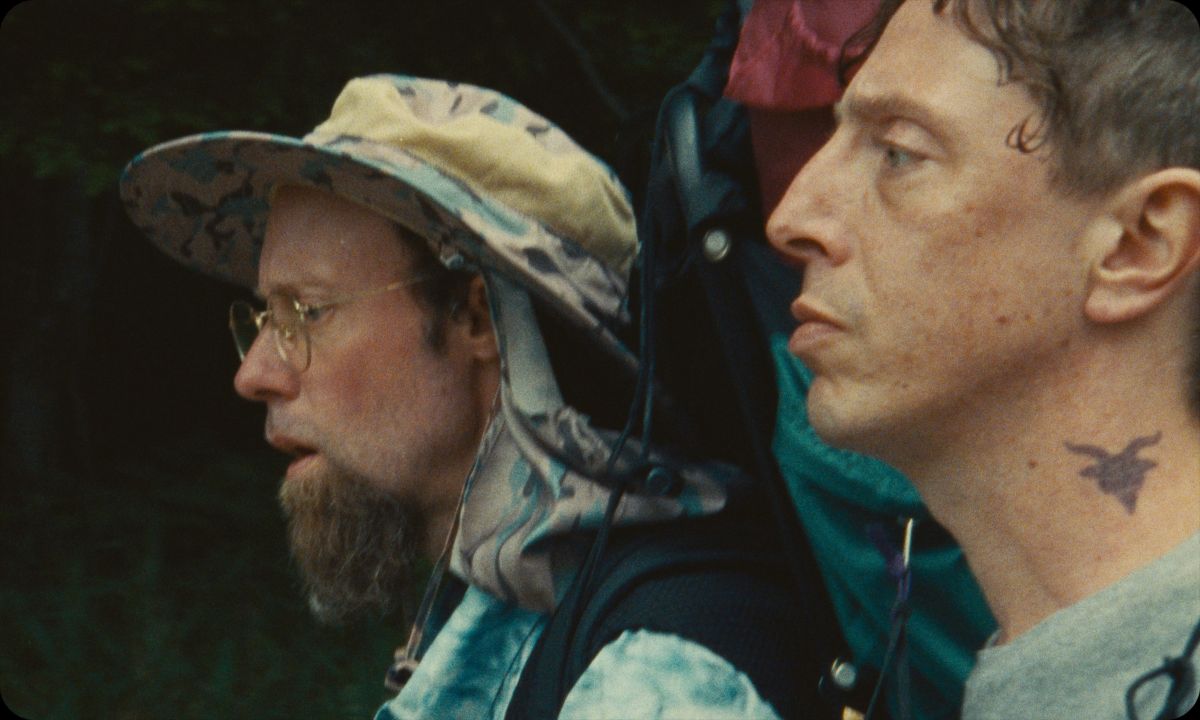
Of all the wild and woolly films at this year’s Boston Underground Film Festival, few were as tough to shake as Joel Potrykus’ Vulcanizadora. The film, in which Potrykus and actor Joshua Burge reprise their roles from Potrykus’ 2014 breakout Buzzard, begins as something of a shaggy-dog hangout comedy, before abruptly shifting gears in the second half to something darker, stranger, and altogether unforgettable. In anticipation of the film’s proper release from Oscilloscope Laboratories, I spoke to Potrykus about the challenges of revisiting old characters, the anxieties of parenthood, and the cultural ubiquity of Godsmack. (This interview has been lightly edited for clarity and flow).
BOSTON HASSLE: This is sort of a follow up to Buzzard, in that you and Joshua Burge play the same characters, but they’re such different films that it doesn’t really feel quite right to call it a sequel. I was curious how this came about. Was it always going to be Marty and Derek, or did they just sort of find their way into the script?
JOEL POTRYKUS: They found their way in. When I came up with the idea it was two guys, and they were going to do this mission, they had a plan in the woods. [But] that was the hardest part, was to figure out who they were going to be. If they were both quiet and depressed and miserable, then I’d be making a drama, but if they were both a little bit goofy, then all of a sudden I’m making a comedy. So one had to be quiet and one had to be goofy, just to keep it off balance a little bit. And it took me a while to figure out who those actors were going to be, because I don’t like to mix the universes, and I don’t know a whole lot of actors, because I’m in Michigan. I thought of Andre Hyland, who had been in Relaxer already, so that wasn’t going to work. And then I was like, well, I know exactly how the tone of this character is supposed to be, but I’ve already been in a movie with Josh— we did Buzzard 10 years ago. And then all of a sudden I was like, oh my gosh, it could be Marty and Derek from Buzzard! And if that’s the case, I have got a LOT to say.
So really, it just kind of happened that way. I didn’t know a whole lot of people, and once I realized I could revisit characters, which I’ve never really done before, it just opened up a lot and made it really easy to write. And I think shooting it was a lot easier, casting myself, because I didn’t have to really be concerned about somebody hitting the tone. Because these movies [have] really specific tones, even though most people have a hard time figuring out what the tone is. That’s the most important thing, is that the tone works to keep everything off balance a little bit. So it evolved, and once it got there, that was the big breakthrough for me, as far as writing it.
BH: I’ll admit that I actually had not seen Buzzard going into it, but I did seek it out, I think the very next morning, just because I had to know more about this.
JP: Yeah, and when I was prepping everybody for it, I was like, “It is not a sequel. Please, don’t ever refer to this as a sequel, it’s not.” I wouldn’t even call it a follow up, because you don’t have to have seen Buzzard. If you have seen Buzzard, that’ll add a lot of extra depth to it, but I didn’t want anybody to go in feeling like they had to have seen something. [It’s] in the same way that you can go into a James Bond movie pretty blind and you get it, but if you’ve seen other James Bond movies, then great, you have some additional backstory to it. But it’s designed to work on its own, and just be a nice little bonus if people had actually seen Buzzard in advance. Or an even cooler experience for you, seeing it reverse order– I never had thought of that. So I guess there’s three ways you can experience this, and that’s the one that I [had] least thought about, so that’s very cool.
BH: It was really interesting because, going back and seeing more of these characters, and especially of Marty, it really made me sort of reevaluate some of his motivations, and who this guy is. I do recommend watching in that order, it definitely added a lot of depth.
JP: As angry and frustrated and lashing out as Marty as in Buzzard, he’s still not quite as defeated as he is in Vulcanizadora. There’s a 10 year gap where things have gotten worse for both of those characters. Buzzard is probably a little more… it’s weird to call it “light,” but in comparison to Vulcanizadora [it is]. It’s nihilistic, but it’s not quite as bleak.
BH: Did you sketch out at all what these characters had been doing in the 10 years in between? Do you have a sense of each of their respective arcs?
JP: Yeah, that was pretty clear to me. I had a kid in between Buzzard and Vulcanizadora, and that informed it the most. I just thought, what are my two biggest fears after becoming a father? Going to prison for something stupid that I did by accident, or accidentally dying— like, accidentally killing myself in some stupid way. So I wanted both of those characters to have those fears in the movie. It was pretty easy to fill in the gaps, because Marty had been up to a lot of bad things in Buzzard, and eventually those were going to catch up with him and the law was going to come breathing down his neck. And Derek was probably one of those guys who, you know, married the first woman he had sex with, and things don’t pan out the way you want, and you feel hopeless, and at the end of your rope. There’s a lot of… I call it personal, but there’s a lot of things that I’m writing that my friends have gone through and their parents had gone through. And I’m a pretty content person in my family life, and sometimes it’s tricky when you’re playing a character and you’re calling a movie personal, and he’s saying something like, “I spanked my son when he was six months old.” And it’s like, my gosh, I hope people don’t read too much into this and think that that’s actually the things that I’m going through right now, or that I have gone through. So there’s a weird kind of gray line, and it’s difficult for me to sometimes hear people interpret the movie if I’m not there to defend it sometimes and make assumptions that aren’t aren’t true.

BH: It felt so well realized, both in that stuff and also in the comedy. Some of the things just felt so specific to these characters, like the Godsmack singalong.
JP: Yeah, that was written into the script. That was the first dopey song that I knew Derek would love [and use] to try to create a mysterious, dark mood for his friend Marty out in the woods. That’s stuff that you couldn’t escape. My perspective is pretty limited, but in Michigan in the late ’90s, you could not escape that song if you turned on a radio, and it just seems like Derek would have really loved that song, and he’s probably still listening to the same stuff he did 20 years ago. So that was an important song, as [much] as I didn’t think about it. It just seemed right, right off the bat.
BH: I grew up in Massachusetts, where Godsmack was from, so you can imagine how much it was on the radio here!
JP: Oh, so you know all about Sully! [laughs]
BH: Something happens at the halfway point which very much bisects the film into two halves that are very tonally distinct. Was it a challenge at all, either while writing or shooting, to go from this one half, and this one tone, to the other half?
JP: I don’t think so. We did shoot them separately. And once you get [past that point]— hmm, let’s see, I’m trying not to spoil anything— there’s not a whole lot of room for anything but kind of a more focused bleakness. It’s weird to me. Some people feel like, “Oh, the second half is really funny!” And I certainly did not write it with the intention of having any jokes in the second half, or any humor, but sometimes I’ll go peek in at some screenings and people are giggling. Which is cool, and weird, because the movie is supposed to keep you off balance, so some people laugh at somebody’s suffering, or certain dialog. That is fine to me, but it was kind of thought of as, as soon as one character is no longer in the story, the tone was going to get less comedic by nature.
BH: That was one of the things that really stuck with me. In that second half it could definitely– it is definitely very bleak and dark, but, for me anyway, it kept from toppling into pure depressingness, just by virtue of how much humanity there was in the characters.
JP: Yeah, and I think there’s an absurdist element, at least, with somebody trying to come clean and confess to something, and no one believing him. I thought there was an inherent– even if it’s, sadly, maybe potentially kind of accurate in the country right now, but there was supposed to be almost slightly, just a hint of surrealism with all that that I’m sure people could interpret as humorous or comical. But, yeah, it was supposed to be the feeling of guilt, but hopefully, luckily, never dive into expressing that verbally, which would I think come off a little melodramatic.
BH: It almost reminded me of a really dark Aki Kaurismäki film in a way, with the deadpan of the second half especially.
JP: Yeah, when I first started off, I’d feel so uneducated sometimes. People would tell me that about my first film, [that] it felt like a Kaurismäki film, and so then I had to go back and start watching all of his movies, and I could kind of see where they were coming from. I try not to let other filmmakers influence me too much, but he’s a guy that, having now seen his films after being compared to him, has kind of reinforced [that] what I’m doing works, I guess. So it helps me go a little bit further with that specific tone.

BH: Do you see yourself revisiting these characters or this world at any point in the future, or is that just another thing that will happen if it happens?
JP: I do feel like it’s inevitable. I don’t know if I can revisit both characters, but I think I want to know what happens to one of them, maybe in a few years, where they’re at. Every movie I make, afterwards, I say, “That’s it. I’m done. I’m never going to make another movie again.” Just because it’s so difficult. It’s very freeing when you don’t have to answer for a big budget, and you have all the freedom to make what you want to make, with no restrictions, and you get final cut. But it’s also really just difficult, because a lot of things you’re doing by yourself, and you’re directing and writing and producing basically, and the producing part is a lot. So if I do another one, I think for the first time I’d look for a bigger budget, just to help pay everybody who’s been helping me for so long, and help bring on some people to alleviate some of the stress that low budget filmmaking brings with it. Because, man, it is a lot.
BH: To wrap things up, I was curious about the title, Vulcanizadora. Could you talk a little bit about what that means?
JP: Vulcanizadora is Spanish for “tire shop,” or “tire repair shop.” There was a tire repair shop in Grand Rapids, Michigan, where I live, that I would pass all the time, and that’s all the building said. I wish it was still there, I think they painted over it, but it just was like the coolest looking word. And I didn’t know at the time if it was somebody’s last name, or it was just the specific name of that shop, but I just loved the word, vulcanizadora. And for years I was like, I’m going to make a movie, and that is going to be the title, and I don’t know how I’m going to work that into the movie, but it’s going to happen! And if people notice it or not, there is a tire shop [that] has some kind of hand in this story, even though it may be kind of far removed or indirect. Again, that’s another benefit of making an independent film, is you can even call it what you want to call it and not have to worry about bringing in a big audience to recoup the investment. So I just wanted to see that word on a title screen, on a poster. It sounds like an album title that never got made by the Smashing Pumpkins or the Pixies or something.
Vulcanizadora
2024
dir. Joel Potrykus
85 min.
Opens in select theaters Friday, 5/2