“Who would kill four innocent people in cold blood for a radio, a pair of binoculars, and forty dollars in cash?”
“These days? Take your pick of anyone walking down the street.”
It’s difficult to fully state the cultural impact of In Cold Blood, Truman Capote’s groundbreaking “non-fiction novel” about the murder and botched robbery of a small-town family by a pair of petty crooks. In the short term, of course, it was a sensation: it made millions of dollars, turned its author into a celebrity, and paved the way for the “new journalism” of Tom Wolfe, Hunter S. Thompson, and countless other equally notable writers. But its true legacy lies in the genre it birthed: true crime as both art and entertainment. From The Thin Blue Line and Helter Skelter to Making a Murderer and Serial, In Cold Blood introduced the idea that crime journalism could go beyond the sundry or the tawdry, becoming a work which can both stand on its own feet and sway the hearts and minds of its readers. It also helps that, beyond the much-discussed circumstances of its writing, it’s a hell of a good book.
On the one hand, the quality of Capote’s source material could be viewed as a lowering of the bar for writer-director Richard Brooks when he adapted it for the screen; previous filmmakers either took a rote approach to the material, or fictionalized it to suit their voice (as Hitchcock did with his Leopold-and-Loeb riff Rope), without such rich source material to guide their hand. But while Brooks remains largely faithful to Capote’s text, his In Cold Blood stands as an important work on its own terms. Much of that can be chalked up to its leads. As the conniving Dick Hickock, Scott Wilson is miles away from The Walking Dead’s Hershel Greene. However, the movie, like the book, belongs to Perry Smith, played here by Robert Blake. While it’s initially somewhat difficult to watch Blake without thinking of his later roles in both David Lynch’s Lost Highway and (allegedly) his wife’s real-life murder, Blake captures the conflicted soul of the crippled, tough-talking Smith. Much has been written (and no fewer than two films have been made) about Capote’s relationship with Smith, and the care with which he crafted his profile of the killer survives the transition to film intact.
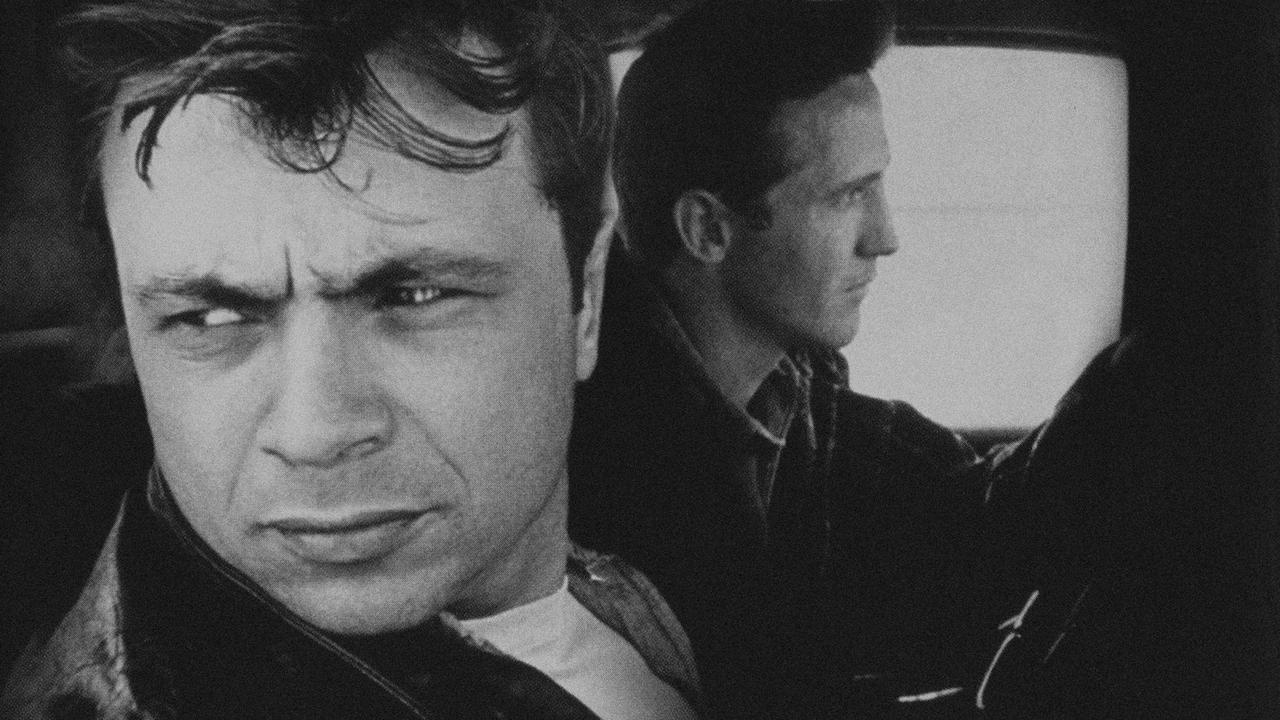
Brooks’ film is also remarkable as a piece of craftsmanship. Capote’s narrative shifts between the killers, the victims, the police, and the townspeople are preserved via remarkably sophisticated editing; conversations are crosscut to create the illusion that disparate characters are in the same room, and dialogue will continue in voiceover well into the following scene. The content is surprisingly frank; there are no f-bombs, but the crass language and undeniable homoeroticism is remarkable for a film of its time. And the climactic recreation of the central murder anticipates such unflinching works as Henry: Portrait of a Serial Killer and Man Bites Dog. Knowing as we do the facts of the case and its aftermath, there is no suspense or thrill to the proceedings; instead, it is harrowing, depressing, and legitimately hard to watch – especially after spending the preceding ninety minutes getting to know the killers.
There will always be those who decry true crime – particularly that which achieves blockbuster popularity – as ghoulishly exploitative of the innocent dead. But to do so is to deny conversations worth having; two of last year’s most compelling and socially relevant works were devoted to unpacking the unparalleled media circus that was the O.J. Simpson trial. At its core, In Cold Blood, both as a book and as a film, is about the psychology that compels real people to forsake their hopes and dreams, and destroy the lives of others. At some point or another, we’ve all been Perry Smith; if we allow ourselves to confront and discuss these monsters within us, perhaps fewer will end up as Herb Clutter.
In Cold Blood
1967
dir. Richard Brooks
134 min.
Screens Tuesday, 5/30 @ Brattle Theatre, 4:15 & 7:00
35mm!