You could argue that your dreams are directed by the same person, even if the cinematography or set design are a bit inconsistent. Maybe it’s reassuring that motifs and archetypes will recur, even if it doesn’t make sense for them to exist in the same sequence. I think of the variability of dreams, and even the ability to dream, in Katsuhito Ishii’s The Taste of Tea, in which the different story arcs within a family living in a rural Japanese village can make it seem like their lives are happening cities and oceans apart. Nevertheless, fantasy and reality within Ishii’s four corners of the camera, keeping the characters from floating away.
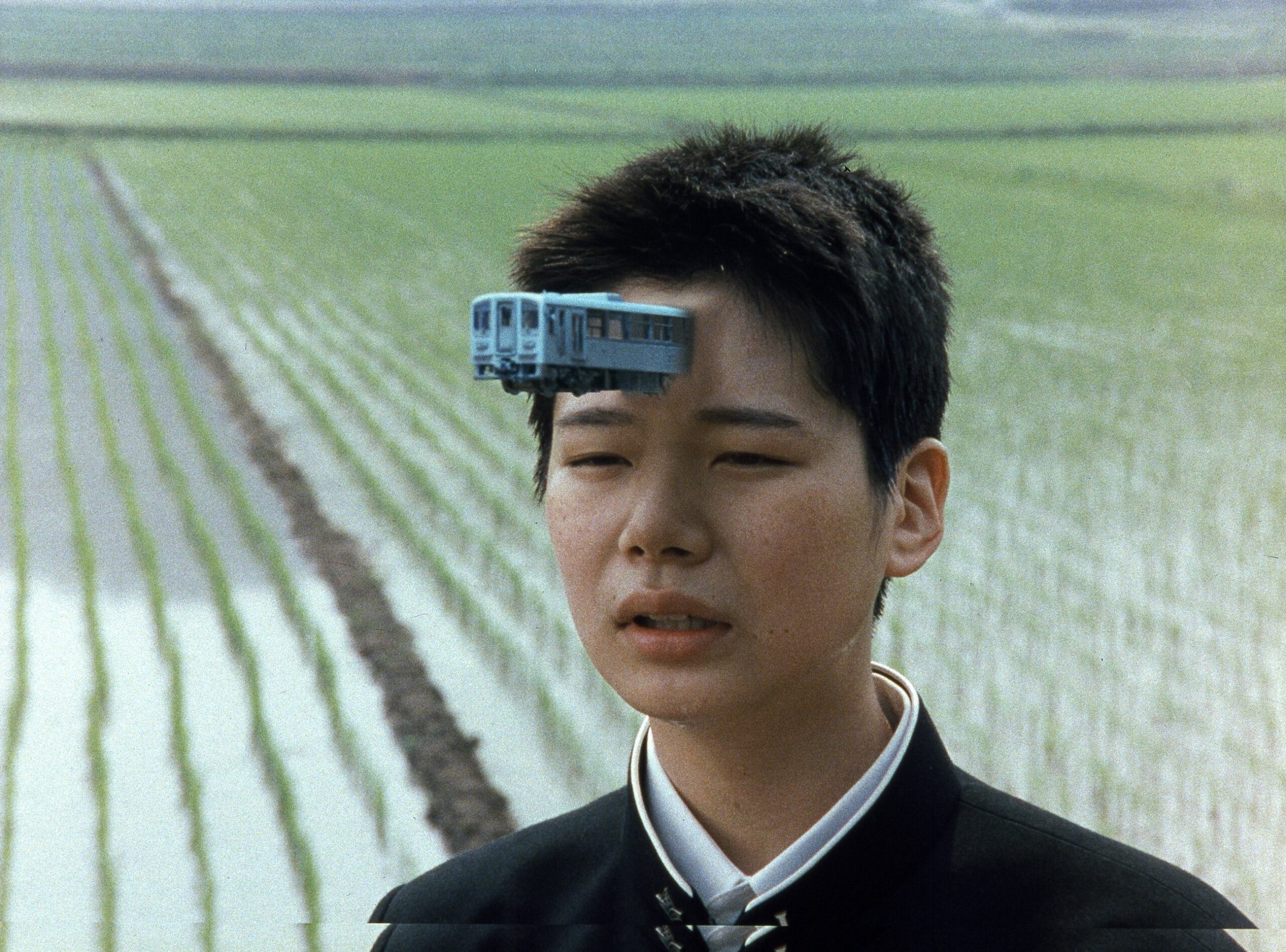
Often in surrealist art, the piece operates under no legal binding or law of physics. In fact, it seems like a privilege to recognize a tangible plot or feeling. The Taste of Tea starts with Hajime (Takahiro Sato), a teenager who tearfully watches his crush leave his town for the last time, regretting that he didn’t confess his feelings when he had the chance. Don’t mind the actual train bursting through his forehead. The anguish that is acknowledged so early in the movie binds Hajime’s actions to a motivation: to revel in love that feels as weightless as clouds. When Hajime develops a crush on a new classmate, the bouncy feeling of infatuation comes alive in his glowing expressions and lackadaisical cycling on a winding road. When Hajime eventually sits down to play a game of Go with his crush in their first solo hangout, it’s the meditative quietness that materializes his internal lightness into something tactile and real, shared between two people.

On a grand comparative scale with other things happening in the universe, Hajime’s crush might be insignificant. While his storyline is one of many embedded in this film, Hajime’s journey is the most palpable and linear. His younger sister Sachiko (Maya Banno) is burdened with a ghost companion (a larger version of herself) following her everywhere, though her uncle Ayano suggests that it may disappear once she learns how to do a backflip on a horizontal bar located somewhere in their land’s grassy fields. The Taste of Tea also showcases a hypnotherapist father, a mother who loves to draw manga, and a grandfather who watches his family brave the yearning storm in their hearts.
At surface level, the film’s textural composition of mountain trees and still skies evoke the same exterior calmness worn by the family members. But imbued with some of the film’s “weirdness” (not quite as visually challenging as Daisies or Obayashi’s work), the movie feels like it wants to initially ward you off – not to dissent, but to protect the inner desire to long after something. As we stick around with the family, the characters and dreamlike imagery eventually settle in co-existence, a touching kind of reward for the quilted vision Ishii set out to embellish. Many of the characters are positioned as either off-centered or on opposite sides in favor for the action directly centered at the frame (e.g. drawing, eating, cooking up a banger at the mixing studio), as if to signify the part in their life that keeps them alive. It is when they are sitting at the foot of their home’s genkan that they find themselves together, deserving to take up space just as they are.
The Taste of Tea
2003
dir. Katsuhito Ishii
143 min.
Screens Saturday, 5/14, 2:00pm @ Museum of Fine Arts, Boston
Part of the UNIQLO Festival of Films from Japan