For eye candy and eardrum-rupturing reasons, I watched Snake Eyes, starring Henry Golding and Warrior‘s Andrew Koji, a couple of weeks ago. It’s true, I know next to nothing about GI Joe; for a couple of outfit-confusion instances, I momentarily crossovered Snake Eyes with Metal Gear Solid’s Snake. However, the movie itself is fine and had fulfilled my expectations of a B-rated action flick. Golding plays Snake Eyes (his birth name is not mentioned, so characters sometimes will passionately yell out “Snake!” to get his attention), a man who seeks to kill the men who murdered his father. Vengeance is the prize, and there is a pair of reptilian eyes set on it.
The principles of revenge seem to be indoctrinated differently between the East and West. Let’s reminisce the punitive nature of Park Chan-wook’s Vengeance trilogy, in which killers — active or dormant, purposeful or accidental — are subjected for the eye-for-an-eye treatment (or in other cases, limb for limb, sister for daughter) in the name of cold-served justice. In his origins story, Snake Eyes’ loyalty to revenge starts to waver when he becomes closer to the Arashikage, a Japanese clan that he originally plans to betray in order to reach his father’s killers. While this back-and-forth allegiance sets the foundation of his character development, it can be frustrating to watch. When Snake Eyes finally confronts one of the killers and decide not to kill him, the notion of revenge is all but futile. Cool moral compass, man, but not fun.
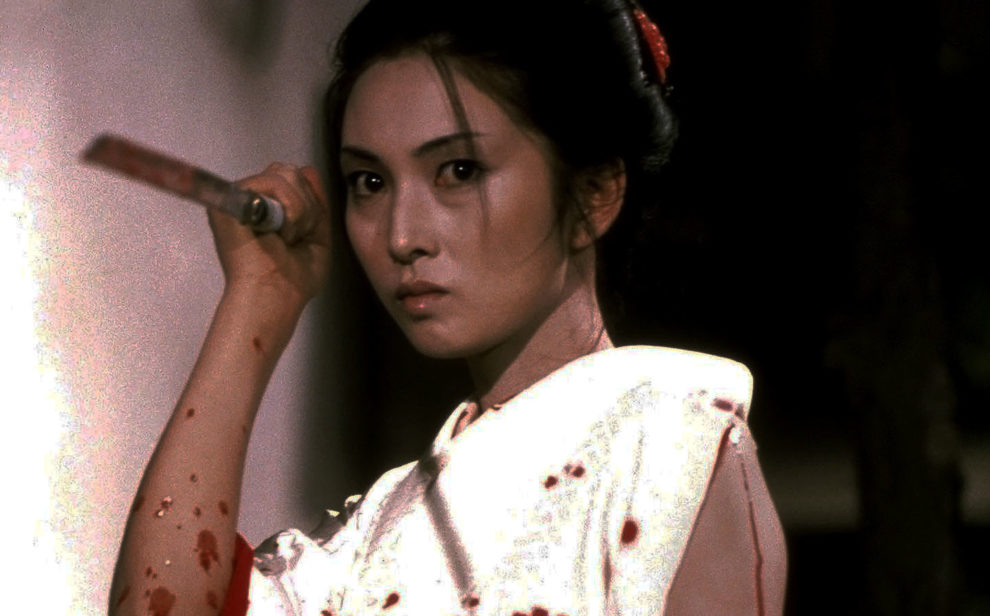
In Toshiya Fujita’s Lady Snowblood, swordmaster/priest Dōkai tells our protagonist Yuki (Meiko Kaji), “Forget love and forget hate. Except for vengeance, these must be forgotten. And thus, there should be no sadness in you.” What makes Lady Snowblood so satisfying is that, from sunrise to sunset, Yuki’s motivations are as clear as the sky. Before dying at childbirth, her mother bestowed Yuki the mission of avenging the family after attackers had killed Yuki’s father and brother. Perhaps we’ll find that, along the journey, there is a sliver of kindness in her hardened heart tissue, but as a “child of the netherworlds,” Yuki’s contention lies in the tormenters’ death by her hand. And to avenge with precision and gratification is to forgo all other interfering emotions.
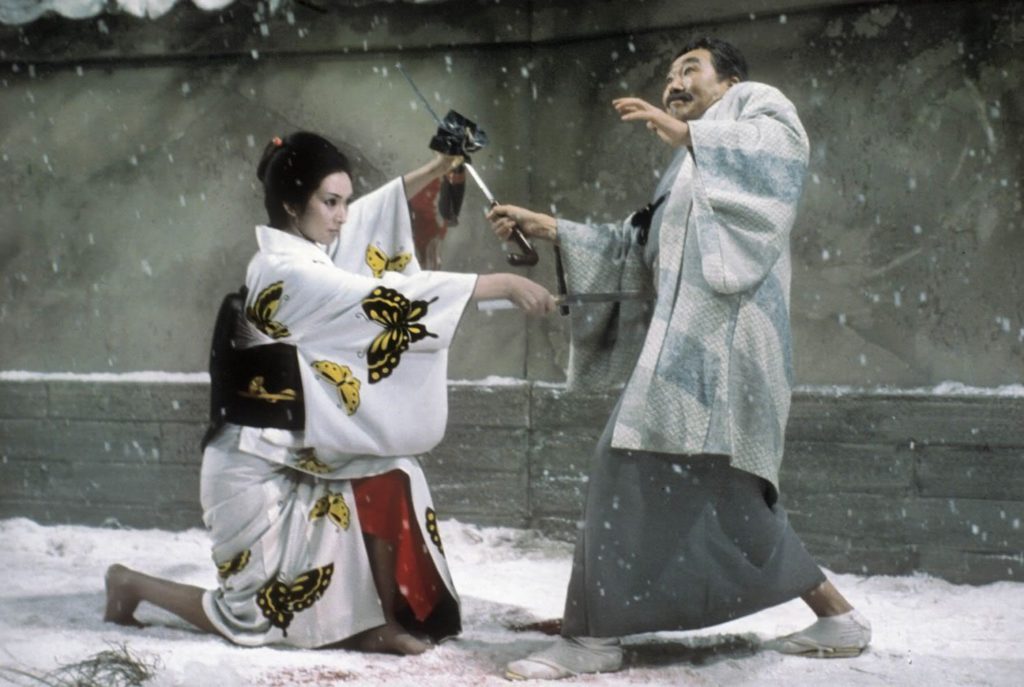
Lady Snowblood may have not come to widespread awareness without Quentin Tarantino’s acknowledgment of the film’s influences for the Kill Bill series. KB Vol. 1 is my favorite Tarantino movie, but it also was one that left me raw and inspired as a budding fan of bloodshed. When I first saw it in middle school, I had never seen an extreme, illogical sense of violence under the guise of coolness. It was also my first time seeing an iconic character, even as a villain, of Asian descent. That, of course, is Lucy Liu as O-Ren Ishii (though Gogo Yubari would be also correct). O-Ren and Yuki are practically the same character, down to family de-lineage and bone-white kimonos. The conviction of avenge stems from Yuki’s singular resolution. The shared vision is passed around like a hot potato; after O-Ren has a quick moment to off the yakuza boss responsible for parents’ death, Uma Thurman’s character then has to kill the members responsible for leaving her almost-dead.
But don’t watch Lady Snowblood for the sole purpose of having a deeper appreciation for Kill Bill. Both movies are fantastic. However, Lady Snowblood especially stands in history as a spectacular sword-wielding saga (along with Tarantino, the Criterion Collection and Post Malone would agree). Kaji turned to the way of the blade after the studio she was contracted to decided to make sexually charged films. Her decision, which soon led to portrayals of the sworded woman in charge, certainly turns upside the idea of the submissive Japanese woman even more so (note: Kaji is also the lead in Blind Woman’s Curse, another film in the SAMURAI SUMMER line-up). When we watch Thurman slash through the Crazy 88 in less than five minutes, one would presume that the best fights might be measured in slash-per-millisecond. Kaji’s steadiness in challenging each enemy is methodical, spiritually sloughing, and engrossing, all in the glowing cinematography that is ornamented with, of course, snow and blood. Like a predator in the dark, the fight scenes are patient and strike in the knowing ways of a legend’s tale in the making. With the right amount of force, even snowfall has a splattering effect.
Lady Snowblood
1973
dir. Toshiya Fujita
97 mins
Screens at the Coolidge Corner Theatre on Monday, August 16 @7PM!
Part of the SAMURAI SUMMER series
Digital restoration