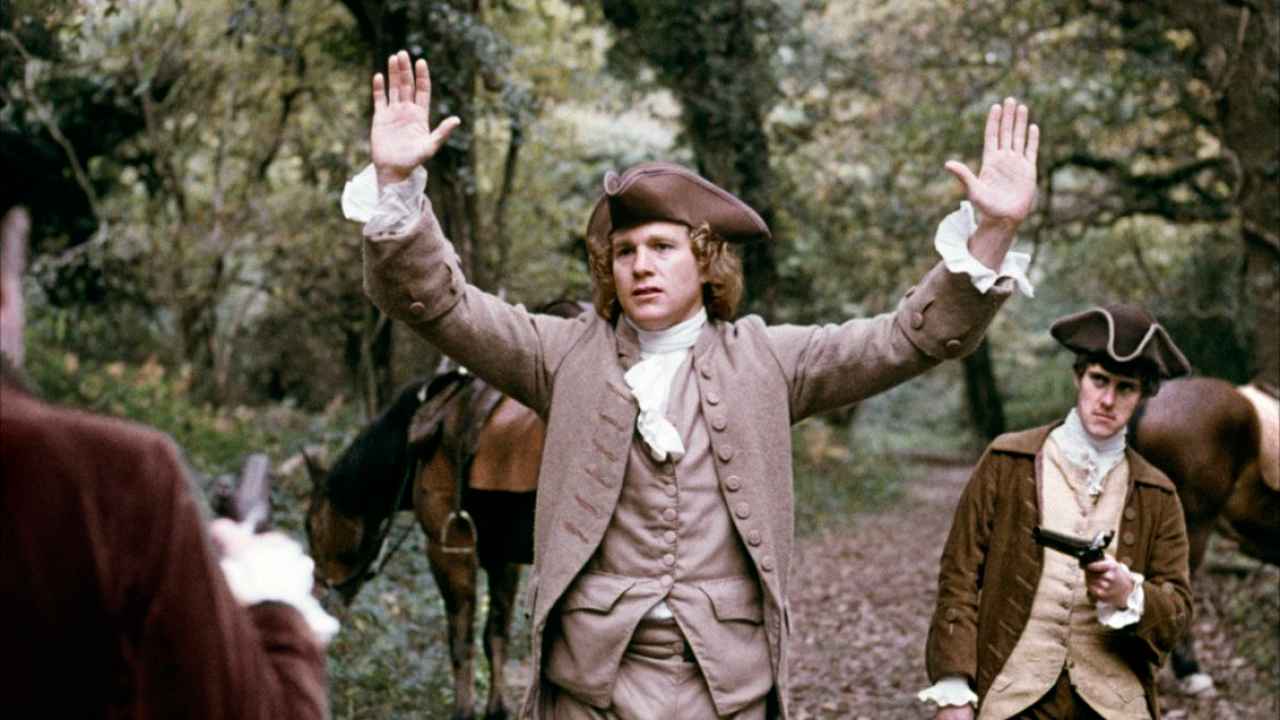
Barry Lyndon is a grandiose portrait of honor, manhood, vanity, parenting, and upper-class emptiness. Its picturesque depiction of 18th-century England in sights and costumes, the characters’ unyielding emotional restraint, and the film’s objective gaze on its acidic titular character’s attempt to become a high-class gentleman make Barry Lyndon classically Kubrickian. It stands as a distant observation of upper-class boredom and arbitrariness that one man first ruthlessly climbs for and eventually loses just as cruelly.
Long before acquiring (read: stealing) the Lyndon name—and further before electricity and lights—Irishman Redmond Barry (Ryan O’Neal) was an inexperienced lad like us all. Having lost his father to a duel in 1750, Redmond grew up with his peasant mother, Belle (Marie Kean), in the Irish countryside. Some years later, an infatuation with his cousin, Nora (Gay Hamilton), forces him to duel her soon-to-be husband, the English Captain John Quin (Leonard Rossiter), whose marriage ensures Nora’s family receives much-needed financial stability. Redmond wins, but gets banished to Dublin for the killing and disrespect. This ostracism starts a decades-long journey in which Redmond, starting in the military before moving onto gambling scams, bloodlessly climbs his way to the socioeconomic top, eventually marrying the aristocratic Lady Lyndon (Marisa Berenson) after causing her first and rich husband, Sir Charles Lyndon (Frank Middlemass), to have a heart attack. Instead of loving his wife and her firstborn son, Lord Bullingdon (Dominic Savage when young; Leon Vitali, Stanley Kubrick’s eventual personal assistant, when older), Barry merely uses them to enrich himself further and to bear his own child, Bryan Patrick Lyndon (David Morley). Sin, cruelty, thuggishness, gentlemen’s ethics, and the hollow mental and physical spaces of rich living ultimately decide the brutish Redmond Barry Lyndon’s fate, whether or not he achieves his personal goals.
Barry Lyndon is to 19th-century romance cinema what James Cameron’s Avatar franchise is to sci-fi action movies: long-winded, technically awe-inspiring, but generic and/or basic screen-fare. The difference is that Barry belongs in an art museum with its more robust themes, whilst Avatar belongs in the home theater. Though painterly throughout, thanks to the entirely candlelit technique Kubrick wowed audiences with (not to mention the equally colorful spaces/apparel, or the beautiful paintings shown throughout that Barry Lyndon exactly emulates), it’s hard not to feel this intentionally three-hour thug voyage drag on. Barry Lyndon is arguably Stanley Kubrick’s least intriguing work—it’s still satisfying, of course—even though it is hailed by many as an exhibit-worthy masterpiece.

When the film does move, Barry Lyndon delivers much in the way of gentlemanliness and its opposite in its two main characters, Barry himself and his stepson, Lord Bullingdon. Both are introduced at similar times in their lives; Barry’s a young man when he’s first banished, and Lord Bullingdon reaches that same age when he becomes the film’s other major player. They both love their mothers, both want to be wealthy, “proper Englishmen”, and both want families to love and be loved by. The major difference is that Barry is shaped by the world around him, while Bullingdon is shaped by an older, browbeaten Barry from childhood onward. Only one, in the end, is a real gentleman, but even then, potential for better and understanding for worse doesn’t fade.
Barry’s start in the world isn’t kind. Getting banished from his stable upbringing for doing what he was told was his right—”ah, a young man after me own soul,” Barry’s uncle and only legit support, Captain Grogan (Godfrey Quigley), tells him upon Barry’s insistence for a duel—he quickly gets robbed by a kind-worded thief and his son, Captain Feeney (Arthur O’Sullivan) and Seamus (Billy Boyle). They bluntly tell him how it is despite his begging for mercy: “Mr. Barry, in my profession, we hear many such stories. Yours is one of the most intriguing and touching I’ve heard in many weeks. Nevertheless, I’m afraid I cannot grant your request [to let you go].” Barry’s entered a world where “such stories” of poverty, scant opportunity, and struggle get scoffed at and manipulated, as the Feeneys did to Barry. That first step towards amorality never leaves poor Barry, unfortunately.
Barry then tries the more noble route through military service, joining a British regiment in Germany during the Seven Years’ War. Instead of honor, he finds death, loss, longing, and humiliation. Bloodshed, war wounds, and painfully realistic bullets spray across the screen. The cherry on top? Not only does Captain Grogan, Barry’s endearing uncle, reveal that Nora’s family replaced Redmond’s bullet with a “plug of tow” to exile him without losing their new income, but he is brutally murdered in battle soon after. Now, without any honor, money, proper support, or even the feat of killing Captain Quin—who’s very much alive—it’s hard not to imagine oneself doing exactly as Barry does: abandon the war front and stumble around until he finds profits scamming with a fellow Irishman, growing more selfish and abusively standoffish with age. As the narrator (Michael Hordern) himself details, “Fate had determined that Barry should leave none of his race behind him… that he should finish his life poor, lonely, and childless”—who wouldn’t grow bitter when fate deals continuous tragedies with no controllable end?
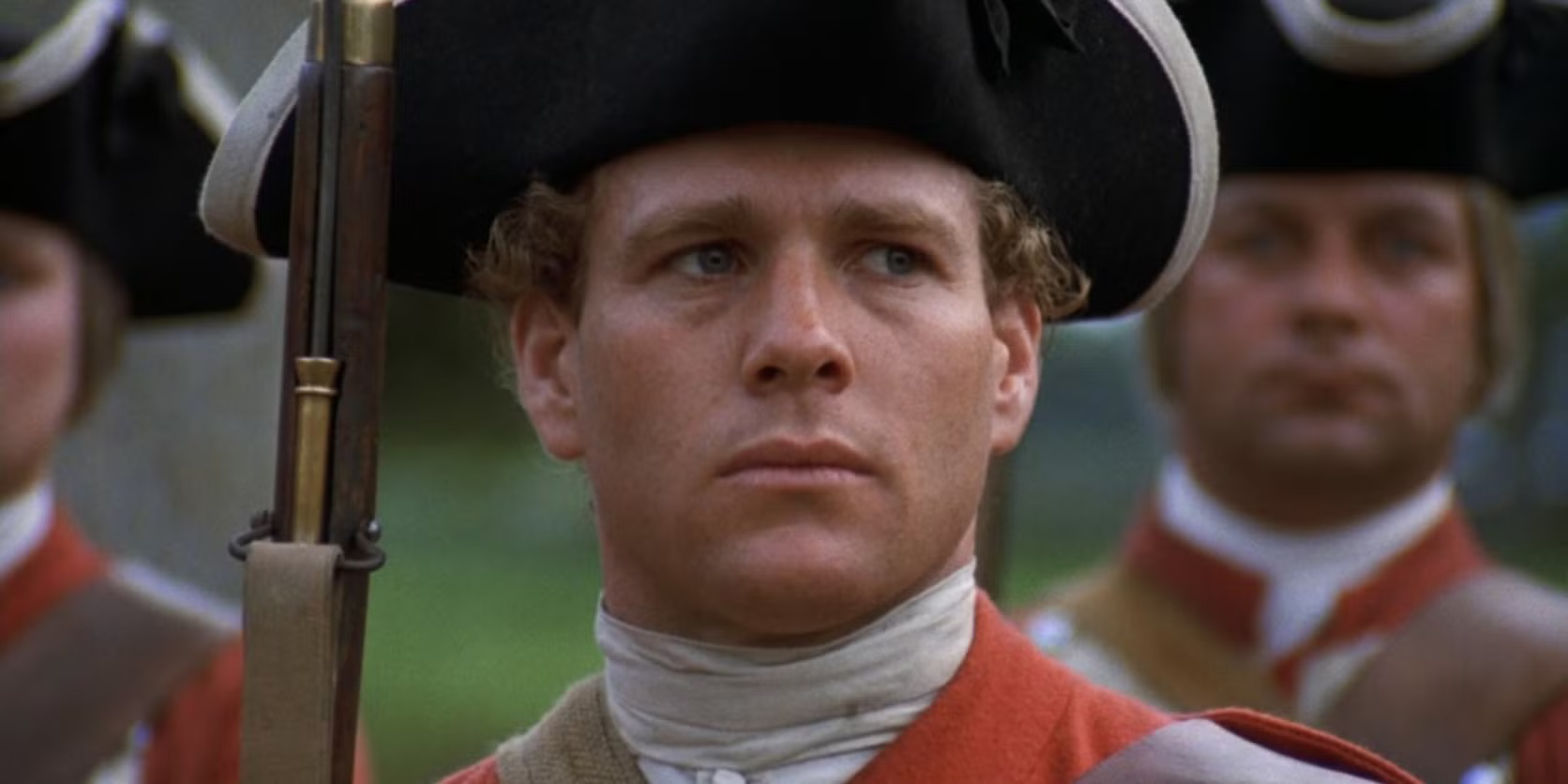
None of that excuses how Redmond—and eventually his equally wealth-hungry mother—treats his wife or kids. While spoilsome and kind to his and Lady Lyndon’s son, Bryan, Barry frequently belts Lord Bullingdon; he openly cheats on Lady Lyndon in their house; he views the supposed love of his life as “… not very much more important than the elegant carpets and pictures which would form the pleasant background of his existence”; he’s the very reason why Lord Bullingdon’s real father died—whose memory the dear boy carries on through a fiery, revenge-bent spirit; he spends all of Lady Lyndon’s funds, squandering the family name in the process. The list goes on. Fortunately for Barry, Lord Bullingdon becomes the gentleman Barry initially strived to become, as demonstrated when he bravely—but politely—stands up for himself and demands a duel (full circle!). He still gives Barry the choice to act gentlemanly, despite everything, as only a proper Englishman would. Thus, Redmond inadvertently displayed everything the average growing lord might need to avoid being, well, a terrible human being, let alone a gentleman of any sort. All Lord Bullingdon needed to do was precisely the opposite of Barry.
Combined with mild comedic undertones, entrenching portrayals, and sharp criticism of high-class hollowness and the bloodless methods many undertake to get there, Barry Lyndon is a dark slowburn through reputation, fate, and personal behavior. Though timing significantly hinders Barry’s life story, there are enough fierce performances and picturesque images contrasted with the unfortunate timelessness of human cruelty for Barry Lyndon to remain a nail-biting watch. For Stanley Kubrick fans, period film lovers, war-drama epic nitpickers, and those looking for a bleak gaze at human nature across the social spectrum, Redmond Barry Lyndon will teach you how NOT to be a gentleman while his wife and stepson pick up the pieces of his trashy existence.
1975
dir. Stanley Kubrick
185 min.
Screens Monday, 3/30, 7:00 p.m. and Sunday, 4/5, 3:00 p.m. @ Harvard Film Archive
Part of the ongoing repertory series: The Complete Stanley Kubrick