
Back in my years as a used record store clerk, there were a handful of questions I had to field on a near-weekly basis: “Can you do any better on this?” “Do you have any good vintage local records?” “How much can you give me for my copy of Thriller?” (The answers, in case you’re curious: “Absolutely not,” “Try Fig. 14 by Human Sexual Response,” “Not nearly as much as you’re expecting.”) Right up there on the list, particularly among college students, was “What’s the big deal about the Beatles?” I would generally give two answers to this question. To understand why the Beatles are a big deal now, I’d tell them to listen to the White Album, a record so masterful and assured and weird as to remain shockingly fresh no matter how many times you’ve heard the singles. But if they wanted to understand why the Beatles were a big deal then, I wouldn’t recommend an album at all. Instead, I’d steer them toward a DVD of A Hard Day’s Night. Though heavily idealized and patently silly, that 1964 film captures what (I imagine) the throes of Beatlemania must have felt like to the afflicted in the 1960s, and remains a perfect work of infectious and exuberant pop art nearly 60 years after its creation.
The plot, such as it is, concerns the travails of the Fab Four as they prepare for a big televised concert. Along the way, they dodge (and occasionally flirt with) rabid female fans, and talk circles around news reporters and other representatives of the square establishment. A surprising percentage of the film concerns the band’s attempts to contain Paul’s mischievous grandfather, played by veteran Irish comic actor Wilfrid Brambell. At one point, Ringo suffers an existential crisis and attempts to leave the band, but he is duly collected and reinstated just in time for the big show.
If the above description sounds thin for a feature-length film, you need to understand that the story is literally the least important thing about A Hard Day’s Night. The film exists to capture John, Paul, George, and Ringo in their pre-psychedelic prime and transfer their star power to the silver screen, and in that it succeeds with flying colors. Its lengthiest and best-remembered scenes consist of nothing but the four lads sprinting around London to the strains of their early singles, translating those already irresistible earworms into weapons-grade instruments of pop propaganda. The result instantly enshrined itself into the mythology and iconography of the 20th century, establishing a new shorthand for anti-establishment freedom which would be endlessly homage and emulated. To take one example out of thousands, American countercultural filmmaker Bert Schneider would attempt to adapt A Hard Day’s Night into a weekly television format with a prefabricated band, but that’s a story to save for the next time someone screens Head.
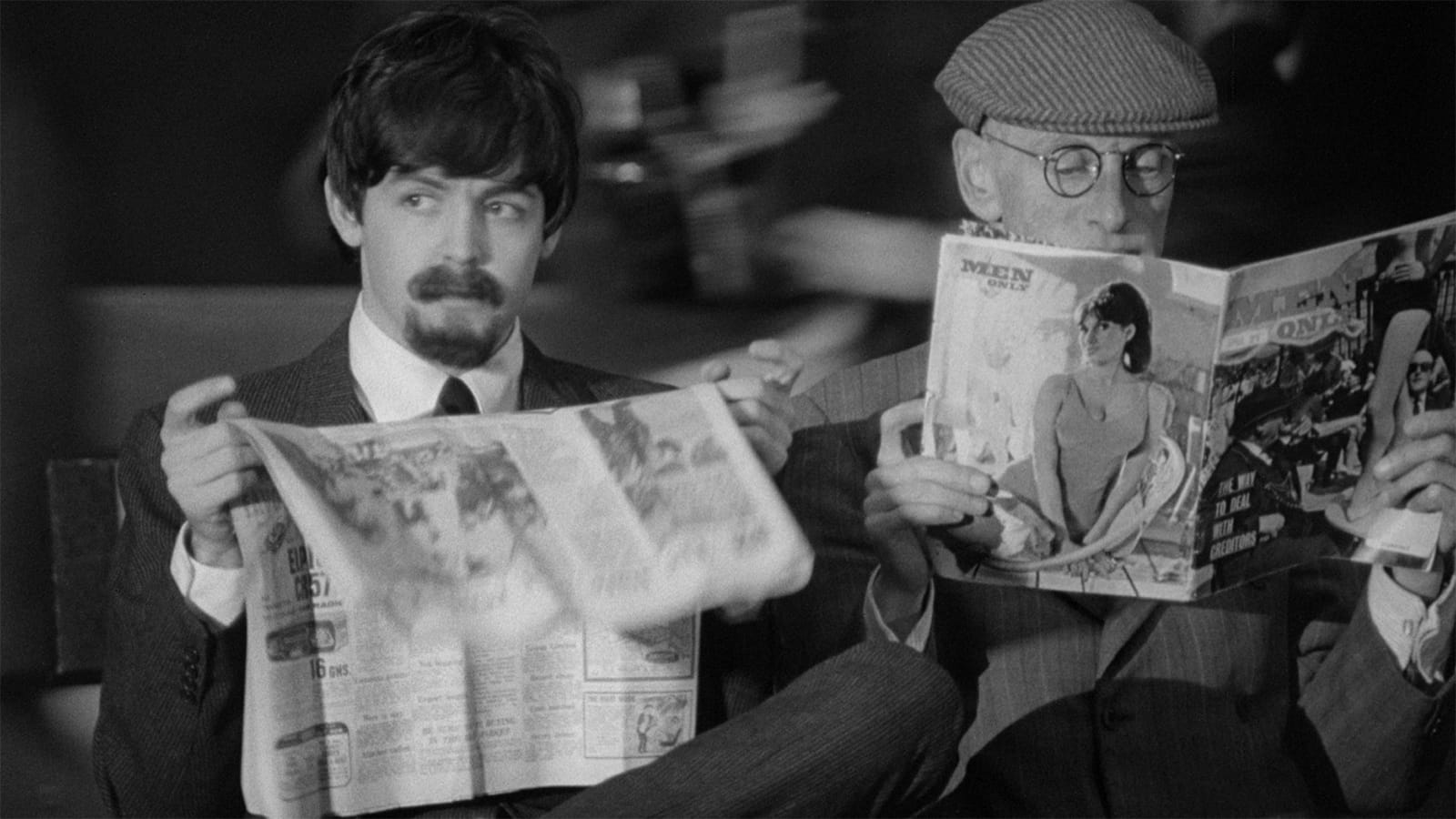
If there is a secret to the success of A Hard Day’s Night beside the obvious, it lies in director Richard Lester. Lester had previously directed the rock ‘n’ roll showcase film It’s Trad, Dad!, but it’s a fair bet he landed on the Beatles’ radar thanks to his 1959 Oscar-nominated short The Running Jumping & Standing Still Film. That film, an 11-minute burst of freeform slapstick nonsense starring Peter Sellers and Spike Milligan, essentially serves as a pilot for A Hard Day’s Night, which, in turn, makes its influence incalculable; from those two films, one can draw a direct line which runs through everything from Rock & Roll High School and MTV to the immaculately managed public images of the K-Pop machine. Lester remains something of a cult figure, despite directing a number of very well-known films (including, strangely, Superman II and III), but he casts a long shadow; at 91, he has to count among our most influential living filmmakers.
To be clear, A Hard Day’s Night contains very little of the “real” Beatles, whose off-stage saga is at this point as heavily mythologized as their early mop-top personae; warts-and-all purists will surely prefer the shaggy, tortured geniuses of Peter Jackson’s Get Back. But for sheer, giddy pop euphoria, Night is hard to beat. I first saw it on the big screen in college, and my roommates and I were so energized leaving the theater that we ran, at top speed, through the late-night streets of Cambridge, all the way home to our apartment in downtown Boston. The Beatles are so thoroughly embedded in our cultural conscience that they are easy to take for granted, and I don’t begrudge anyone for rejecting their inescapable overexposure. But watching A Hard Day’s Night, especially as large and as loud as possible, I suspect even the most heard-it-all skeptic might mutter: I get it now.
A Hard Day’s Night
1964
dir. Richard Lester
87 min.
Screens Thursday, 7/6, 7:00 @ Coolidge Corner Theatre
Part of the ongoing series: Cinema Jukebox