Diractors is an ongoing series in which Hassle writer Jack Draper examines films, new and old, whose directors are better known for their work in front of the camera.
“We’re hardly two separate people now.”
Clint Eastwood has spent so much time separately as a director and as a lead actor that it’s easy to forget that how impressive his proficiency at both is. As an actor in the 1990s, Eastwood didn’t coast even as he entered his 60s. It’s easy to draw a connection between him and Woody Allen, two actors who continued to star in their own directorial projects. When they don’t, you’ll see a surrogate actor in place of them to complain about the kinds of movies they like to make. The biggest difference that most everyone will agree on is that Allen has less range as an actor compared to Eastwood, who continued to challenge himself in things like Absolute Power or True Crime. But Eastwood’s best work to date can be found in The Bridges of Madison County— as a filmmaker, but especially as an actor. For someone as direct and efficient as Clint, a swooning love story that lets you feel every emotion fits into his sensibility with ease.
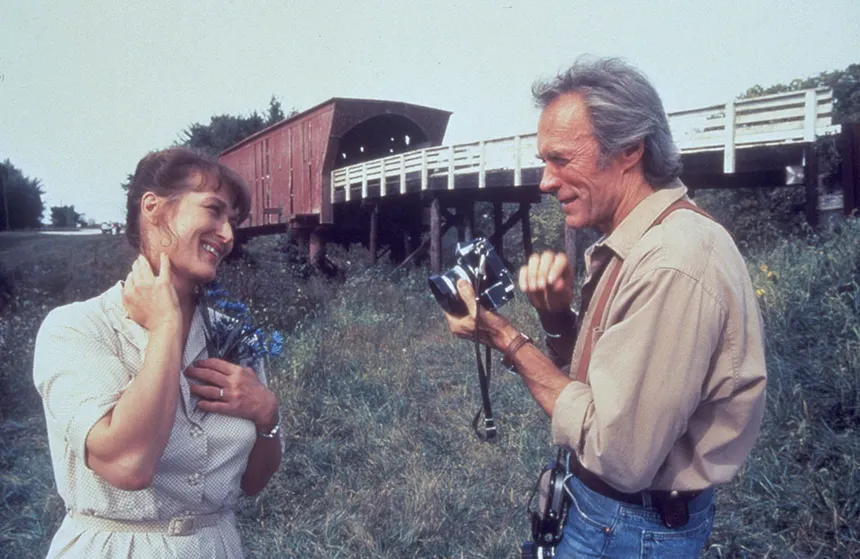
Bridges is about many of life’s great questions and complicated answers. Set in 1965, the film centers on Italian war bride Francesca Johnson (Meryl Streep), who lives with her husband and two children on their Iowa farm. That year she meets National Geographic photojournalist Robert Kincaid (Eastwood), who comes to Madison County to photograph its historic covered bridges. With Francesca’s family away for a short trip, the couple have an intense, four-day love affair. Robert isn’t one to take advantage of someone just because her family is gone; it’s an affair with an immense amount of maturity, yet both Robert and Franny are unable to disrupt their lives. In fact, Robert’s quiet gravitas isn’t so clearly romantic, and Franny loves it– loves drinking together, walking, smoking, talking, listening to music. These are all things that you see people do on a first date, no matter their age. Robert can charm Franny well enough without seeming like he has a romantic agenda. Robert and Francesca are soulmates by the end of all this, but continue to live life separately, acting on impulses with the knowledge that their love is on a stopwatch.
Eastwood and screenwriter Richard LaGravenese go the extra mile to see the perception of Francesca throughout the town. Using the character of Lucy to draw a parallel of an outcast woman with family troubles and no ability to shake her perception. Eyes are constantly on her, with shame from herself and neighbors. Does Franny want that? The possibility of a beloved marriage on the inside, then scrutiny on the outside reputation? Even the framing device of Francesca’s kids going through their mom’s things after her passing (the one element of this masterpiece I could do without) feels like a legacy that’s better left tucked away in a box. Memories are so clear from these two mature adults, both of whom right, such as when Robert suggests her desire to be unfaithful, or when Francesca starts to feel their time slip away and decides to lash out at Robert for entering her life. Both are trying to rationalize desires for each other without making any major life changes.
“I’ve been that guy a little bit, going off by myself years ago in a pickup truck into Nevada, scouting locations for High Plains Drifter. But I didn’t stop off with any housewives while doing that.” Clint remarks here on his familiarity with Kincaid. This bleeds through to the ease and confidence he sees in this guy who doesn’t fake who he is; his genuine interest in Francesca isn’t some elaborate set up. Eastwood reveals so much by what’s not said or done versus being emotionally raw. But despite being originally developed as a Spielberg film, there are some images here that play directly to Eastwood’s easy touch– Kincaid watching Francsesca drive away with her husband in the rain, for example, or Kincaid’s arm brush up against Franny’s leg while reaching for the cigarettes in the glove compartment. These are beautiful moments with zero false notes. It’s clear also that Meryl got her most interesting work from collaborating with actors turned directors; as with most legends, she can turn it on without much trouble. Her best movies, like Madison County, Silkwood or Defending Your Life, go the extra mile to unlock a new gear that continues to amaze.
Bridges of Madison County
1995
dir. Clint Eastwood
135 min.
Currently available digitally and on demand on all major platforms