In recent years— certainly since the release of Keir-La Janisse’s authoritative documentary Woodlands Dark and Days Bewitched, though it had been percolating for some time before then— folk horror has been something of the subgenre du jour among horror cognoscenti. Though not always clearly defined (like pornography, you know it when you see it), folk horror draws upon ancient beliefs and superstitions, and the general sense of a terrifying something older than the hills. At first blush, Mārama, the feature debut from New Zealand filmmaker Taratoa Stappard, would appear to fall into the folk horror bucket, dealing as it does with Māori customs and imagery. But Mārama belongs, at heart, to an altogether different subgenre: gothic horror. Its indigenous heroine is dropped into a world of creepy manors and buried family secrets, and even performs the gothic ritual of stealing down a spiral staircase while clutching a candelabra. While Mārama’s ambitions occasionally outstrip its means, it remains a haunting and vital work of indigenous filmmaking.
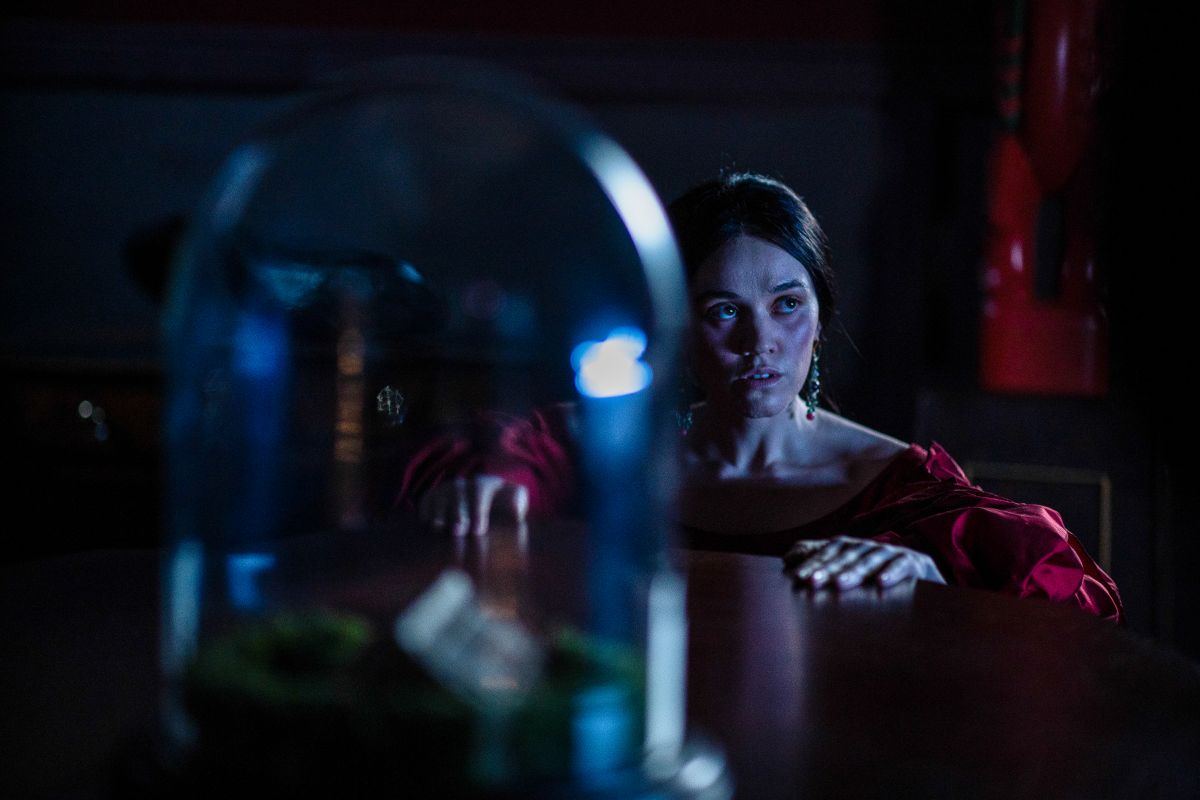
Ariāna Osborne stars as Mary Stevens, a young woman of Māori descent who finds herself halfway across the world in Victorian North Yorkshire. She’s come at the bequest of a cryptic letter from a Thomas Boyd, whom she’s never met but who claims to have known her for her entire life. She hopes to learn that he’s her father, or at least has some clues to offer regarding her family history; she was adopted as a child, raised by white merchants in Wellington. When she arrives, however, she finds that Mr. Boyd has since passed away (such is the peril of a 73-day transcontinental journey). Nevertheless, Boyd’s employer, Sir Nathaniel Cole (Toby Stephens) takes pity on the girl, offering her a job as governess to his young granddaughter Anne. Mary takes to Anne, but finds herself unnerved by the Māori artifacts which fill the estate, as well as Cole’s flamboyant and sinister business associate “Uncle Jack” (Erroll Shand). She’s also haunted by visions of herself covered in blood, and encouraged by a mysterious, spectral Māori woman. What does it all mean— and what is locked in the replica Māori hut hidden in the center of the hedge maze?
Like many contemporary low-budget period pieces, Mārama suffers a bit from the fact that modern digital photography just looks too good. There is a digital sheen to the proceedings which flattens shadows rather than deepens them, and brings seams into focus in unflattering ways. (It doesn’t help that Osborne is made up to look almost exactly like Lily-Rose Depp in Robert Eggers’ Nosferatu, inviting comparisons in verisimilitude that few living filmmakers can live up to). Period horror, and especially gothic horror, requires a little bit of softness around the edges, both visually and in text, to call up a past which never quite existed. In its high-def crispness, Mārama is at times too literal when it should lean into dreaminess.

But I’m willing to grant a lot of slack to a horror movie with such a clear and personal perspective, and doubly so when it’s actually got something on its mind. Stappard, who is of Māori descent himself, ingeniously uses the gothic formula to probe the evils of colonialism and white supremacy. Living in the manor, Mary is beset by microagressions centuries before the term existed. When Boyd reassures Mary, “I have nothing but respect for the Māori!” the effect is every bit as patronizing as Bradley Whitford’s famous boast from Get Out that he would have voted for Obama a third time if he could. Then there’s Uncle Jack, a terrifying creation who underscores the universal lesson to never, ever trust a white guy with tribal tats.
Mārama is a horror movie, even though, eerie visions aside, there’s nothing supernatural going on here. Instead, the horror is the very real subjugation of indigenous peoples at the hands of white settlers, traders, and “pioneers.” While there’s nothing here quite as stomach-turning as the atrocities of The Nightingale, we feel Mary’s sense of grief and loss as everything she suspects about the world she finds herself in is confirmed— and worse. Credit here is due to Osborne, whose performance runs the gamut from heartbreak and fear to, in one memorable scene as she interrupts a racist minstrel floorshow, pure, righteous rage. It’s a wonderful performance, and I hope to see more from her.
It’s said that the best horror movies are the ones that tap into the anxieties of their era. To this end, Mārama could scarcely be better timed. In a world where colonial, white supremacist powers are thrashing to maintain their centuries-old stranglehold, films which center indigenous and other marginalized perspectives are more and more valuable. The term “social horror” is generally used to describe films about the here and now, while gothic and folk horror tend to look backwards to the distant past. In Mārama, it’s clear that it’s all one and the same.
Mārama
2025
dir. Taratoa Stappard
89 min.
Opens Friday, 5/8 @ Alamo Drafthouse Boston Seaport