S: Would you share something about your background? Where are you from?
G:I always lived in Eastern Mass growing up, either just north or just south of Boston. I moved around. When I was ready for undergrad, I went across the country, lived in Oakland, CA and got my BFA at California College of the Arts.
S: How did you start making your artwork?
G: As a kid, my Bubbie was my reference for being an artist. She was primarily a very skilled painter and printmaker, but she was also skilled in needlepoint. I have made art ever since I was a child. As a kid, I liked to paint and draw. I also did beading. As an adult, my mediums are collage, sculpture with found objects, performance and altered books. Some of my work contains writing. I was not even introduced to collage, one of my favorite mediums, until my senior year in high school. I feel like the mediums kids are introduced to in the public school systems can be sort of limiting. I rediscovered collage when I graduated college, and needed an affordable way to make art without any fancy equipment.
S: Can you talk about collage?
G: Yes, I love raving about collage. It’s one of my most favorite mediums. It can be very challenging, like putting together a puzzle of disparate parts. I appreciate how it can get surreal with all the variation in scale. Probably what attracts me most to this medium is how accessible it is. Also, I’m so intrigued by how, unlike a blank canvas, the material for the medium is already imbued with so much history and meaning. It makes for work that can be really conceptually rich. And I find that if I’m really interested in the idea, I can produce work that is more aesthetically pleasing. The two are not mutually exclusive for me.
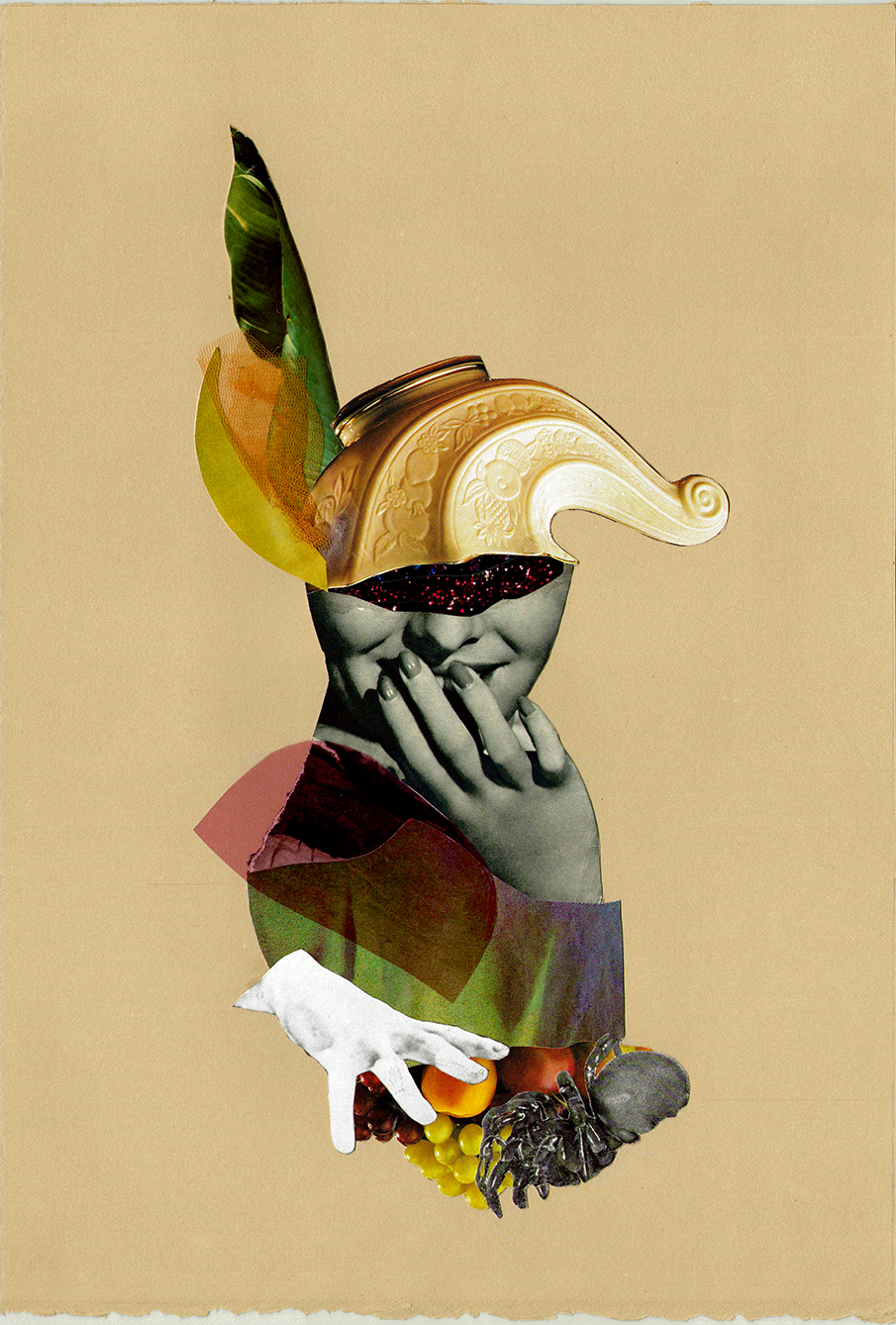
Reoccurring Nightmare – Gem Rosenberg
S: Are there particular ideas you explore in your art practice?
G: Themes that run through my work are human/animal relationships, esp. as they pertain to industry. I consider my work to also be environmentalist, as most of my materials are recycled or found. Themes surrounding gender and representation also run through my work. My ideas are always developing an expanding. My most recent show had a lot of work in it that talked about healing and mental health. I try to use my work as a way to talk about socially pertinent issues. For example, although my first ever solo show was not centered around the topic of disability, I made a point to make sure all my work was hung at a lower height to make it wheelchair accessible and easier to read. Ideas and feelings are central to my work.
S: Recently, I was able to attend your most recent solo show, Piecemeal, curated by Rory Bledsoe in her home gallery space. The piece Attachment Trauma particularly caught my attention. Could you talk about what that piece means to you?
G: Sure! That piece is a found object collage. The package material is from a drain stopper. I filled the package with an image of a fetus surrounded by loose lavender. I associate water, whether the bath tub or the ocean, with healing and self-care. The fetus image came from an anti-abortion pamphlet I found near Tufts, tattered on the ground. I thought of the lavender as a soothing environment to reclaim the image from an anti-abortion perspective. But, “Attachment Trauma” is actually a concept from psychology about relationships. So, I also thought of that piece as having to do with healing ones inner child. Often, my work can be read in multiple ways.

Attachment Trauma – Gem Rosenberg
S: Tell me more about how animals show up in your work.
Animals were a constant theme in all the work I made from 2008-2012. I still made art about animals after that, but I also started to introduce other themes .. I was really interested in using art as a message for animal rights & advocacy. I’d been vegan since my senior year in High School. I did lots of animal rights activism in art school when I made most of my work about animals. Since my thesis show, Better Gardens with Birds, I’ve begun to think more about how subtle or charged to make my message. When you have something important to communicate, you don’t want to push people away with too strong a message, but you also don’t want to water it down so that the message gets lost. That’s always been a tricky balance. I’d like to think that my epic poem in the altered book ALF (which stands for Animal Liberation Front) struck that balance. I think poetry has a way of inviting an audience in with a story. But that story is also really intense.
S: Can you say a little bit more about how plants and landscape enter your work?
G: I’m really interested in nature as a theme because I appreciate our planet, but also because humans are destroying it. So, the environmentalist theme is there, even if it is subtle. I also associate nature with healing, connection, and a positive, yet fierce power. I think it’s interesting howmy generation’s interest in plants and the environment also pertains to archetypes like the witch or the goddess. I am interested in associations between the earth and femininity historically and in the present..
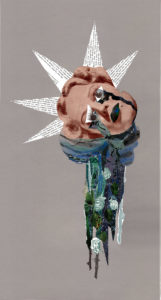
Venus in Tears – Gem Rosenberg
S: Are there artists you admire in particular?
G: I always have a hard time with this question, even though it is a good and curious one! Sure, I have lots of favorite artists, but I tend to just talk about whatever is fresh in my mind. For example, one of the most recent shows I saw was Nari Ward at the Institute of Contemporary Art, Boston. Although that work is so large scale compared to mine, Ward also uses tons of trash and found objects in art. I can tell that we are drawn to found objects for similar reasons, the history and meaning inherent within. In particular, Ward’s work was looking at concepts around race, immigration, and citizenship I think found objects are really effective for communicating identity, because of their relationship to our daily lives.

No sleep, Sweetie – Gem Rosenberg