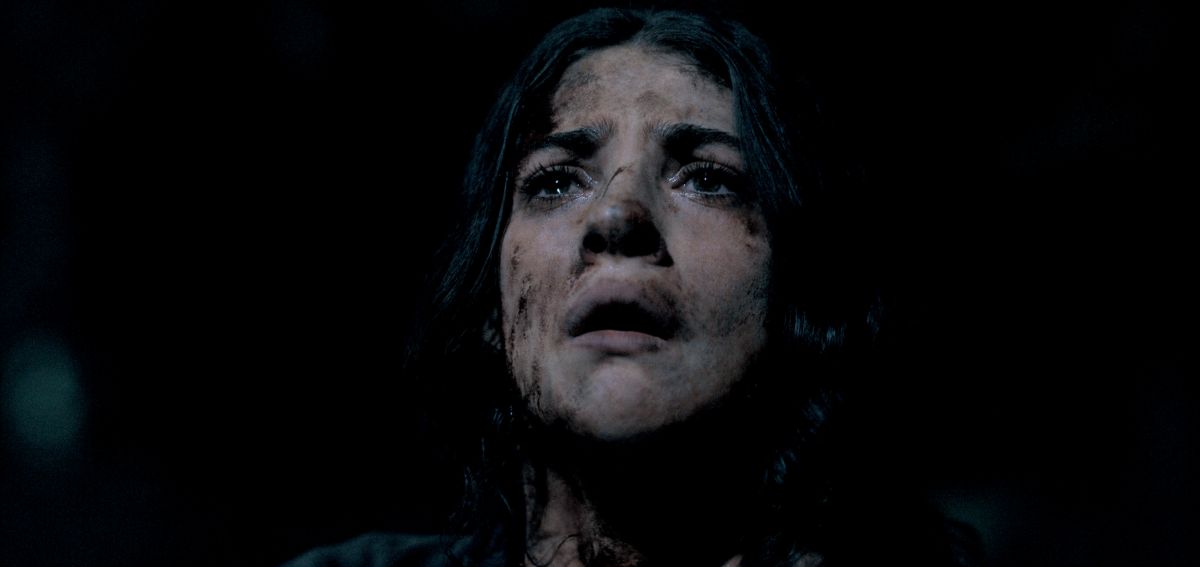
Until Dawn is a disappointing horror film that has virtually nothing in common with the classic multi-ending PlayStation video game. The story follows a group of teenagers on the trail of a missing friend. Clover (Ella Rubin) lost her sister, Melanie (Maia Mitchell), roughly a year before the events of Dawn, leading her to a year’s battle with depression and suicide. To help her let go of her sister, her friends Megan (Ji-young Yoo), Max (Michael Cimino), Nina (Odessa A’zion), and Nina’s boyfriend Abe (Belmont Cameli) go on a road trip with her to Melanie’s last known location: a deep-country gas station. Upon finding it, Clover meets the cashier, Hill (Peter Stormare), who warns that many have disappeared in a nearby earth-swallowed mining town called Glore Valley. They reluctantly go, arriving to immediate eeriness and strange occurrences: the rain stops around the last standing Glore Valley house; numerous missing posters appear inside; an odd hourglass clock awaits an unknown instruction. They quickly get trapped as night falls, realizing partly through Megan’s psychic abilities and the now-flipped hourglass that they are to be fatally chased ‘til morning. If they survive, they leave; if not, they all resurrect at the beginning of the night to try again, each time physically and mentally more degraded. They must stop at nothing—even death—to survive.
If the above description sounds enticing, it should not. Featuring an entirely different roster of (dull) characters in a (bland) new setting with a (stakes-killing) new horror mechanic in the group’s getting reincarnated each time they don’t survive, Until Dawn focuses entirely on its thinly veiled narrative with little more than a few throwaway lines used to depict “character development.” While the premise is intriguing, thanks to Hill’s involvement—as gamers will recognize him as the same Dr. Hill in the same-named game—in execution, it’s bland. All the characters fill some horror archetype. Clover is the as-told-but-not-shown depressed main character. Rachel is the supportive, yet unexplained, supernatural sidekick who receives little more than what she calls “signals” from the paranormal world. Nina is the upfront, loyal friend who “never leaves my friends behind,” with Abe as her more self-inclined counterpart. Max is the slightly scared but determined ex-boyfriend of Clover, ensuring that they get through everything because “we stick together.” They don’t change beyond saying they do—”I’m sorry Melanie, I love you,” Clover tells a wendigo’d Melanie before seemingly forgetting about her once she’s dead—and their actors appear equally uninvolved.
On top of a generic narrative that features characters constantly mentioning “sticking together,” the scares are ineffective, the jokes are mostly flat, and any potential intrigue is lacking. While seeing Hill terrorize again can be fun, and visually, things look convincing (minus the oddly unblended photo of Rami Malek, obviously pulled from the video game), Until Dawn is nevertheless a shamefully uncreative venture into this otherwise promising horror world. Ultrafans may find some references appealing, and those who have never seen a horror movie before will probably find this okay, but for everyone else, Until Dawn is skippable at all times.
2025
dir. David F. Sanberg
103 min.
In theaters now