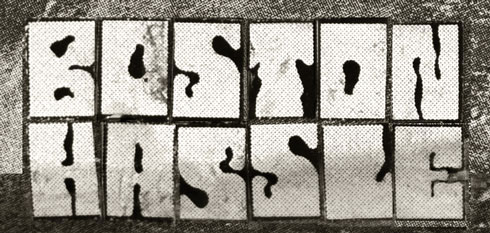

A good friend of mine once handily summed up the experience of learning about electronic voice phenomenon, or EVP— the supposedly supernatural occurrence in which ghostly “voices” can be heard in the knocks and artifacts on a supposedly normal audio recording. The first time you hear the clip, you don’t hear anything but whatever is ostensibly being recorded. Then the host of whatever Ghost Hunters-type show you happen to be watching (they love EVP on those shows because it lets them include a ghost without actually seeing a ghost) tells you what you’re supposed to be hearing and plays it again, and your blood runs cold because holy shit, you actually heard it! Then, regrettably, the show plays the clip over and over again (you gotta reach that 22-minutes-plus-ads mark somehow), each time rendering the purported apparition less and less convincing. Then it’s onto the next clip, and the cycle begins anew.
EVP plays a big part in Undertone, the new horror movie from first-time director Ian Tuason, along with backmasking, found audio, and other eerie auditory phenomena. Like the best EVP listening sessions, it’s a genuinely scary experience, effectively capturing in the moment the creepy sensation of hearing something you shouldn’t. Unfortunately, like the evidence on so many TV spookshows, it hangs together less and less the more you think about it, and ultimately makes you question whether you heard anything at all.
Nina Kiri plays Evie (get it?), a young woman tending to her mother during the final days of an undisclosed illness. Understandably, she doesn’t get out much, but she’s managed to make a mark on the world as the cohost of The Undertone, an apparently quite successful paranormal/true crime podcast. Evie fills the role of the skeptical Scully while her partner Justin (voiced by The White Lotus’s Adam DiMarco) plays enthusiastic Mulder, digging up spooky stories to submit for her and the audience’s approval. Justin’s latest discovery is a series of audio files anonymously sent to his inbox, seemingly chronicling a young couple’s descent into demonic possession. True to her character, Nina claims to be unconvinced, but a series of strange occurrences makes her begin to wonder whether there’s something to it— and whether, by playing the tapes, she has invited something into her own home.
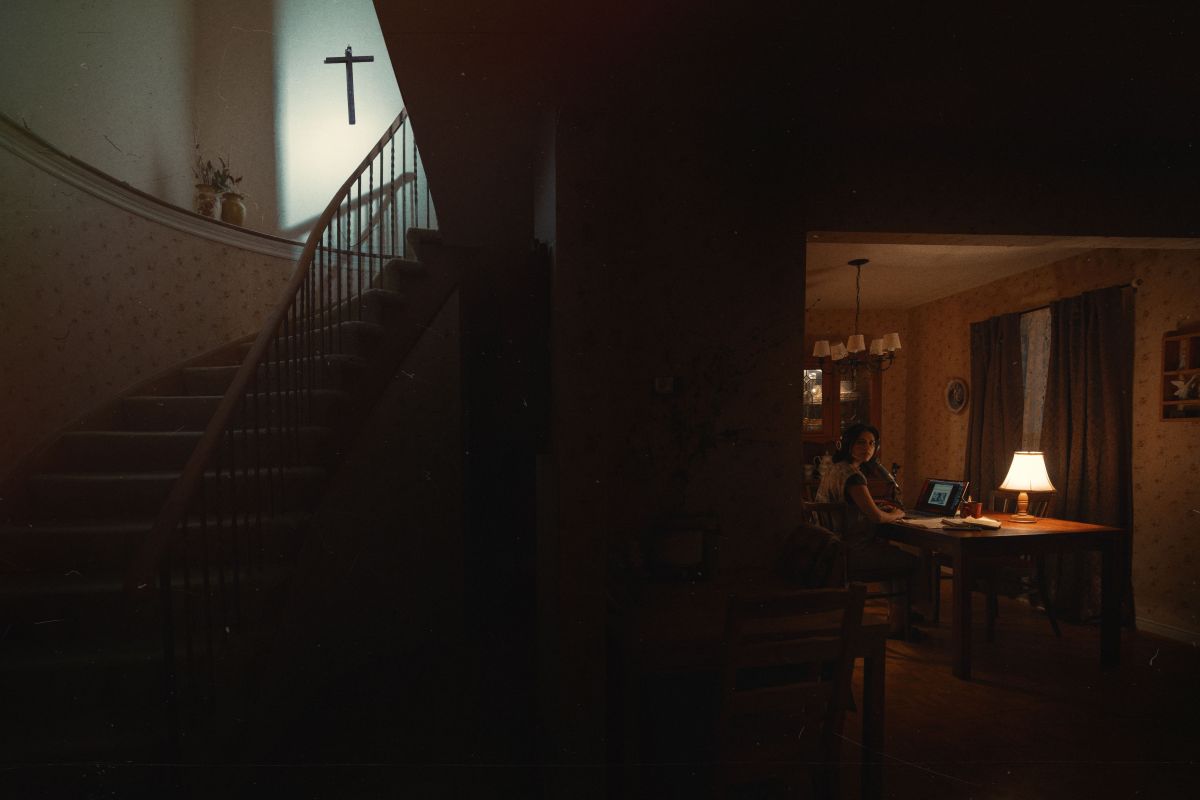
Undertone is built on the notion that what you hear is often scarier than what you can see, and Tuason sticks to this premise with admirable purity. There is a tendency among filmmakers to cheat this sort of closed-door thriller, expanding the narrative through flashbacks and cutaways. Undertone makes no such missteps, leaving us confined with Evie in her house for the duration. The only characters we see on camera are Evie and her catatonic mother; Justin, the doomed couple, and other ancillary characters are only heard piped in through Evie’s noise-cancelling headphones. When the scares come, we can relate to Evie’s isolation because we’ve come to feel it alongside her.
And those scares are considerable. The most ingenious (and publicized) element of Undertone is its sound design, which toys with conventions to maximum discomfort. When Evie slips into her headphones the roomtone— the ambient white noise which plays in the background of every movie scene you’ve ever watched— drops out, placing us into an uneasy headspace even before we get blasted by ghost noises. The camerawork is unshowy but effective, remaining on a single shot for long enough that we can’t help but scan the room, trying to detect the slightest movement or figure out where the next ghost will materialize. Kiri, for her part, makes for an excellent final girl, serious and soulful and imminently doomed. Things eventually come to a head in a maelstrom of poltergeistic shenanigans, but the real meat of the picture is in the buildup. Tuason effectively captures the feeling of staying up late at night spooking yourself silly with creepypasta and unexplained video clips, and when it works, it works.
Unfortunately, like those dark-web rabbit holes, the result is not terribly cohesive. In one scene, for example, Evie decides to play an audio sample of “Mary Had a Little Lamb” backwards, zeroing in on a part which seems to warble, “Look and lick the blood off.” It’s undeniably creepy, but what does it mean? There’s a lot of stuff like that— fragments of urban legends and flashes of archival woodcuts which never quite build into a satisfying whole. The resulting film at times feels more like a notepad of ideas than a story unto itself, as if Tuason is simply running down a list of suitably spooky thoughts he’s jotted down without making sure they fit together. This may be the first film I’ve seen in which Wikipedia is listed in the special thanks, and it’s easy to see why; by the end, it feels like we’ve clicked so many links we’ve forgotten what we originally looked up.
Ultimately, Undertone is one of those films that’s just good enough that it’s frustrating that it’s not better. If Tuason the writer had half as much confidence and discipline as Tuason the director it would probably be something very special indeed; as it stands, it’s an exercise in ruthless, thrilling style over wobbly, unfocused substance. As a thrill ride, Undertone is a marvel, especially when viewed in a theater with a state-of-the-art sound system (or perhaps, once it hits streaming, via headphones), but it’s not nearly as smart or sober as it presents itself. It’s a great calling card toward bigger and better things, but it’s a rare case in which I think the director would benefit from working from other people’s scripts, or at least taking on a co-writer. Like those EVP recordings, there just might be a voice in there— or maybe it’s just static.
Undertone
2026
dir. Ian Tuason
93 min.
Opens Friday, 3/13 @ Coolidge Corner Theatre, Somerville Theatre, Kendall Square Cinema, Apple Cinemas Cambridge, Alamo Drafthouse Boston Seaport, and all local AMCs