As computer-generated special effects have grown more and more seamless, I have become increasingly convinced that realism is only half the point. Now that CGI can create any spectacle a filmmaker can conceive, it’s harder to gin up that childlike sense of wonder; if you’ve seen one exploding planet, you’ve seen them all. On the flipside, consider the stop-motion creations of Ray Harryhausen, or the grisly homemade effects of the original Evil Dead. One can easily discern that the former are plasticine miniatures, and the latter are nearly non-representational in their disregard for human anatomy, but both hold up better today than any number of blockbusters from even the past few years. The reason for this is simple: unlike much modern CGI, the effects in these films look fucking rad.
This point is reinforced by The Vourdalak, the intriguing new French folk horror film which makes its local premiere run this week at the Brattle. The effects of The Vourdalak likely won’t convince you that vampires are real– but then, they wouldn’t anyway, because you (presumably) already know that they aren’t. They are, however, remarkably bonkers and inventive, and will likely stick in your mind longer than the past five mainstream superhero movies combined. The monster in The Vourdalak is something I can honestly say I’ve never seen on screen before, and that is far from nothing.
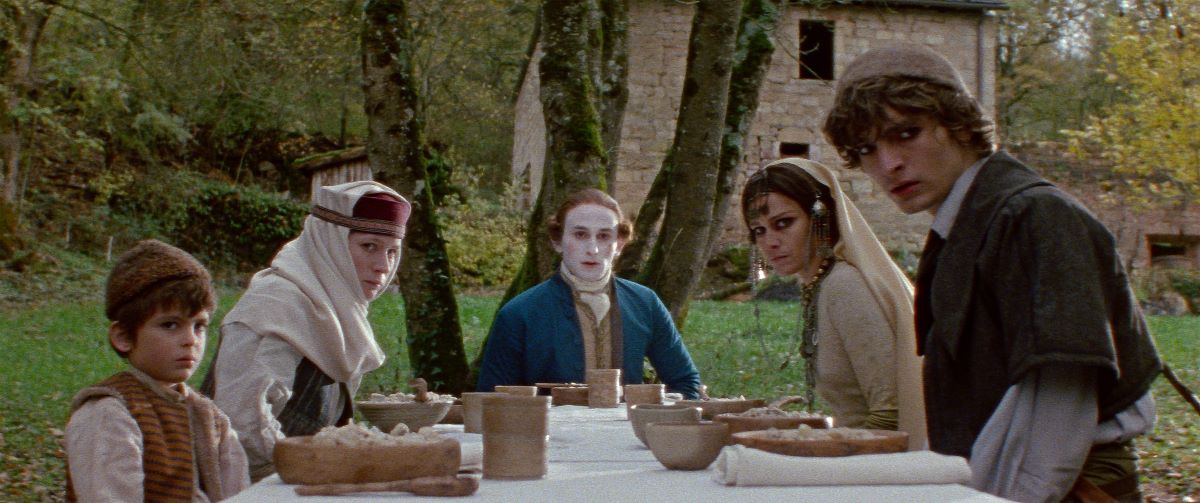
The setup for The Vourdalak is straight out of the Vampire Movies 101 playbook: a French nobleman, the Marquis Jacques Antoine Saturnin d’Urfé (a hilariously effete Kacey Mottet-Klein), gets lost in the woods of Serbia after being beset by Turkish marauders. Left with no other options, he seeks shelter in the home of a man named Gorcha. Gorcha himself is not home, so the Marquis is left in the care of his children: spooky beauty Sdenka (Ariane Labed), gender-nonconforming Piotr (Vassili Schneider), and stern Jegor (Grégoire Colin), as well as Jegor’s wife and child. Gorcha himself has marched into battle, leaving behind an ominous note: if his trip takes more than six days, he is to be considered a vourdalak– a Slavic variant of the vampire who only feeds on his family and loved ones.
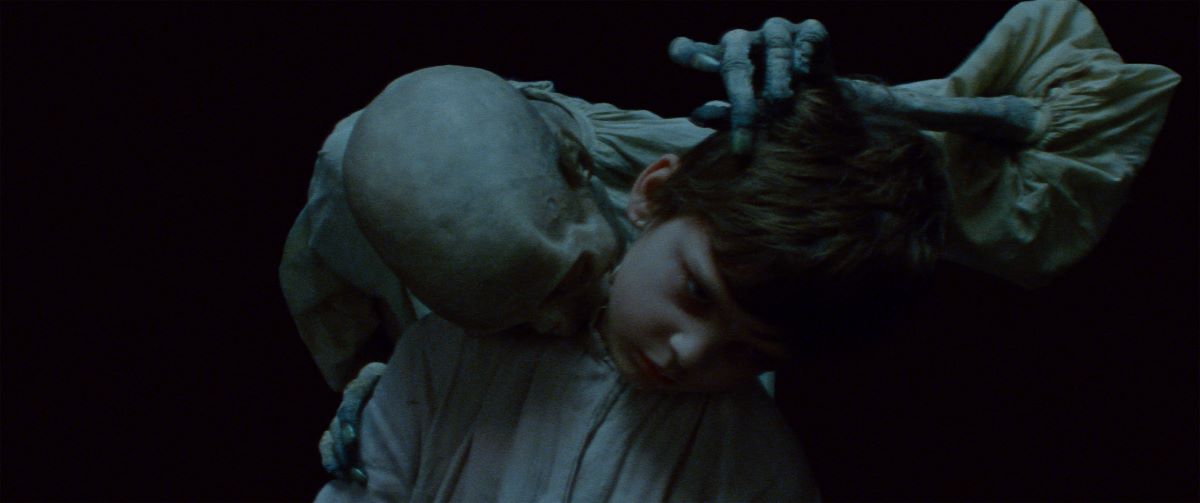
It should not come as a surprise that Gorcha does indeed return as a vourdalak; the title of the film is, after all, The Vourdalak. What is surprising is the way in which the vourdalak is presented. Gorcha is not portrayed by a flesh-and-blood actor, but by what appears to be a very elaborate rod puppet. His lips don’t move much (indeed, he doesn’t really have lips to speak of around his rictus grin), but there does appear to be a mechanism to raise and lower his eyelids. His fingers aren’t articulated, but his arms gesture expansively when he speaks. When he does speak, it’s in a sonorous baritone provided by Beau himself. It should go without saying that we don’t see much of his feet; he spends most of the film either lying in bed or sitting behind a table.
What makes this effect so brilliant is that the filmmakers make no attempt whatsoever to hide the fact that Gorcha is a puppet, neither going the Jaws route of cloaking him in darkness nor “cheating” by augmenting his movements with CGI. Rather, they lean into the uncanniness of the effect. There is an undeniable level of knowing black humor as the other characters interact with this creation, but there’s also something very eerie about its presence. We are so used to watching movies which strive for “realism” (whatever that could possibly mean when talking about superheroes and space creatures and the like) that it’s tough to know how to process an effect which so proudly embraces artifice. Gorcha is, in the context of the film, a thing which should not be; by portraying him as a puppet, Beau ingeniously transfers that feeling to the viewer.
This layer of unreality applies to a certain extent to the rest of the film as well, which owes as much to the ancient stage traditions of pantomime as to the Hammer Horror canon. Mottet-Klein plays the Marquis as an outrageously foppish dandy, complete with powdered wig, cartoonishly rouged cheeks, and removable beauty mark (his wig falls off during the film’s climactic sequences, but his makeup remains beat for the gods). Likewise, there’s something distinctly theatrical about each of the characters, from Sdenka’s haunted monologues and private dances to Piotr’s flower crown and penchant for eyeliner. Taken as a whole, the film would play a bit like a Punch & Judy puppet show even if the title character weren’t literally played by a puppet.
It should be said that those looking for a folk horror experience as intense and bone-chilling as The Witch might walk away somewhat disappointed; The Vourdalak is, perhaps by design, a somewhat slight film, confined as it is by a single location and a villain with limited mobility. But if The Vourdalak’s aims are modest, they are also very deliberate. This is a film that knows exactly what it wants to do, and succeeds in making itself into something you won’t soon forget. With a few rods and a good helping of foam rubber, the Vourdalak takes on more life than all the Na’vi on Pandora.
The Vourdalak
2023
dir. Adrien Beau
91 min.
Screens Friday, 7/12 through Monday, 7/15 @ Brattle Theatre – click here for showtimes and ticket info