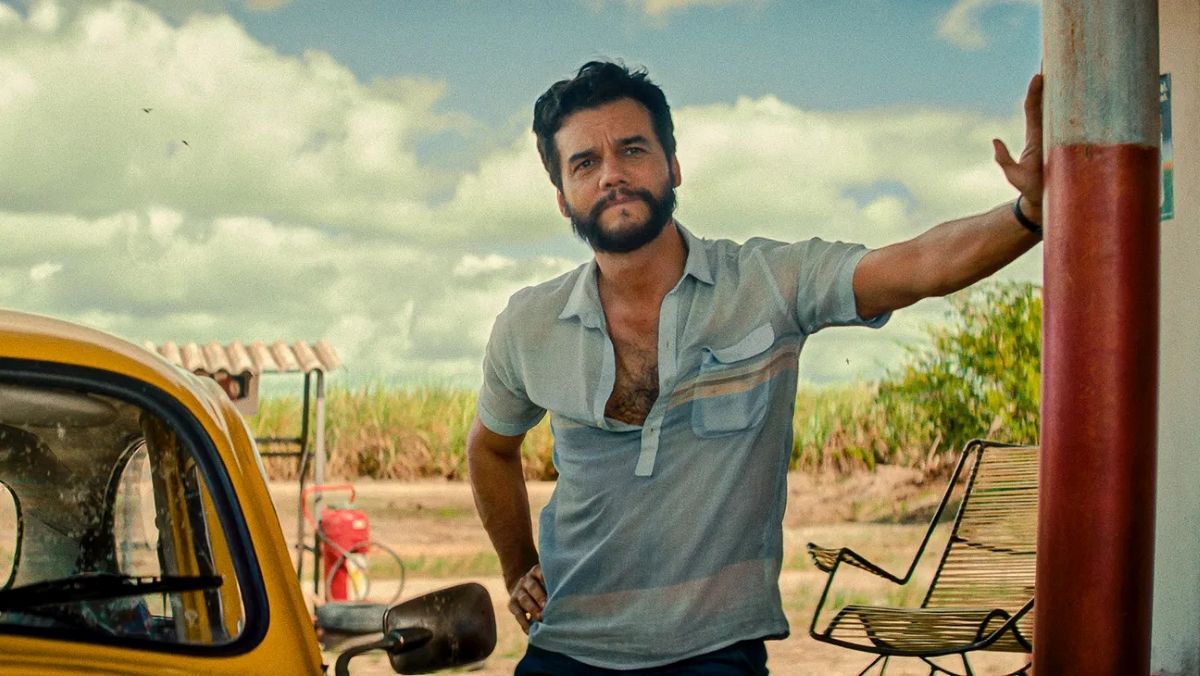
The Secret Agent, the new feature from Brazilian filmmaker Kleber Mendonça Filho, begins with a brief opening crawl: “Our story is set in the Brazil of 1977, a period of great mischief.” To American eyes, that last word may seem like an odd descriptor for a harrowing thriller about the struggle against a corrupt, oppressive government, but it is a key term in Brazil’s rich history of protest and rebellion. Consider, for example, the tropicalia movement of the 1960s, a loose confederacy of musicians like Tom Ze and Os Mutantes, whose puckish, lysergic fusion of traditional Brazilian music with psychedelic rock was a potent vehicle for subversion against the country’s then-ascendant military dictatorship. Brazil’s history of governmental oppression is long and grim, but it has historically been matched by a uniquely sly counterculture.
This spirit is plainly visible in Bacurau, the genre-fluid siege epic Mendonça co-directed with Juliano Dornelles, and its wild mix of pulpy thrills and righteous fury. Likewise, The Secret Agent, while nominally more sober than that film, carries its strident political message with a wily smirk. It’s one of the best films of the year, tackling deadly serious subject matter with a wry playfulness which will keep you off balance from its first scene to its last.
That first scene is a doozy. Marcelo (Wagner Moura) pulls his yellow Beetle into a remote gas station, only to notice what is plainly a dead body lying under a sheet of cardboard. The attendant shrugs it off; the deceased had attempted an armed robbery some days earlier, but the station’s owners won’t answer their phone and the police are too busy with Carnival. Eventually, some officers do arrive, but they’re more concerned with checking Marcelo’s car (and collecting a bribe) than with removing the corpse. “If I leave, I lose my job,” the attendant sighs, “If I stay, I’m stuck with rotting meat. I’m almost getting used to this shit.” His only real concern is making sure the corpse isn’t devoured by roving packs of stray dogs.
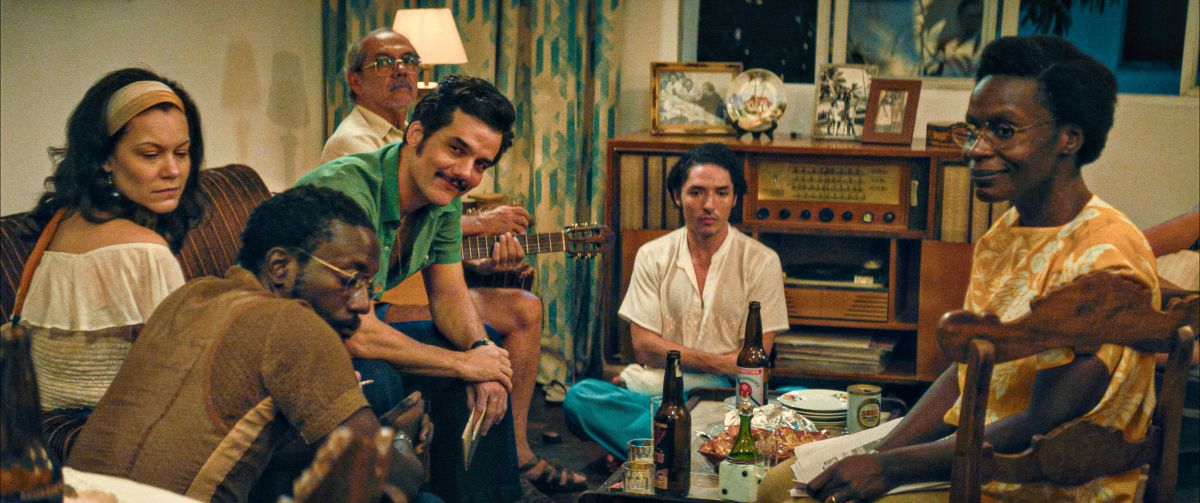
For reasons which gradually become clear, Marcelo is a fugitive of sorts, biding his time in a communal safehouse in the city of Recife until he can find passage for himself and his young son out of Brazil. From here, the film spirals out across a web of colorful characters: Marcelo’s fellow dissidents in the safehouse, guarded by a kindly and ethereal old woman (and her two-headed cat); the corrupt town sheriff and his goon-like sons; an uncle-nephew hitman team; a German WWII refugee (the late, great Udo Kier), who the sheriff insists on showing off his scars to strangers; a stop-motion severed leg which emerges from the stomach of a dead shark and hops around kicking sex workers (a hilariously literal interpretation of a notorious bit of journalistic code); and so forth. Perhaps you’re starting to get the gist of that “mischief” line.
Even the title of The Secret Agent is a bit of a sly joke. Marcelo is a good and clever man, but he’s no James Bond; he’s a soft-spoken former professor of agriculture from a local university, and he finds himself more frequently battling bureaucracy than faceless henchmen. Even the suspense, which is legitimately gripping, is deliberately undercut by flashes forward to a pair of 21st century grad students, who are dispassionately reconstructing the narrative through newspaper clippings and reels of audio tape. The implication is clear: as wild as all of this is, it’s merely a footnote of a truly wild time and place.
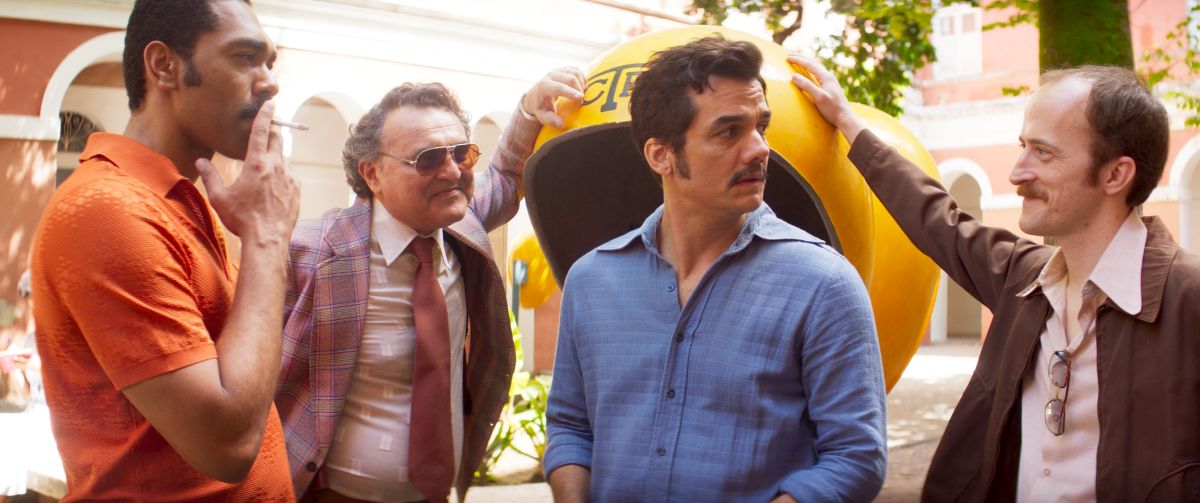
But while Marcelo may not be an according-to-Johnny-Rivers secret agent man, there are layers to his persona which are revealed to us throughout the film; Marcelo isn’t his real name, for starters. Moura deftly handles this deceptively tricky role, navigating treacherous waters with a wry (mischievous, even) deadpan, subtly modulating his performance as the situation warrants. By the end of the film, we feel like we’ve seen him play several more roles than he actually does, yet he never loses the center of the character. It’s one of the richest performances of the year, and I’m certain I’ll pick up more nuances the next time I watch it.
Those who have seen Mendonça’s previous film, last year’s essayistic documentary Pictures of Ghosts, will have a leg up (so to speak) on understanding the time and place of The Secret Agent. That film, like this one, is set in Recife, which also happens to be Mendonça’s hometown; the movie theater owned and operated by Marcelo’s father-in-law is one of the real-life cinemas previously visited by Mendonça’s documentary lens, and a monologue in the final scene could be lifted directly from Ghosts’ narration. Indeed, The Secret Agent at times feels like an extension of its predecessor’s thesis of films as phantoms. Jaws and The Omen, both screening in the town cinema, haunt the proceedings, working themselves into the very fabric of the film as if by their own will. The barriers between reality and fantasy seem porous, a notion underscored by the colorful, inherently surreal backdrop of Carnival.
In case it’s not clear, there is a lot going on here, perhaps more than can be fully grasped in a single viewing. Fortunately, the pleasures of watching The Secret Agent are so immense that the prospect of a second viewing isn’t daunting in the least. There is a texture to this film which is nearly irresistible, the location photography (courtesy of cinematographer Evgenia Alexandrova) and soundtrack building to a dizzying whole. Though it is set in the 1970s, The Secret Agent feels tuned to its times, but, like One Battle After Another, it is never despairing in its view of the constant battle against fascism. As long as there’s mischief, there’s hope.
The Secret Agent
2025
dir. Kleber Mendonça Filho
158 min.
Now playing @ Coolidge Corner Theatre & AMC Boston Common. Opens Friday, 12/19 @ Somerville Theatre