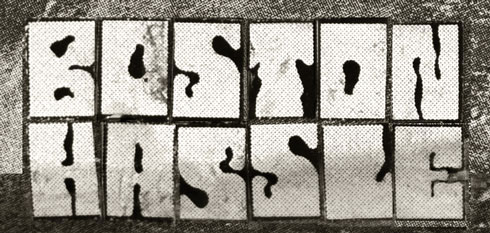
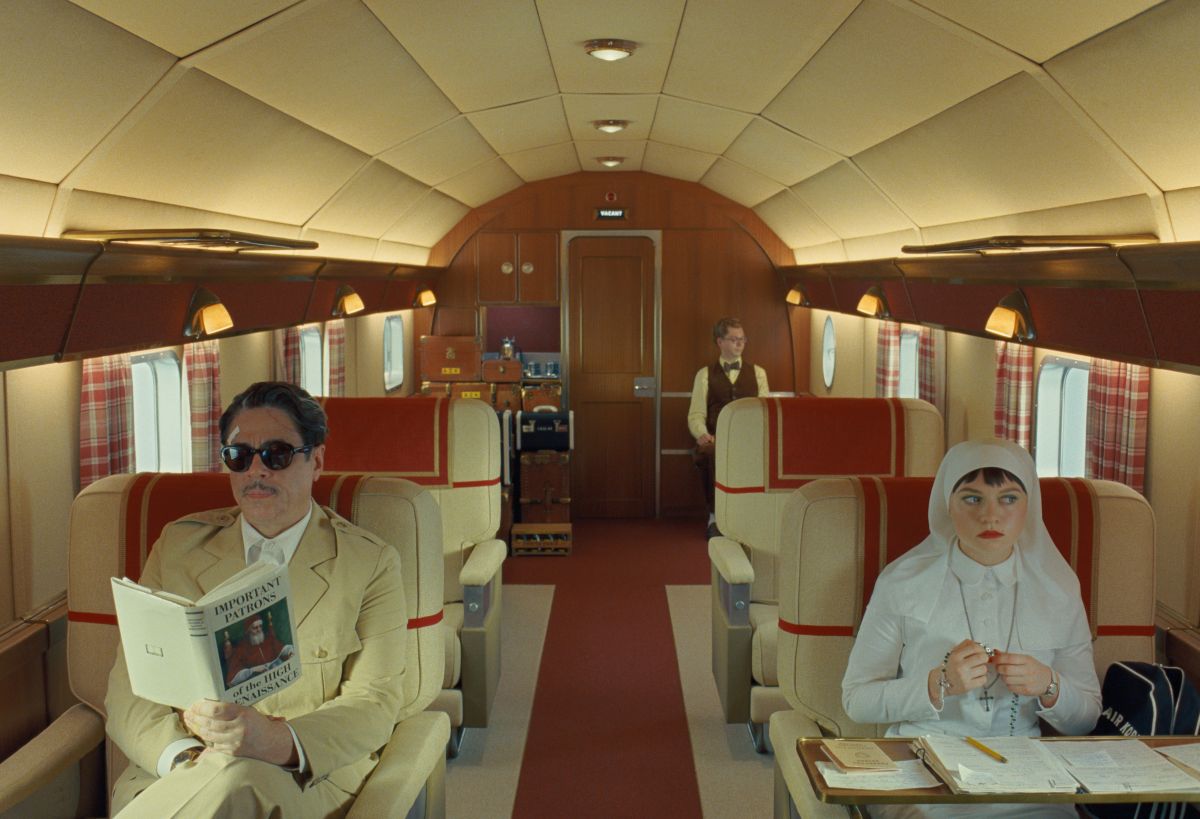
As I watched The Phoenician Scheme, a funny thought came into my head: Wes Anderson is one of our most extreme working filmmakers. This is, perhaps, counterintuitive; “extremity,” in cinematic terms, is most often associated with the transgressive likes of Takashi Miike or Gasper Noe, not the whimsical fancy-lad behind The Royal Tenenbaums and The Grand Budapest Hotel. But Anderson’s films are so charming and easy on the senses that it’s easy to overlook just how far his signature style pushes the envelope, both formally and aesthetically. No one else’s films look or move like Anderson’s, with their immaculately manicured mise-en-scene, hypersyllabic rat-a-tat dialog and narration, and byzantine rat’s nests of plot and framing devices. Few living filmmakers can claim to have invented their own unique cinematic grammar— Godfrey Reggio, Guy Maddin maybe— and fewer of those still regularly turn a profit in mainstream moviehouses. Zack Snyder wishes he was as extreme as Wes Anderson.
Intentionally or not, and perhaps fittingly for his status as the blockbuster king of the arthouse, Anderson’s last couple of films have curiously mirrored contemporary mainstream hits, as if emanating from a bespoke, alternate Hollywood. If Asteroid City, with its southwestern atom-age setting and shady government brass, was Anderson’s Oppenheimer, The Phoenician Scheme is his Mission Impossible, a globetrotting action picture of the sort only Anderson could— or would think to— devise. In terms of emotion or ambition, The Phoenician Scheme doesn’t quite measure up to Anderson’s last couple of films, but it is perhaps his most purely entertaining in years, and a welcome bit of summer counterprogramming.
Benicio del Toro plays Anatole “Zsa-zsa” Korda, a ruthless and despised millionaire whose private jet is constantly being blown out of the air by various rival interests. Following the latest attempt on his life, Zsa-zsa decides to finally get his affairs in order. His first priority is to make peace with novitiate nun Leisl (Mia Threapleton), his heir and only daughter (he has nine sons as well, but doesn’t like any of them). His second is to tie up all loose ends on the Phoenician Scheme, a multi-level business project involving the construction of a railroad, a dam, and god knows what else. To do this, Zsa-zsa sets off with Leisl, as well as his personal entomology tutor Bjorn (Michael Cera, shockingly only now making his Anderson debut), to settle the score with his various business partners and get them to sign off on their shares of the project— if the assassins don’t catch up with him first.

In a strange way, The Phoenician Scheme is Anderson’s most straightforward film in years. Gone are the multi-tiered framing devices and layers of narrative parentheses which enclose Asteroid City and The French Dispatch, and the fourth-wall-breakage of Anderson’s Roald Dahl adaptations for Netflix is kept to a relative minimum. This is a story with a beginning, middle, and end, and the actors are all playing their characters at face value (give or take a disguise or two). That said, this is still a Wes Anderson film, with far more jokes and detail than can be digested within a single viewing. Not only are there flashes of maps on which every marked location has a ridiculous made-up name (my favorite is “The Gulf of Methuselah”), but we are also regularly treated to onscreen math equations which evolve as Zsa-zsa’s plan unfolds. It’s often joked that you need a slide rule to follow some overly complicated films, but in this case it may actually be true.
Likewise, I will admit right off the bat that I do not have the foggiest sense of what “the Phoenician Scheme” actually entails. I suspect that Anderson does— I can easily imagine an impeccably handwritten flowsheet laying the whole thing out in Anderson’s office— but I also think he would probably admit that the ins and outs don’t matter. Rather, the scheme itself is a MacGuffin, propelling Zsa-zsa and his compatriots from one location to the next. The plot itself is largely episodic, as each business partner presents their own conflict: Mathieu Almaric as a nightclub owner beset by communist revolutionaries (led by a hilariously effete Richard Ayoade); Scarlett Johannson, speaking with what can only be described as a Ruben & the Jets accent, as Zsa-zsa’s second cousin and possible fourth wife; Tom Hanks and Bryan Cranston as a pair of gruff railroad tycoons and old-timey basketball fanatics (sidenote: can this really be the first time someone has thought to put Cranston in a straw boater hat?); and on and on, across a typically sprawling, Andersonian cast.
This staccato rhythm perhaps gets in the way of the emotional throughline; the threads don’t interweave quite as deftly as they do in The French Dispatch or Asteroid City, leaving each set of characters oddly isolated from one another. Fortunately, the film is anchored on a trio of performances which rank among the best in Anderson’s oeuvre. Cera delivers a sublimely silly performance through an outrageous Swedish accent and fright wig, continuing the image-reclamation tour which began in Twin Peaks and ran through Barbie. Threapleton is even better, in what has to count as one of the great discoveries of the year. Visually, Leisl is one of Anderson’s great creations, decked out in an all-white habit from legendary costumer Milena Canonero, pastel makeup, corncob pipe, and Cartier-bejeweled “secular rosary” provided by her father’s people. But she also provides the film’s deadpan heart, reacting to the absurdity around her with a steely glance of her eyes. Threapleton is a natural comic talent; I would not be surprised if she joins the ranks of young actors whom Anderson has propelled to stardom, alongside Jason Schwartzman and Saorise Ronan.
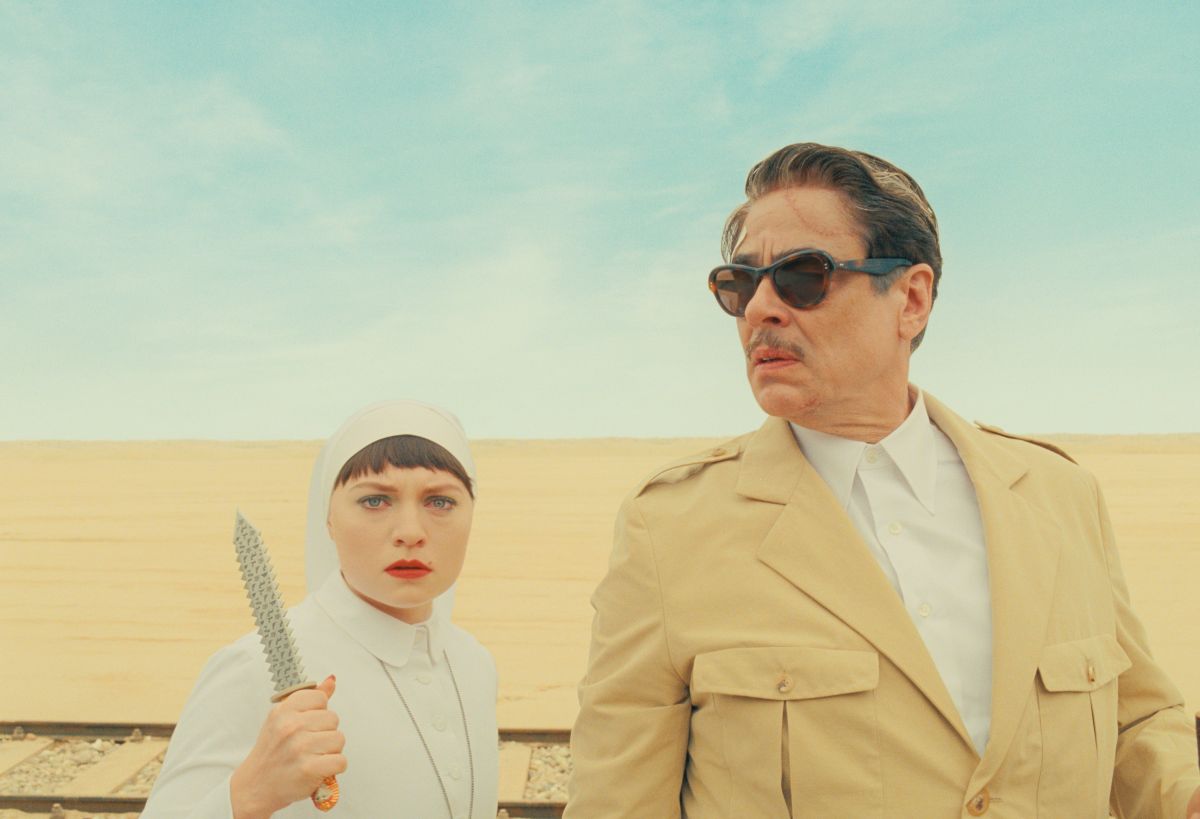
Then there’s del Toro, playing the latest of Anderson’s gruff, world-weary father figures. Del Toro is a deceptively brilliant addition to the Anderson stock company; his physicality and simmering snarl constantly threaten to break the bonds of the director’s dollhouse world, but he is just as nimble with a one-liner as any of his co-stars. When Liesl accuses Zsa-zsa of killing her mother, he snaps back, “I never killed anyone’s mother!” before further equivocating, “I never personally killed anyone!” Anderson’s films are occasionally accused of being airless, and in some ways that criticism applies to The Phoenician Scheme more than most— but when you look into del Toro’s haunted, twitching eyes, you can see that there’s more swirling under the surface than there appears.
Because who is Zsa-zsa Korda? Anderson has said that he’s based in part on his father-in-law, the late Fuad Malouf, who was apparently a businessman with his fingers in a similar number of pies. It is difficult, however, to watch a film in 2025 about a bull-headed, widely disliked businessman with a distant, disdainful relationship with his progeny and not think of someone else we know; early on there’s an offhand reference to “tariffs,” and the effect is like hearing a dentist’s drill. No one would likely consider Anderson a particularly political filmmaker, but one senses there is a bit of commentary going on here underneath the candy-colored frippery— about the ways in which the moneyed and brutish stomp their way through life at the expense of those around them (“I don’t need my human rights!” Zsa-zsa snaps at one point to an underling). Zsa-zsa’s arc, as illustrated by a series of visions in which he takes the stand at a tribunal in Heaven (stocked with Anderson regulars in intentionally shoddy biblical drag), lies in his attempts to reclaim his humanity after a life of dealing and double-crossing. That’s more charity than I’m inclined to grant most of the real-life Zsa-zsa Kordas of the world, but then I’m not an internationally beloved humanist filmmaker.
And that’s the thing about Anderson: underneath all the flash and foofaraw— all the extremity— is a good-natured optimism, and one of the most rewarding parts of digging into his films is hitting upon the moments when he means it. On this count, The Phoenician Scheme may count as one of his lesser efforts (though, again, ask me after a second viewing), but there are moments, such as a late monologue about the balance between piety and the pleasures of the flesh, which stick out like the italicized passages in a Jonathan Swift piece, as if we are catching a glimpse of the director’s actual opinions. The Phoenician Scheme is a confection, but it still gives us more to chew on than the average summer action film, and any journey into the Wes Anderson dollhouse is a welcome one.
The Phoenician Scheme
2025
dir. Wes Anderson
101 min.
Opens Thursday, 6/5 @ Coolidge Corner Theatre, Somerville Theatre, Kendall Square Cinema, Alamo Drafthouse Boston Seaport, and all local AMCs