
To paraphrase the famous tagline to Stanley Kubrick’s 1962 adaptation of Lolita, “How did they ever make a movie of Tetris?”
Though it’s probably for the best, I’m faintly disappointed to report that Tetris, the new feature film now streaming on AppleTV+, does not attempt to adapt the famous falling-brick video game into a summer blockbuster action film (though I’m sure Dwayne Johnson would have made a killer L-block). Rather, Tetris tells the story of the man who brought the game to the western world– a story which, improbably, involves espionage, international media moguls, and the fall of the Iron Curtain. It’s a gripping (and more than a little absurd) tale, and while Tetris isn’t a terribly deep film, it’s an amply entertaining way to spend a couple of hours.
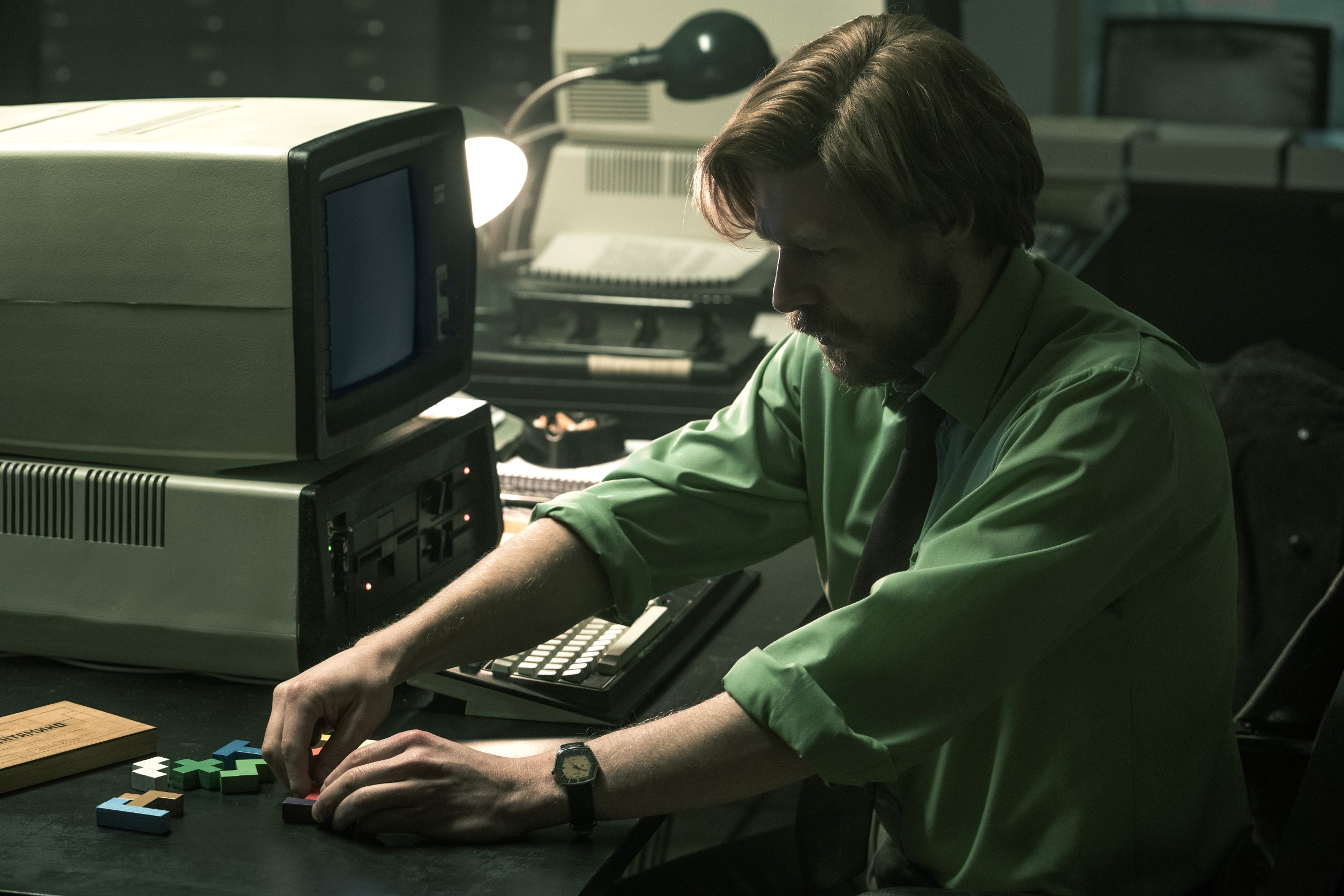
Taron Egerton plays Henk Rogers, struggling head of the Japanese-based Bulletproof Software during the heady video game boom of the late 1980s. Rogers has his own personal Colonel Parker moment when he sees a demo of a new Russian puzzle game at a trade show, and makes it his mission to acquire its international distribution rights. That, however, proves easier said than done: its ambassador, Russian salesman Robert Stein (Toby Jones, exactly the guy you want to play your sweaty little toady in a cheap suit), seems to have sold the rights several times over– including to Daily Mirror owner Robert Maxwell (Roger Allam)– and may or may not have ever actually had them to begin with. In an effort to get to the bottom of things (and, not incidentally, pull himself and his company from the brink of bankruptcy), Rogers flies to Moscow to meet the game’s serious, soft-spoken creator Alexey Pajitnov (Nikita Efremov) and hammer out a deal in person with its parent company, a shadowy corporation called Elorg. But it shouldn’t take a political scientist to tell you that the Soviet Union wasn’t particularly hospitable toward ambitious western businessmen at the tail end of the Cold War, and Rogers soon finds the blocks falling down around him.
Though such distinctions have eroded in the age of streaming, I feel comfortable designating Tetris a “TV movie.” As a rule, I prefer seeing just about any film in the theater, but somehow I just can’t imagine watching Tetris anywhere but on my couch. It possesses the sheen of a bingeable Netflix documentary, right down to its cute 8-bit scene transitions and driving, synth-heavy soundtrack (built, naturally, around variations on the Russian folk song “Korobeiniki”). Though clearly not a low-budget film, there is a curious cheapness to the production, as if the entire movie is a dramatic reenactment (Egerton’s mustache looks about as much an organic extension of his body as the Beastie Boys’ “Sabotage” disguises). Awards season is over, and the streamers are back to what they do best: programming your takeout delivery night.
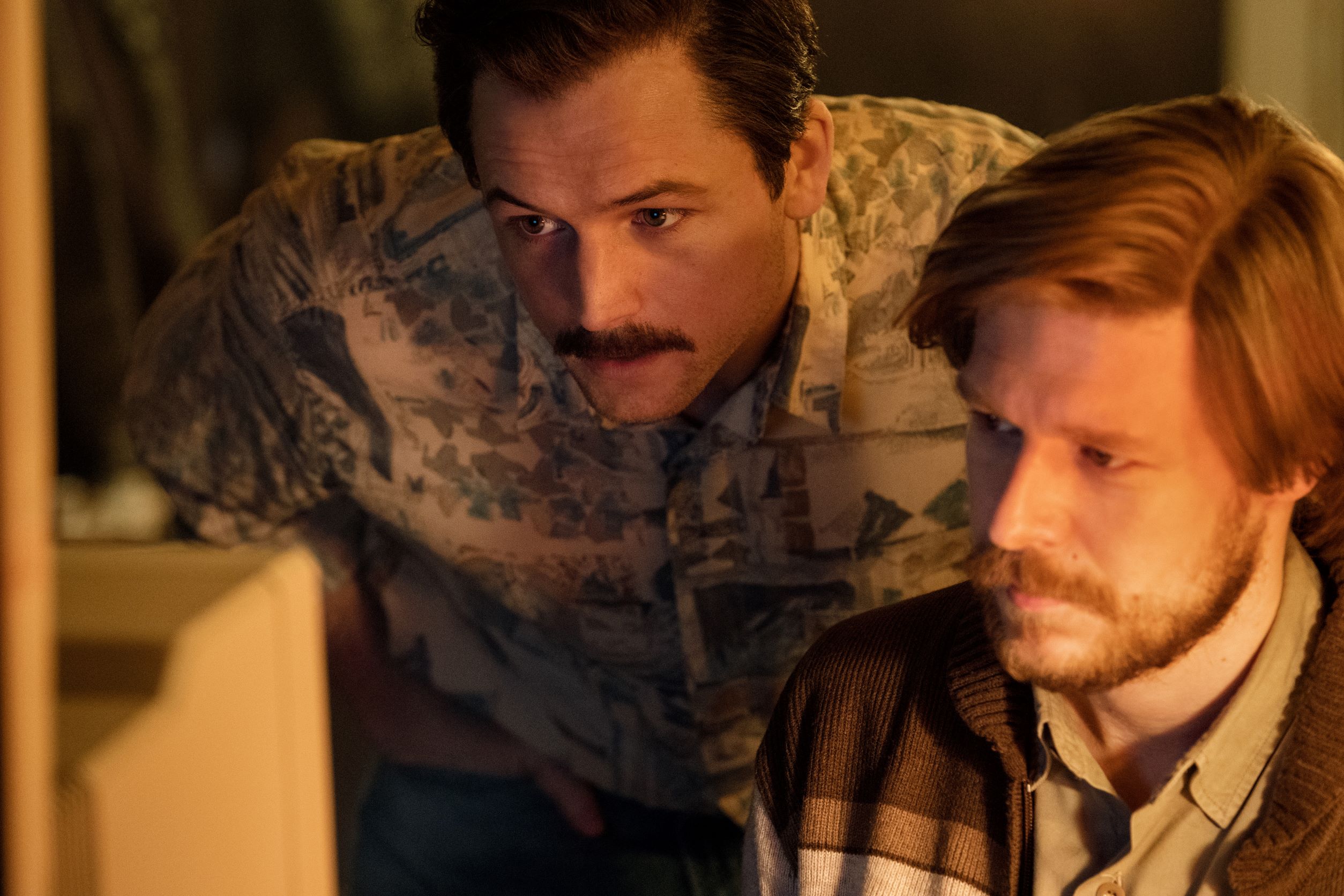
So Tetris is a TV movie. But I want to be clear: I don’t mean that entirely as a slight. Though its pleasures may be surface level, they are undeniable, and the whole thing pings and whizzes as infectiously as a classic Game Boy game. Egerton is a winning lead, and the rest of the cast play their respective “types” with gusto (I was particularly entertained by Anthony Boyle, who plays Maxwell’s sycophantic son as a perfectly punchable nepo-baby twit). Perhaps most remarkably for a two-hour film in which the majority of the scenes consist of contract negotiations and/or people playing video games, Tetris is almost never boring. It may be a TV movie, but it’s a pretty great one– the kind of TV movie your parents let you stay up half an hour past your bedtime to see to its conclusion.
The secret, of course, is that the story at its center is a damned good one. I was only vaguely familiar with the true-life tale going in, and while I’m sure there are embellishments for dramatic effect (I’m going to go out on a limb and guess that Pajitnov never led the KGB on a high-speed car chase through the streets of Moscow), I was gripped from beginning to end. This is perfect airport-paperback pulp, complete with globetrotting action, diet-LeCarre suspense, and glowering Russian agents muttering sinister half-threats like “You heff a lahvly family, Mr. Rogers.” The sight of these characters passing a video game cartridge back and forth like a nuclear football is absurd, but they commit so fully that you’ll be convinced that “handheld rights” are, indeed, a matter of life and death.
When making this sort of film, there is a danger of over-mythologizing one’s subject. I do not think that this is the case with Tetris. Of all the arguments that video games can constitute fine art, Tetris just might be the most persuasive. It is perhaps the only video game as purely elemental and universal as backgammon or chess; where other games have been revamped and reimagined to keep up with changing technology, Tetris is still played more or less exactly as it was conceived by Alexey Pajitnov on a Soviet word processor nearly 40 years ago. One can understand why someone like Henk Rogers would upend his life and risk dying in a gulag over it; in the world of video games, discovering Tetris must have been like discovering fire. Tetris the movie is nowhere nearly as perfectly designed as Tetris the video game– how could it be?– but it does its subject justice, and will have you humming that infectious little ditty for days.
Tetris
2023
dir. Jon S. Baird
118 min.
Streaming on AppleTV+ starting Friday, 3/31